Virgin Atlantic + AI: Faster Delivery, Smarter Decisions, Better CX

Virgin Atlantic + AI: Faster Delivery, Smarter Decisions, Better CX

Artificial Intelligence
Feb 4, 2026

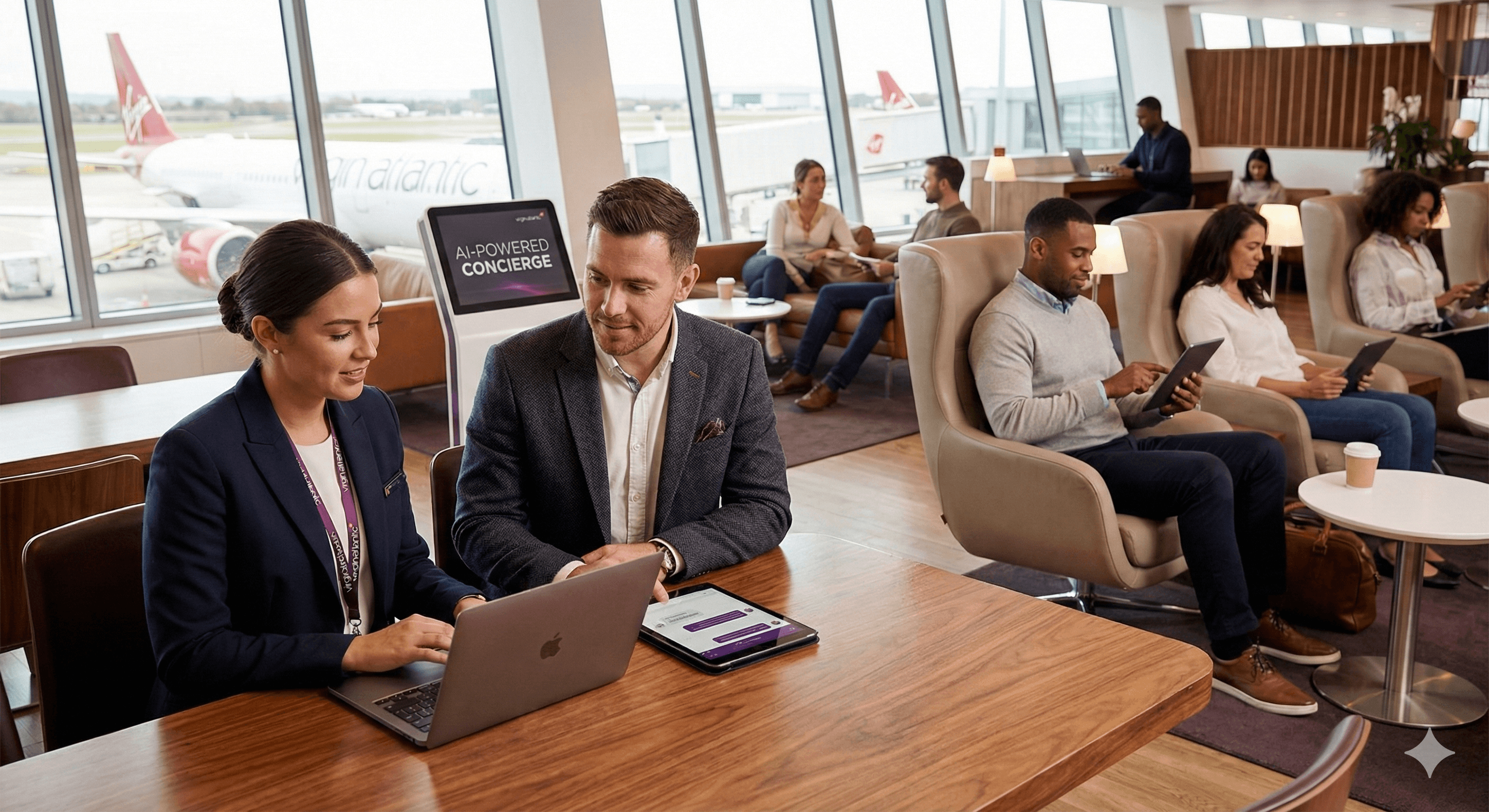
The image depicts a busy airport lounge with people seated comfortably, engaged with digital devices, while a sign in the background reads "AI-powered concierge," reflecting Virgin Atlantic's commitment to using AI for faster delivery, smarter decisions, and better customer experience.

Not sure what to do next with AI?
Assess readiness, risk, and priorities in under an hour.

Not sure what to do next with AI?
Assess readiness, risk, and priorities in under an hour.

➔ Schedule a Consultation

Virgin Atlantic is using AI to improve productivity, decision-making, and customer experience. Internally, teams use ChatGPT Enterprise and Codex to ship software faster, support HR self-service, and generate finance narratives. Externally, the airline has rolled out an AI-powered digital Concierge to help customers plan and manage trips through natural conversation.

In aviation, brand and reliability are inseparable. A great experience isn’t just the onboard service—it's how quickly an airline can resolve issues, keep customers informed, and remove friction across booking, check-in, loyalty, and support.

Virgin Atlantic is investing in AI to do exactly that. In an OpenAI interview, CFO Oliver Byers explains the airline is using AI both to speed internal delivery and to build customer experiences that still feel unmistakably “Virgin”: warm, witty, and human.

Why Virgin Atlantic is leaning into AI

Byers frames the motivation in straightforward CFO terms: value and competitiveness.

Virgin Atlantic is smaller than many global rivals. That makes technology a lever to offset scale disadvantages—shipping improvements faster and supporting teams with better tools.

Crucially, the airline didn’t jump straight to a single vendor or a single use case. It tested broadly, learned where value showed up, then went deeper with a small number of partners, including OpenAI.

Where AI is being used internally

Virgin Atlantic’s AI story isn’t limited to a single “big bet”. It’s a portfolio:

1) Digital and software development

Byers highlights some of the clearest wins in engineering: teams use AI to write and test code faster, shorten cycle times, and ship improvements more quickly across customer-facing touchpoints such as the app and check-in experience.

2) People (HR) teams

Virgin Atlantic has built custom GPTs grounded in HR and company policies to support faster internal self-service and day-to-day employee support.

3) Finance teams

AI supports first-pass narratives, performance analysis, and real-time insight generation—useful in a heavily regulated environment where clarity and consistency matter.

The customer-facing leap: Virgin Atlantic’s AI digital Concierge

The most visible AI innovation is the airline’s digital Concierge, rolled out across both Virgin Atlantic and Virgin Atlantic Holidays websites.

It is described as:

  • Powered by OpenAI and built in partnership with Tomoro

  • Multimodal and conversational (customers can tap, type, or talk)

  • Designed to learn traveller preferences and recommend options in real time

  • Able to support travel planning, Flying Club questions, and broader customer assistance

Importantly, the Concierge is framed as “AI with judgement”: it handles routine requests quickly, but is designed to hand off to a person when a situation is complex or sensitive.

How Virgin Atlantic thinks about safe adoption

In the OpenAI conversation, Byers outlines four pillars that will feel familiar to any organisation scaling AI responsibly:

  1. Education – guides and playbooks on how to use AI effectively and build custom GPTs

  2. Community – a network of champions sharing patterns that work

  3. Guardrails – policies around privacy, access control, and safe use

  4. Iteration – continually improving what’s working and replacing what isn’t

This matters because airlines are regulated, data-sensitive environments. The approach is ambitious—but grounded in governance.

How they measure ROI

Virgin Atlantic evaluates AI on two levels:

  • Short-term productivity gains: time saved, output volume, faster cycle times

  • Long-term strategic impact: outcomes such as reduced contact-centre wait times, improved self-service, and customer experience measures (plus revenue impact for larger initiatives like Concierge)

The lesson is simple: start with outcomes, build metrics from there, and treat governance as how you scale confidence.

What other organisations can learn from Virgin Atlantic

Virgin Atlantic’s approach offers a repeatable blueprint:

  • Start broad, then focus investment where value is proven

  • Move beyond pilots by building enablement and internal champions

  • Treat guardrails as the foundation for scaling

  • Build customer-facing experiences that are on-brand and know when to hand off to humans

Summary & next steps

Virgin Atlantic is using AI in two complementary ways: internal productivity and decision support (ChatGPT Enterprise + Codex), and a customer-facing Concierge designed to make travel planning more personal and frictionless.

Next step: If you want a practical AI roadmap—use cases, governance, ROI tracking, and rollout—Generation Digital can help.

FAQs

How is AI used by Virgin Atlantic?

Virgin Atlantic uses AI internally with ChatGPT Enterprise and Codex to speed software delivery, support HR self-service, and improve finance analysis. Externally, it offers an AI-powered digital Concierge for travel planning and customer help.

What is Virgin Atlantic’s digital Concierge?

A conversational, multimodal assistant available on Virgin Atlantic and Virgin Atlantic Holidays websites, built with Tomoro and powered by OpenAI to help customers plan, book, and manage travel.

How does Virgin Atlantic measure AI ROI?

They track time savings and productivity for smaller use cases, and tie larger initiatives to outcomes such as self-service rates, reduced wait times, engagement, and revenue impact.

How does Virgin Atlantic handle safety and governance?

By focusing on education, community champions, guardrails (privacy and access control), and continuous iteration—so teams can adopt AI confidently in a regulated environment.

Virgin Atlantic is using AI to improve productivity, decision-making, and customer experience. Internally, teams use ChatGPT Enterprise and Codex to ship software faster, support HR self-service, and generate finance narratives. Externally, the airline has rolled out an AI-powered digital Concierge to help customers plan and manage trips through natural conversation.

In aviation, brand and reliability are inseparable. A great experience isn’t just the onboard service—it's how quickly an airline can resolve issues, keep customers informed, and remove friction across booking, check-in, loyalty, and support.

Virgin Atlantic is investing in AI to do exactly that. In an OpenAI interview, CFO Oliver Byers explains the airline is using AI both to speed internal delivery and to build customer experiences that still feel unmistakably “Virgin”: warm, witty, and human.

Why Virgin Atlantic is leaning into AI

Byers frames the motivation in straightforward CFO terms: value and competitiveness.

Virgin Atlantic is smaller than many global rivals. That makes technology a lever to offset scale disadvantages—shipping improvements faster and supporting teams with better tools.

Crucially, the airline didn’t jump straight to a single vendor or a single use case. It tested broadly, learned where value showed up, then went deeper with a small number of partners, including OpenAI.

Where AI is being used internally

Virgin Atlantic’s AI story isn’t limited to a single “big bet”. It’s a portfolio:

1) Digital and software development

Byers highlights some of the clearest wins in engineering: teams use AI to write and test code faster, shorten cycle times, and ship improvements more quickly across customer-facing touchpoints such as the app and check-in experience.

2) People (HR) teams

Virgin Atlantic has built custom GPTs grounded in HR and company policies to support faster internal self-service and day-to-day employee support.

3) Finance teams

AI supports first-pass narratives, performance analysis, and real-time insight generation—useful in a heavily regulated environment where clarity and consistency matter.

The customer-facing leap: Virgin Atlantic’s AI digital Concierge

The most visible AI innovation is the airline’s digital Concierge, rolled out across both Virgin Atlantic and Virgin Atlantic Holidays websites.

It is described as:

  • Powered by OpenAI and built in partnership with Tomoro

  • Multimodal and conversational (customers can tap, type, or talk)

  • Designed to learn traveller preferences and recommend options in real time

  • Able to support travel planning, Flying Club questions, and broader customer assistance

Importantly, the Concierge is framed as “AI with judgement”: it handles routine requests quickly, but is designed to hand off to a person when a situation is complex or sensitive.

How Virgin Atlantic thinks about safe adoption

In the OpenAI conversation, Byers outlines four pillars that will feel familiar to any organisation scaling AI responsibly:

  1. Education – guides and playbooks on how to use AI effectively and build custom GPTs

  2. Community – a network of champions sharing patterns that work

  3. Guardrails – policies around privacy, access control, and safe use

  4. Iteration – continually improving what’s working and replacing what isn’t

This matters because airlines are regulated, data-sensitive environments. The approach is ambitious—but grounded in governance.

How they measure ROI

Virgin Atlantic evaluates AI on two levels:

  • Short-term productivity gains: time saved, output volume, faster cycle times

  • Long-term strategic impact: outcomes such as reduced contact-centre wait times, improved self-service, and customer experience measures (plus revenue impact for larger initiatives like Concierge)

The lesson is simple: start with outcomes, build metrics from there, and treat governance as how you scale confidence.

What other organisations can learn from Virgin Atlantic

Virgin Atlantic’s approach offers a repeatable blueprint:

  • Start broad, then focus investment where value is proven

  • Move beyond pilots by building enablement and internal champions

  • Treat guardrails as the foundation for scaling

  • Build customer-facing experiences that are on-brand and know when to hand off to humans

Summary & next steps

Virgin Atlantic is using AI in two complementary ways: internal productivity and decision support (ChatGPT Enterprise + Codex), and a customer-facing Concierge designed to make travel planning more personal and frictionless.

Next step: If you want a practical AI roadmap—use cases, governance, ROI tracking, and rollout—Generation Digital can help.

FAQs

How is AI used by Virgin Atlantic?

Virgin Atlantic uses AI internally with ChatGPT Enterprise and Codex to speed software delivery, support HR self-service, and improve finance analysis. Externally, it offers an AI-powered digital Concierge for travel planning and customer help.

What is Virgin Atlantic’s digital Concierge?

A conversational, multimodal assistant available on Virgin Atlantic and Virgin Atlantic Holidays websites, built with Tomoro and powered by OpenAI to help customers plan, book, and manage travel.

How does Virgin Atlantic measure AI ROI?

They track time savings and productivity for smaller use cases, and tie larger initiatives to outcomes such as self-service rates, reduced wait times, engagement, and revenue impact.

How does Virgin Atlantic handle safety and governance?

By focusing on education, community champions, guardrails (privacy and access control), and continuous iteration—so teams can adopt AI confidently in a regulated environment.

Receive practical advice directly in your inbox

By subscribing, you agree to allow Generation Digital to store and process your information according to our privacy policy. You can review the full policy at gend.co/privacy.


AI Integration Resources & How-To Guides for Canadian Businesses

A diverse group of professionals collaborating around a table in a bright, modern office setting.

Maximizing the Benefits of Miro AI for Canadian Businesses

In-Person Workshop
November 5, 2025
Toronto, Canada

A diverse group of professionals collaborating around a table in a bright, modern office setting.

Work With AI Teammates - Asana

In-Person Workshop
Thurs 26th February 2026
London, UK

A diverse group of professionals collaborating around a table in a bright, modern office setting.

From Idea to Prototype - AI in Miro

Virtual Webinar
Weds 18th February 2026
Online

Generation
Digital

Canadian Office
33 Queen St,
Toronto
M5H 2N2
Canada

Canadian Office
1 University Ave,
Toronto,
ON M5J 1T1,
Canada

NAMER Office
77 Sands St,
Brooklyn,
NY 11201,
USA

Head Office
Charlemont St, Saint Kevin's, Dublin,
D02 VN88,
Ireland

Middle East Office
6994 Alsharq 3890,
An Narjis,
Riyadh 13343,
Saudi Arabia

UK Fast Growth Index UBS Logo
Financial Times FT 1000 Logo
Febe Growth 100 Logo (Background Removed)

Business Number: 256 9431 77 | Copyright 2026 | Terms and Conditions | Privacy Policy

Generation
Digital

Canadian Office
33 Queen St,
Toronto
M5H 2N2
Canada

Canadian Office
1 University Ave,
Toronto,
ON M5J 1T1,
Canada

NAMER Office
77 Sands St,
Brooklyn,
NY 11201,
USA

Head Office
Charlemont St, Saint Kevin's, Dublin,
D02 VN88,
Ireland

Middle East Office
6994 Alsharq 3890,
An Narjis,
Riyadh 13343,
Saudi Arabia

UK Fast Growth Index UBS Logo
Financial Times FT 1000 Logo
Febe Growth 100 Logo (Background Removed)


Business No: 256 9431 77
Terms and Conditions
Privacy Policy
© 2026





