Deploy AI for GTM Success with Forrester’s Scalable Model

Deploy AI for GTM Success with Forrester’s Scalable Model

IA

Miro
11 févr. 2026

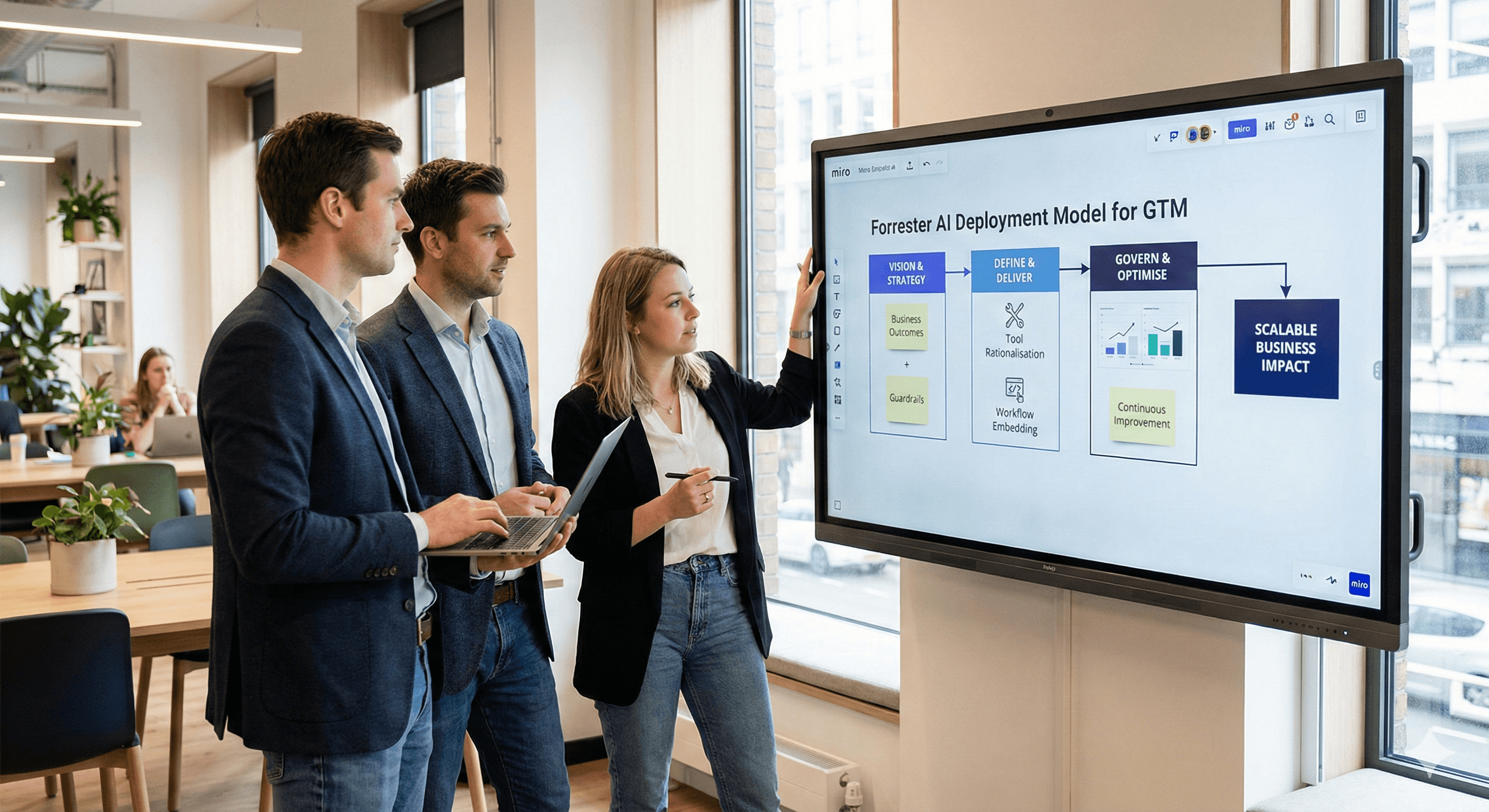
Three individuals in a modern office setting discuss a presentation on a large screen displaying the "Forrester AI Deployment Model for GTM," which outlines steps for achieving scalable business impact.

Pas sûr de quoi faire ensuite avec l'IA?
Évaluez la préparation, les risques et les priorités en moins d'une heure.

Pas sûr de quoi faire ensuite avec l'IA?
Évaluez la préparation, les risques et les priorités en moins d'une heure.

➔ Téléchargez notre kit de préparation à l'IA gratuit

Forrester’s AI Deployment Model for Go-To-Market (GTM) functions is a three-step framework—Vision & Strategy, Define & Deliver, and Govern & Optimise—designed to help GTM and RevOps leaders move from siloed AI tooling to measurable, scalable business impact. Miro supports adoption by keeping strategy, workflows and execution in one connected workspace.

AI is being adopted fast—but in many organisations it’s being adopted in pieces. Teams add copilots, plug-ins and point solutions in silos, then wonder why productivity and ROI don’t show up in a way leaders can measure or scale.

Forrester’s latest research tackles that exact problem with a practical deployment model for go-to-market (GTM) functions—built to turn AI from scattered experiments into an operating system for revenue teams.

AI sprawl is a scaling problem, not a creativity problem

Two pressures are colliding:

  • Visibility and risk: organisations often have limited visibility into how AI is being used when teams rely on personal accounts and non-SSO access paths.

  • ROI scrutiny: finance leaders are pushing harder for measurable outcomes, increasing pressure to prove value and reduce duplication.

In plain terms: AI can’t stay a grab-bag of tools. It needs governance, integration, and a route from strategy to execution.

Forrester’s AI Deployment Model for GTM functions

Forrester positions the model as a way for GTM and revenue operations leaders to provide strategic direction, align teams, and ensure AI drives measurable, scalable impact—rather than fragmented capability and limited visibility.

1) Vision & Strategy

Start by aligning AI initiatives to enterprise strategy, business unit objectives and customer needs—then define success criteria before procurement.

What “good” looks like:

  • Clear business outcomes (e.g., higher win rate, faster cycle time, improved forecast accuracy)

  • Agreed guardrails (data access, compliance, review expectations)

  • A shortlist of use cases worth scaling (not “AI everywhere”)

2) Define & Deliver

Assess capabilities and gaps, prioritise by business impact (not vendor pitches), then build implementation plans that include integration, training and workflow alignment.

What “good” looks like:

  • A rationalised toolset with defined owners

  • AI embedded into the workflow (not bolted on)

  • Enablement that turns usage into habit

3) Govern & Optimise

Track performance, adjust based on results, and spot new opportunities for innovation—without losing control of risk, cost and quality.

What “good” looks like:

  • Adoption + outcome metrics (not just licence counts)

  • Continuous improvement loops

  • A living governance model that supports growth

Where Miro fits: turning the model into something teams can actually run

Forrester gives you the framework. The execution challenge is closing the “infrastructure gap”: strategy lives in one place, delivery in another, and AI tools somewhere else entirely—creating friction before teams even start.

Miro can act as a consolidation layer that helps you:

  • Align strategy and delivery in one workspace, connecting outcomes to initiatives and dependencies.

  • Integrate AI where work happens, connecting tools and enterprise knowledge sources so outputs stay grounded.

  • Support governance and auditability, keeping requirements, artefacts, runbooks and status visible in central hubs rather than scattered across tools.

Practical steps: adopt the model in 30–60 days

A sensible rollout is less about “deploying AI” and more about deploying a system:

  1. Inventory every AI tool in use and assign an owner

  2. Map each tool to a business objective and workflow

  3. Identify duplicate capabilities and unused licences

  4. Confirm data sources, access controls and integrations

  5. Document governance: what’s allowed, what’s reviewed, what’s restricted

  6. Prioritise three initiatives with clear ROI, owners and timelines

  7. Move planning + reporting into a single workspace so progress stays visible

Summary

Forrester’s AI Deployment Model for GTM functions offers a clear route out of AI sprawl: align to strategy, deliver consistently, then govern and optimise for scalable impact. Miro strengthens the execution side by connecting strategy, collaboration, integrations and governance artefacts in one place—so AI becomes operational, not experimental.

Next steps: If you want help rationalising your AI stack, defining GTM AI use cases, or building a governed rollout plan that teams actually adopt, contact Generation Digital.

FAQs

What is Forrester’s AI deployment model for GTM functions?
It’s a three-step framework—Vision & Strategy, Define & Deliver, and Govern & Optimise—designed to help GTM and RevOps leaders move from siloed AI tools to measurable, scalable outcomes.

How does Miro support this model?
Miro supports adoption by consolidating strategy, planning, delivery and governance artefacts in one workspace, and by integrating AI and connected tools into where teams actually work.

Why is tool consolidation important for AI?
Because fragmented tools make it harder to integrate workflows, control access, measure impact and scale repeatable use cases. Consolidation reduces friction and improves visibility—both critical when AI spend is under scrutiny.

When was the Forrester model published?
Forrester’s model overview report is dated January 5, 2026.

Forrester’s AI Deployment Model for Go-To-Market (GTM) functions is a three-step framework—Vision & Strategy, Define & Deliver, and Govern & Optimise—designed to help GTM and RevOps leaders move from siloed AI tooling to measurable, scalable business impact. Miro supports adoption by keeping strategy, workflows and execution in one connected workspace.

AI is being adopted fast—but in many organisations it’s being adopted in pieces. Teams add copilots, plug-ins and point solutions in silos, then wonder why productivity and ROI don’t show up in a way leaders can measure or scale.

Forrester’s latest research tackles that exact problem with a practical deployment model for go-to-market (GTM) functions—built to turn AI from scattered experiments into an operating system for revenue teams.

AI sprawl is a scaling problem, not a creativity problem

Two pressures are colliding:

  • Visibility and risk: organisations often have limited visibility into how AI is being used when teams rely on personal accounts and non-SSO access paths.

  • ROI scrutiny: finance leaders are pushing harder for measurable outcomes, increasing pressure to prove value and reduce duplication.

In plain terms: AI can’t stay a grab-bag of tools. It needs governance, integration, and a route from strategy to execution.

Forrester’s AI Deployment Model for GTM functions

Forrester positions the model as a way for GTM and revenue operations leaders to provide strategic direction, align teams, and ensure AI drives measurable, scalable impact—rather than fragmented capability and limited visibility.

1) Vision & Strategy

Start by aligning AI initiatives to enterprise strategy, business unit objectives and customer needs—then define success criteria before procurement.

What “good” looks like:

  • Clear business outcomes (e.g., higher win rate, faster cycle time, improved forecast accuracy)

  • Agreed guardrails (data access, compliance, review expectations)

  • A shortlist of use cases worth scaling (not “AI everywhere”)

2) Define & Deliver

Assess capabilities and gaps, prioritise by business impact (not vendor pitches), then build implementation plans that include integration, training and workflow alignment.

What “good” looks like:

  • A rationalised toolset with defined owners

  • AI embedded into the workflow (not bolted on)

  • Enablement that turns usage into habit

3) Govern & Optimise

Track performance, adjust based on results, and spot new opportunities for innovation—without losing control of risk, cost and quality.

What “good” looks like:

  • Adoption + outcome metrics (not just licence counts)

  • Continuous improvement loops

  • A living governance model that supports growth

Where Miro fits: turning the model into something teams can actually run

Forrester gives you the framework. The execution challenge is closing the “infrastructure gap”: strategy lives in one place, delivery in another, and AI tools somewhere else entirely—creating friction before teams even start.

Miro can act as a consolidation layer that helps you:

  • Align strategy and delivery in one workspace, connecting outcomes to initiatives and dependencies.

  • Integrate AI where work happens, connecting tools and enterprise knowledge sources so outputs stay grounded.

  • Support governance and auditability, keeping requirements, artefacts, runbooks and status visible in central hubs rather than scattered across tools.

Practical steps: adopt the model in 30–60 days

A sensible rollout is less about “deploying AI” and more about deploying a system:

  1. Inventory every AI tool in use and assign an owner

  2. Map each tool to a business objective and workflow

  3. Identify duplicate capabilities and unused licences

  4. Confirm data sources, access controls and integrations

  5. Document governance: what’s allowed, what’s reviewed, what’s restricted

  6. Prioritise three initiatives with clear ROI, owners and timelines

  7. Move planning + reporting into a single workspace so progress stays visible

Summary

Forrester’s AI Deployment Model for GTM functions offers a clear route out of AI sprawl: align to strategy, deliver consistently, then govern and optimise for scalable impact. Miro strengthens the execution side by connecting strategy, collaboration, integrations and governance artefacts in one place—so AI becomes operational, not experimental.

Next steps: If you want help rationalising your AI stack, defining GTM AI use cases, or building a governed rollout plan that teams actually adopt, contact Generation Digital.

FAQs

What is Forrester’s AI deployment model for GTM functions?
It’s a three-step framework—Vision & Strategy, Define & Deliver, and Govern & Optimise—designed to help GTM and RevOps leaders move from siloed AI tools to measurable, scalable outcomes.

How does Miro support this model?
Miro supports adoption by consolidating strategy, planning, delivery and governance artefacts in one workspace, and by integrating AI and connected tools into where teams actually work.

Why is tool consolidation important for AI?
Because fragmented tools make it harder to integrate workflows, control access, measure impact and scale repeatable use cases. Consolidation reduces friction and improves visibility—both critical when AI spend is under scrutiny.

When was the Forrester model published?
Forrester’s model overview report is dated January 5, 2026.

Recevez chaque semaine des nouvelles et des conseils sur l'IA directement dans votre boîte de réception

En vous abonnant, vous consentez à ce que Génération Numérique stocke et traite vos informations conformément à notre politique de confidentialité. Vous pouvez lire la politique complète sur gend.co/privacy.


Ateliers et webinaires à venir

A diverse group of professionals collaborating around a table in a bright, modern office setting.

Clarté opérationnelle à grande échelle - Asana

Webinaire Virtuel
Mercredi 25 février 2026
En ligne

A diverse group of professionals collaborating around a table in a bright, modern office setting.

Collaborez avec des coéquipiers IA - Asana

Atelier en personne
Jeudi 26 février 2026
London, UK

A diverse group of professionals collaborating around a table in a bright, modern office setting.

De l'idée au prototype - L'IA dans Miro

Webinaire virtuel
Mercredi 18 février 2026
En ligne

Génération
Numérique

Bureau du Royaume-Uni

Génération Numérique Ltée
33 rue Queen,
Londres
EC4R 1AP
Royaume-Uni

Bureau au Canada

Génération Numérique Amériques Inc
181 rue Bay, Suite 1800
Toronto, ON, M5J 2T9
Canada

Bureau aux États-Unis

Generation Digital Americas Inc
77 Sands St,
Brooklyn, NY 11201,
États-Unis

Bureau de l'UE

Génération de logiciels numériques
Bâtiment Elgee
Dundalk
A91 X2R3
Irlande

Bureau du Moyen-Orient

6994 Alsharq 3890,
An Narjis,
Riyad 13343,
Arabie Saoudite

UK Fast Growth Index UBS Logo
Financial Times FT 1000 Logo
Febe Growth 100 Logo (Background Removed)

Numéro d'entreprise : 256 9431 77 | Droits d'auteur 2026 | Conditions générales | Politique de confidentialité

Génération
Numérique

Bureau du Royaume-Uni

Génération Numérique Ltée
33 rue Queen,
Londres
EC4R 1AP
Royaume-Uni

Bureau au Canada

Génération Numérique Amériques Inc
181 rue Bay, Suite 1800
Toronto, ON, M5J 2T9
Canada

Bureau aux États-Unis

Generation Digital Americas Inc
77 Sands St,
Brooklyn, NY 11201,
États-Unis

Bureau de l'UE

Génération de logiciels numériques
Bâtiment Elgee
Dundalk
A91 X2R3
Irlande

Bureau du Moyen-Orient

6994 Alsharq 3890,
An Narjis,
Riyad 13343,
Arabie Saoudite

UK Fast Growth Index UBS Logo
Financial Times FT 1000 Logo
Febe Growth 100 Logo (Background Removed)


Numéro d'entreprise : 256 9431 77
Conditions générales
Politique de confidentialité
Droit d'auteur 2026