Mistral AI Invests €1.2bn in Sweden for European Data Centre

Mistral AI Invests €1.2bn in Sweden for European Data Centre

Mistral

IA
12 févr. 2026

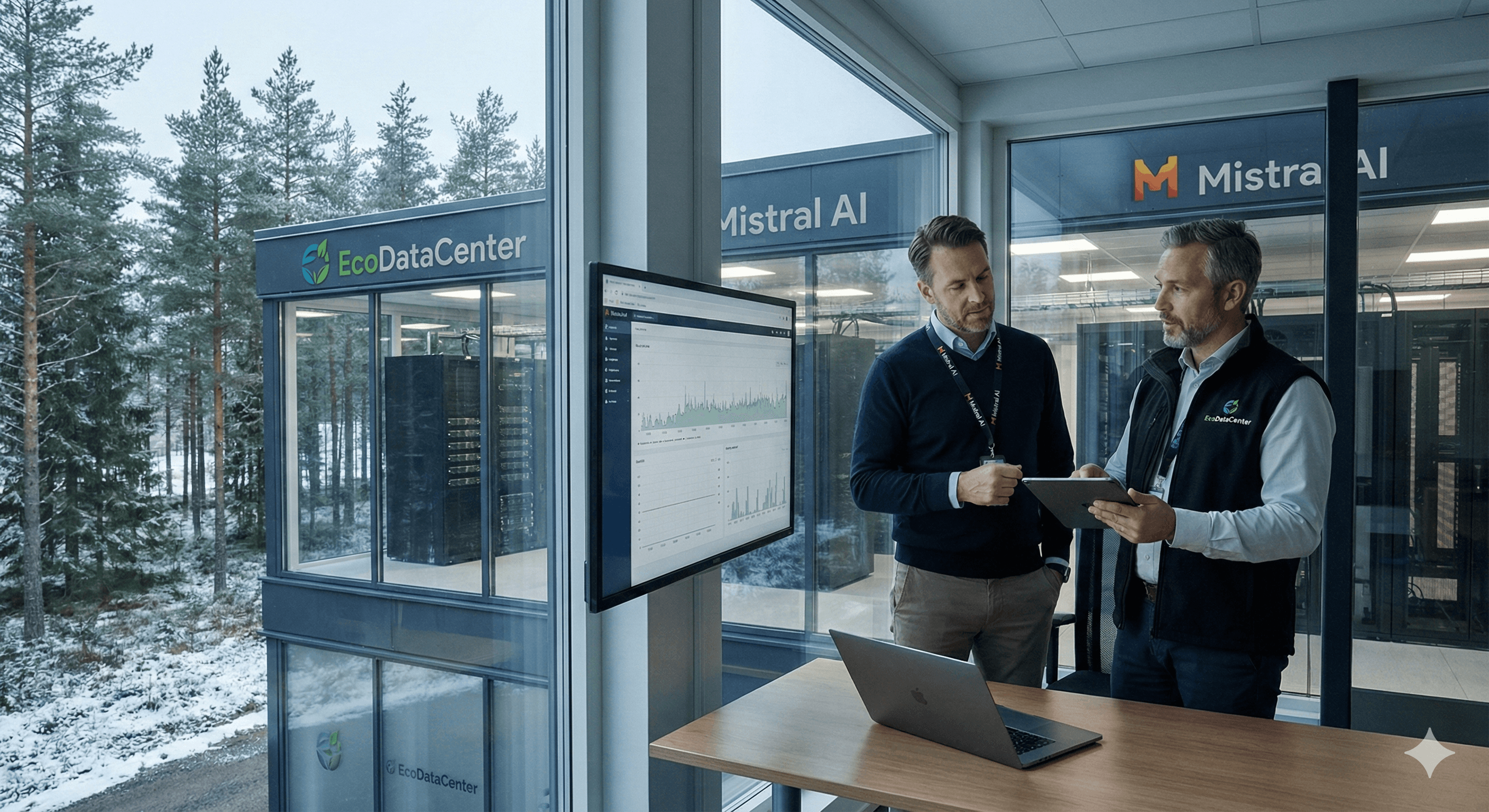
Two professionals discuss inside a modern data center office, featuring digital displays and overlooking the snowy landscape and EcoDataCenter buildings, highlighting Mistral AI's €1.2bn investment in Sweden for a European data centre.

Pas sûr de quoi faire ensuite avec l'IA?
Évaluez la préparation, les risques et les priorités en moins d'une heure.

Pas sûr de quoi faire ensuite avec l'IA?
Évaluez la préparation, les risques et les priorités en moins d'une heure.

➔ Téléchargez notre kit de préparation à l'IA gratuit

Mistral AI is investing €1.2 billion in AI-focused data centre infrastructure in Sweden, partnering with EcoDataCenter to build and operate a new facility expected to begin operations in 2027. The move is positioned as a step towards European AI sovereignty, keeping critical compute and data processing within Europe for enterprise and government customers.

European AI has had a recurring problem: strong models and strong intent, but limited control over the most strategic layer of the stack—compute. That’s why Mistral AI’s announcement of a €1.2 billion infrastructure investment in Sweden matters. It isn’t just expansion; it’s a statement about where European AI wants to live, who controls it, and how it will scale.

The plan is to develop AI-oriented data centre capacity in Sweden in partnership with EcoDataCenter, with the first facility expected to start operations in 2027. It is also described as Mistral’s first major infrastructure development outside France.

What’s been announced (and the parts worth paying attention to)

Mistral’s investment focuses on building AI compute capacity in Sweden, with EcoDataCenter responsible for design, build and operations. The project is expected to support next-generation AI workloads and is framed around keeping critical infrastructure and data processing within Europe.

This isn’t a typical “we opened a regional office” announcement. It’s closer to a strategic repositioning:

  • From model provider to vertically integrated supplier (software, models and compute)

  • From cloud dependency to optionality, especially for regulated buyers

  • From experimentation to procurement-ready AI, with clearer answers on residency, reliability and scale

Why Sweden: cost, carbon, and capacity

Sweden has become a serious contender for AI infrastructure for three practical reasons:

  1. Energy profile and price stability (often a decisive factor for high-density compute)

  2. Cooling and climate advantages, which can materially affect operating cost

  3. Data centre maturity, with operators building for high-availability, high-power workloads

For buyers, the implication is simple: if you need European compute that can scale, the Nordics are increasingly where that capacity is being built.

What this means for GTM teams and enterprise buyers

This move is a GTM signal as much as an engineering one. Here’s what enterprise, public sector and regulated industries typically take from announcements like this:

1) Data residency becomes a product feature

When AI workloads are trained, fine-tuned or served within Europe, it supports governance requirements and reduces uncertainty for procurement and security teams.

2) Supplier risk posture shifts

Vertical integration can reduce reliance on external hyperscalers for core workloads. That may appeal to buyers who are rethinking concentration risk, geopolitical exposure or policy volatility.

3) “AI at scale” becomes easier to operationalise

Infrastructure investment often precedes more predictable performance, capacity planning and enterprise-grade service expectations.

4) A more credible path to European sovereignty narratives

Many “sovereign AI” claims collapse under scrutiny when compute is offshore. Owning or tightly controlling regional infrastructure strengthens the story.

Practical steps: what GTM and RevOps teams should do next

If you’re responsible for AI adoption or vendor selection, use this kind of news as a prompt to tighten your approach:

  1. Update your vendor scorecard to include compute location, data residency, and operational control

  2. Ask vendors to map where data is processed (inference, fine-tuning, training, logging)

  3. Require clarity on commercial packaging for regional hosting and enterprise SLAs

  4. Align security, legal and procurement on a single view of acceptable AI deployment patterns

  5. Consolidate your AI stack: fewer tools, stronger governance, clearer ownership

Where Generation Digital fits

If you’re working towards a governed AI rollout—particularly across GTM functions—the hard part isn’t choosing a model. It’s designing the operating system: governance, workflows, enablement, measurement, and tool consolidation.

Generation Digital helps teams standardise the way AI is adopted, deployed and scaled across modern work tooling.

Summary

Mistral AI’s €1.2bn Sweden investment is a meaningful step towards European-controlled AI compute. For buyers, it strengthens the case for regionally hosted AI services with clearer answers on scale, sovereignty and operational resilience. For GTM leaders, it’s also a reminder that AI strategy is increasingly infrastructure strategy.

Next steps: If you want help turning AI adoption into a scalable, governed GTM operating model—reach out to Generation Digital.

FAQs

What is Mistral AI doing in Sweden?
Mistral AI plans to invest €1.2bn in AI infrastructure in Sweden, partnering with EcoDataCenter to build and operate data centre capacity expected to begin operations in 2027.

Why does this matter for European AI?
Control of compute is critical to AI sovereignty. Building and operating infrastructure within Europe can reduce dependency and strengthen data residency and governance for enterprise and government buyers.

Where will the facility be built?
Coverage of the announcement indicates a project in Sweden with EcoDataCenter, associated with the Borlänge site.

When is it expected to go live?
The first facility is expected to begin operations in 2027.

What should enterprise buyers ask vendors after this?
Ask where inference, fine-tuning, training and logs are processed; how data residency is enforced; what SLAs apply; and how capacity planning is handled for peak workloads.

Mistral AI is investing €1.2 billion in AI-focused data centre infrastructure in Sweden, partnering with EcoDataCenter to build and operate a new facility expected to begin operations in 2027. The move is positioned as a step towards European AI sovereignty, keeping critical compute and data processing within Europe for enterprise and government customers.

European AI has had a recurring problem: strong models and strong intent, but limited control over the most strategic layer of the stack—compute. That’s why Mistral AI’s announcement of a €1.2 billion infrastructure investment in Sweden matters. It isn’t just expansion; it’s a statement about where European AI wants to live, who controls it, and how it will scale.

The plan is to develop AI-oriented data centre capacity in Sweden in partnership with EcoDataCenter, with the first facility expected to start operations in 2027. It is also described as Mistral’s first major infrastructure development outside France.

What’s been announced (and the parts worth paying attention to)

Mistral’s investment focuses on building AI compute capacity in Sweden, with EcoDataCenter responsible for design, build and operations. The project is expected to support next-generation AI workloads and is framed around keeping critical infrastructure and data processing within Europe.

This isn’t a typical “we opened a regional office” announcement. It’s closer to a strategic repositioning:

  • From model provider to vertically integrated supplier (software, models and compute)

  • From cloud dependency to optionality, especially for regulated buyers

  • From experimentation to procurement-ready AI, with clearer answers on residency, reliability and scale

Why Sweden: cost, carbon, and capacity

Sweden has become a serious contender for AI infrastructure for three practical reasons:

  1. Energy profile and price stability (often a decisive factor for high-density compute)

  2. Cooling and climate advantages, which can materially affect operating cost

  3. Data centre maturity, with operators building for high-availability, high-power workloads

For buyers, the implication is simple: if you need European compute that can scale, the Nordics are increasingly where that capacity is being built.

What this means for GTM teams and enterprise buyers

This move is a GTM signal as much as an engineering one. Here’s what enterprise, public sector and regulated industries typically take from announcements like this:

1) Data residency becomes a product feature

When AI workloads are trained, fine-tuned or served within Europe, it supports governance requirements and reduces uncertainty for procurement and security teams.

2) Supplier risk posture shifts

Vertical integration can reduce reliance on external hyperscalers for core workloads. That may appeal to buyers who are rethinking concentration risk, geopolitical exposure or policy volatility.

3) “AI at scale” becomes easier to operationalise

Infrastructure investment often precedes more predictable performance, capacity planning and enterprise-grade service expectations.

4) A more credible path to European sovereignty narratives

Many “sovereign AI” claims collapse under scrutiny when compute is offshore. Owning or tightly controlling regional infrastructure strengthens the story.

Practical steps: what GTM and RevOps teams should do next

If you’re responsible for AI adoption or vendor selection, use this kind of news as a prompt to tighten your approach:

  1. Update your vendor scorecard to include compute location, data residency, and operational control

  2. Ask vendors to map where data is processed (inference, fine-tuning, training, logging)

  3. Require clarity on commercial packaging for regional hosting and enterprise SLAs

  4. Align security, legal and procurement on a single view of acceptable AI deployment patterns

  5. Consolidate your AI stack: fewer tools, stronger governance, clearer ownership

Where Generation Digital fits

If you’re working towards a governed AI rollout—particularly across GTM functions—the hard part isn’t choosing a model. It’s designing the operating system: governance, workflows, enablement, measurement, and tool consolidation.

Generation Digital helps teams standardise the way AI is adopted, deployed and scaled across modern work tooling.

Summary

Mistral AI’s €1.2bn Sweden investment is a meaningful step towards European-controlled AI compute. For buyers, it strengthens the case for regionally hosted AI services with clearer answers on scale, sovereignty and operational resilience. For GTM leaders, it’s also a reminder that AI strategy is increasingly infrastructure strategy.

Next steps: If you want help turning AI adoption into a scalable, governed GTM operating model—reach out to Generation Digital.

FAQs

What is Mistral AI doing in Sweden?
Mistral AI plans to invest €1.2bn in AI infrastructure in Sweden, partnering with EcoDataCenter to build and operate data centre capacity expected to begin operations in 2027.

Why does this matter for European AI?
Control of compute is critical to AI sovereignty. Building and operating infrastructure within Europe can reduce dependency and strengthen data residency and governance for enterprise and government buyers.

Where will the facility be built?
Coverage of the announcement indicates a project in Sweden with EcoDataCenter, associated with the Borlänge site.

When is it expected to go live?
The first facility is expected to begin operations in 2027.

What should enterprise buyers ask vendors after this?
Ask where inference, fine-tuning, training and logs are processed; how data residency is enforced; what SLAs apply; and how capacity planning is handled for peak workloads.

Recevez chaque semaine des nouvelles et des conseils sur l'IA directement dans votre boîte de réception

En vous abonnant, vous consentez à ce que Génération Numérique stocke et traite vos informations conformément à notre politique de confidentialité. Vous pouvez lire la politique complète sur gend.co/privacy.


Ateliers et webinaires à venir

A diverse group of professionals collaborating around a table in a bright, modern office setting.

Clarté opérationnelle à grande échelle - Asana

Webinaire Virtuel
Mercredi 25 février 2026
En ligne

A diverse group of professionals collaborating around a table in a bright, modern office setting.

Collaborez avec des coéquipiers IA - Asana

Atelier en personne
Jeudi 26 février 2026
London, UK

A diverse group of professionals collaborating around a table in a bright, modern office setting.

De l'idée au prototype - L'IA dans Miro

Webinaire virtuel
Mercredi 18 février 2026
En ligne

Génération
Numérique

Bureau du Royaume-Uni

Génération Numérique Ltée
33 rue Queen,
Londres
EC4R 1AP
Royaume-Uni

Bureau au Canada

Génération Numérique Amériques Inc
181 rue Bay, Suite 1800
Toronto, ON, M5J 2T9
Canada

Bureau aux États-Unis

Generation Digital Americas Inc
77 Sands St,
Brooklyn, NY 11201,
États-Unis

Bureau de l'UE

Génération de logiciels numériques
Bâtiment Elgee
Dundalk
A91 X2R3
Irlande

Bureau du Moyen-Orient

6994 Alsharq 3890,
An Narjis,
Riyad 13343,
Arabie Saoudite

UK Fast Growth Index UBS Logo
Financial Times FT 1000 Logo
Febe Growth 100 Logo (Background Removed)

Numéro d'entreprise : 256 9431 77 | Droits d'auteur 2026 | Conditions générales | Politique de confidentialité

Génération
Numérique

Bureau du Royaume-Uni

Génération Numérique Ltée
33 rue Queen,
Londres
EC4R 1AP
Royaume-Uni

Bureau au Canada

Génération Numérique Amériques Inc
181 rue Bay, Suite 1800
Toronto, ON, M5J 2T9
Canada

Bureau aux États-Unis

Generation Digital Americas Inc
77 Sands St,
Brooklyn, NY 11201,
États-Unis

Bureau de l'UE

Génération de logiciels numériques
Bâtiment Elgee
Dundalk
A91 X2R3
Irlande

Bureau du Moyen-Orient

6994 Alsharq 3890,
An Narjis,
Riyad 13343,
Arabie Saoudite

UK Fast Growth Index UBS Logo
Financial Times FT 1000 Logo
Febe Growth 100 Logo (Background Removed)


Numéro d'entreprise : 256 9431 77
Conditions générales
Politique de confidentialité
Droit d'auteur 2026





