GABRIEL Toolkit: Scale Qualitative Research with GPT
OpenAI

Pas sûr de quoi faire ensuite avec l'IA?Évaluez la préparation, les risques et les priorités en moins d'une heure.
➔ Téléchargez notre kit de préparation à l'IA gratuit
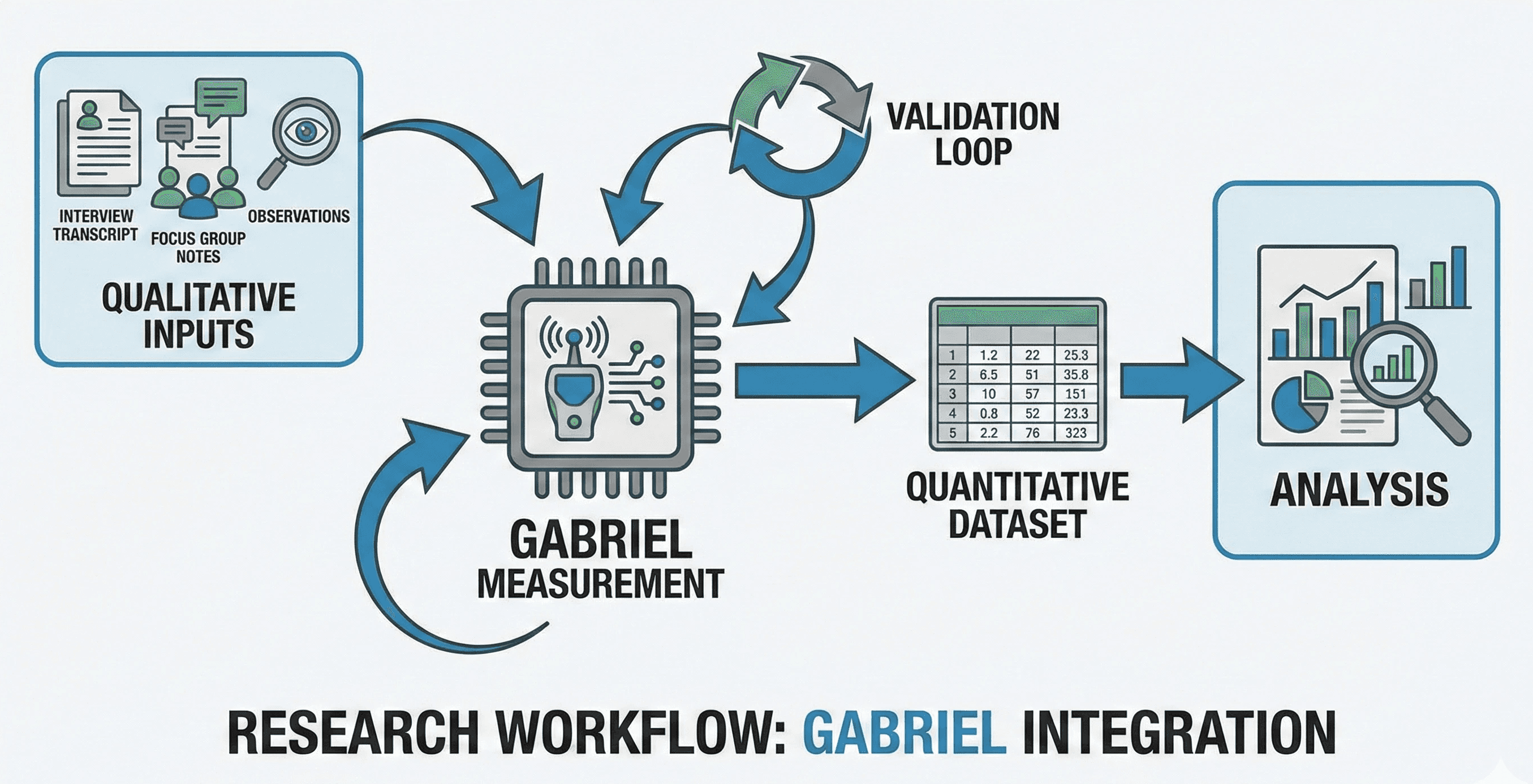
GABRIEL is an open-source toolkit from OpenAI that uses GPT to convert unstructured qualitative material — like text and images — into quantitative measurements. It helps social scientists define what they want to measure, apply consistent labelling at scale, and analyse large datasets faster than manual coding alone.
Qualitative data is rich — interviews, open-ended survey responses, policy documents, images — but it’s also slow to analyse when you’re coding by hand. That bottleneck makes it hard to run studies at the scale modern research questions demand.
GABRIEL is OpenAI’s new open-source toolkit built to close that gap. It uses GPT to help researchers turn unstructured inputs into quantitative measurements that can be analysed statistically, without losing the interpretability that social science requires.
What GABRIEL is (and what it isn’t)
GABRIEL is best thought of as a measurement workflow: you define the attribute you want to quantify (for example, sentiment, policy stance, or “pro‑innovation” framing), then apply that measurement consistently across large volumes of data.
It’s not a magic “auto-truth” button. The value comes from making your coding more scalable and more auditable: you can test prompts, compare results against human labels, and iterate until the measurement behaves the way your study design requires.
What data can it handle?
OpenAI’s announcement focuses on text and images, and the GitHub repository description also notes audio as a supported modality.
That matters because many research datasets aren’t just spreadsheets — they’re mixed-media collections that are hard to quantify without an army of research assistants.
How it works in practice
A practical way to use GABRIEL is to treat it as a structured bridge between qualitative interpretation and quantitative analysis:
Define the construct you want to measure (what “counts” and what doesn’t).
Design a rubric and prompt that captures that construct consistently.
Validate on a small sample (compare against expert labels; check edge cases; refine).
Scale to the full dataset once your measurement is stable.
This approach keeps the research logic in the foreground, while letting the toolkit handle the repeatability and volume that makes manual analysis drag on for months.
Practical examples social scientists can start with
GABRIEL is particularly useful when you need to apply the same judgement many times, such as:
Coding themes or stances across thousands of policy documents
Turning open-ended survey responses into consistent categories
Measuring attributes in mixed datasets (text + images) for comparative studies
Summary
If your research workflow is bottlenecked by manual coding, GABRIEL offers a structured way to scale measurement across qualitative data — while keeping validation and interpretability in view. As an open-source toolkit, it’s accessible to researchers who want to build repeatable, testable measurement pipelines using GPT.
Next steps: Generation Digital can help you assess where GABRIEL fits in your methodology, design evaluation steps, and integrate the workflow into your existing tooling.
FAQs
Q1: How does GABRIEL improve research scalability?
By turning qualitative inputs into repeatable quantitative measurements, it reduces the amount of manual coding required and makes it feasible to analyse much larger datasets.
Q2: What types of data can GABRIEL handle?
OpenAI describes support for text and images, and the repository also mentions audio.
Q3: Is GABRIEL accessible to all researchers?
Yes. It’s released as open-source under the Apache 2.0 licence, so researchers can use and adapt it within the licence terms.
Q4: Does using GABRIEL remove the need for human validation?
No — the accompanying “GPT as a measurement tool” framing emphasises designing the measurement carefully and validating it, especially on a labelled subset, before scaling.
Recevez chaque semaine des nouvelles et des conseils sur l'IA directement dans votre boîte de réception
En vous abonnant, vous consentez à ce que Génération Numérique stocke et traite vos informations conformément à notre politique de confidentialité. Vous pouvez lire la politique complète sur gend.co/privacy.



Génération
Numérique

Bureau du Royaume-Uni
Génération Numérique Ltée
33 rue Queen,
Londres
EC4R 1AP
Royaume-Uni
Bureau au Canada
Génération Numérique Amériques Inc
181 rue Bay, Suite 1800
Toronto, ON, M5J 2T9
Canada
Bureau aux États-Unis
Generation Digital Americas Inc
77 Sands St,
Brooklyn, NY 11201,
États-Unis
Bureau de l'UE
Génération de logiciels numériques
Bâtiment Elgee
Dundalk
A91 X2R3
Irlande
Bureau du Moyen-Orient
6994 Alsharq 3890,
An Narjis,
Riyad 13343,
Arabie Saoudite






Numéro d'entreprise : 256 9431 77 | Droits d'auteur 2026 | Conditions générales | Politique de confidentialité