OpenAI lance un appel d'offres pour renforcer la chaîne d'approvisionnement en IA aux États-Unis grâce à la fabrication domestique
OpenAI
IA
Pas sûr de quoi faire ensuite avec l'IA?Évaluez la préparation, les risques et les priorités en moins d'une heure.
➔ Téléchargez notre kit de préparation à l'IA gratuit
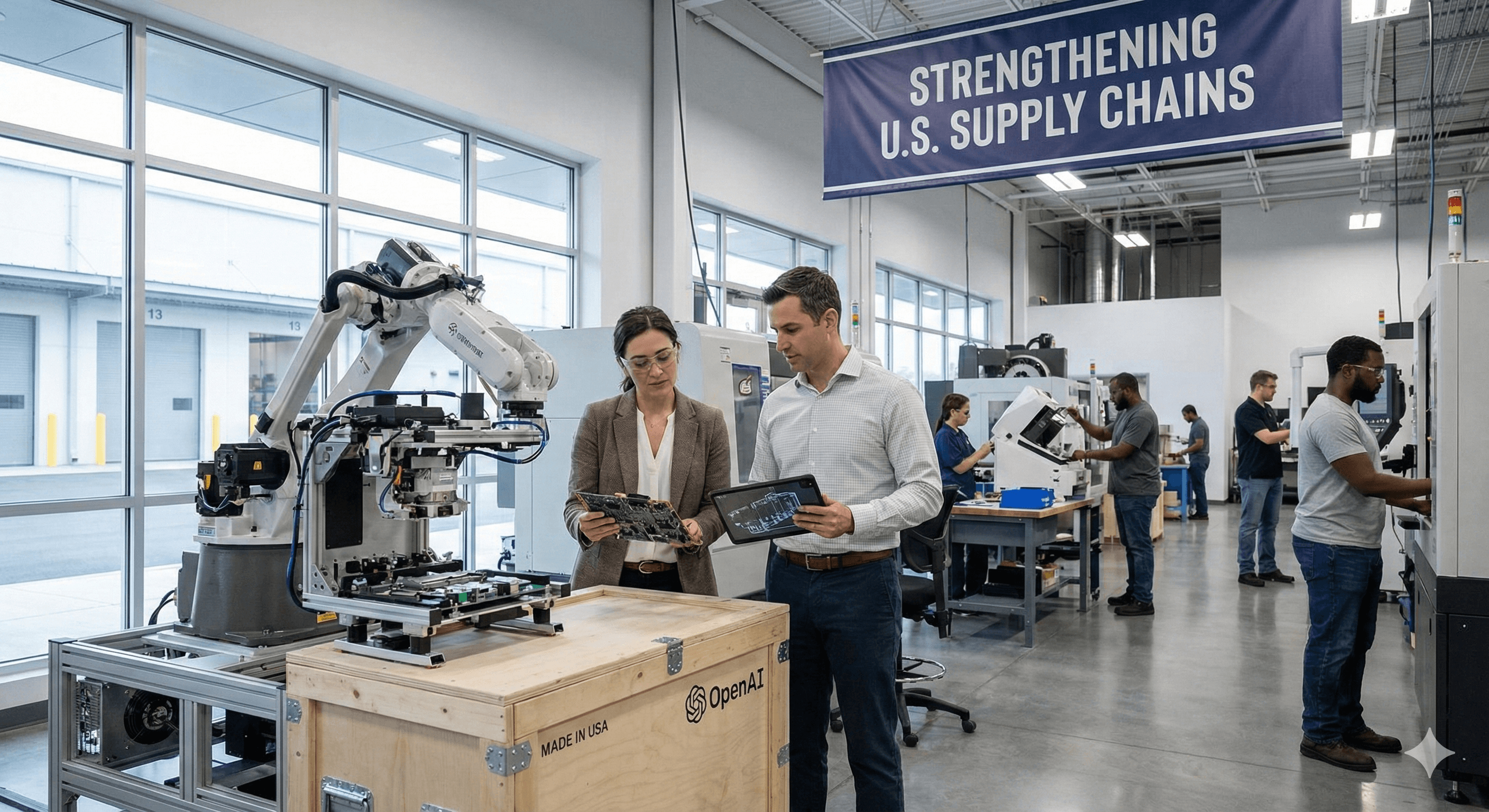
OpenAI a lancé un appel aux fabricants et partenaires américains capables de construire des composants critiques pour l'IA à grande échelle. Le programme vise à réduire les délais de construction, renforcer la résilience de la chaîne d'approvisionnement, et étendre le leadership technologique alors que la demande pour la puissance de calcul de l'IA et l'IA incarnée augmente.
Les besoins du RFP sont regroupés en trois volets :
Entrées de centre de données — calcul, puissance, refroidissement, racks et réseaux.
Électronique grand public — modules, composants et outils utilisés dans les appareils activés par l'IA.
Robotiques avancées — incluant des réducteurs, moteurs et électroniques de puissance.
Pourquoi c'est significatif
Résilience : Amène les étapes clés de production sur le territoire pour réduire l'exposition aux goulots d'étranglement mondiaux.
Rapidité : Chaînes logistiques plus courtes et itération plus rapide pour les systèmes d'IA de nouvelle génération.
Emplois et investissements : Soutient des rôles de grande valeur dans la fabrication, l'emballage avancé, les systèmes électromécaniques et l'infrastructure du centre de données.
Contexte : la course à l'IA — pourquoi OpenAI en a besoin
Demande de calcul explosive : L'entraînement et le service des modèles de pointe nécessitent des volumes rapidement croissants d'accélérateurs, de mémoire (HBM) et d'emballage avancé. Sécuriser les fournisseurs domestiques aide à garantir un accès prévisible à ces entrées.
Goulots d'étranglement dans l'empilement : Depuis les substrats avancés et l'emballage de style CoWoS jusqu'à la puissance, le refroidissement, les racks et l'optique, les points de blocage retardent les déploiements. Construire la capacité aux États-Unis à travers ces liens réduit les points de défaillance unique.
Contraintes de puissance et thermiques : Les clusters d'IA denses intensifient les besoins en livraison de puissance et en retrait de chaleur. La fabrication localisée de PDU, de barres omnibus, de refroidisseurs, de plaques froides et d'encadrements à haute efficacité accélère le déploiement.
Passage des laboratoires aux produits : Alors que l'IA passe dans les appareils de consommation et la robotique incarnée, OpenAI a besoin de sources domestiques fiables pour la mécanique de précision (réducteurs, moteurs), l'électronique de contrôle et les modules CE.
Géopolitique et risque commercial : Les contrôles à l'exportation, les tarifs et les chocs logistiques peuvent prolonger les délais de livraison. La fabrication domestique réduit les risques d'approvisionnement pour des programmes critiques en termes de temps.
Rapidité d'apprentissage : Des cycles de construction plus rapides et localisés signifient une expérimentation et une itération plus rapides sur l'infrastructure d'entraînement et d'inférence des modèles—un avantage dans une course effrénée.
Signalisation de l'écosystème : S'engager envers les fournisseurs américains encourage l'investissement dans les matériaux en amont, les outils et la main-d'œuvre—augmentant la capacité au fil du temps.
Qui devrait postuler
Fabricants américains et consortiums avec capacité existante ou à court terme dans l'un des trois domaines d'intérêt.
Fournisseurs de technologies habilitantes comme l'emballage avancé, la gestion thermique, l'optique, le mouvement de précision, et les outils associés.
Partenaires capables de démontrer installations évolutives, systèmes de qualité et valeur ajoutée domestique.
Que inclure dans votre proposition
Alignement sur le scope : Indiquez le(s) domaine(s) d'intérêt que vous abordez et les goulots d'étranglement que vous résolvez.
Capacité et calendrier : Installations, plan d'équipement, objectifs de débit, calendrier de montée en puissance.
Plan de résilience : Double source, traçabilité, et localisation du fournisseur aux États-Unis.
Personnel et conformité : Embauche, formation, sécurité et contrôles pertinents.
Impact : Quantifier la réduction des délais, les objectifs de rendement, et la valeur ajoutée domestique.
Dates clés
Date de publication : 15 janvier 2026
Revues : Continue, au fur et à mesure
Date limite finale : Juin 2026
Comment Generation Digital peut aider
Préparation de l'offre : Évaluation rapide des critères d'admissibilité, des preuves et des jalons.
Soutien à la proposition : Structuration, narration, et conception de KPI.
Outils de livraison : Asana pour le contrôle de programme, Miro pour les revues et conception, Notion pour la documentation et la traçabilité.
Contactez-nous pour évaluer votre adéquation et accélérer votre soumission.
FAQs
Quelle est la date limite ?
Juin 2026 ; propositions évaluées au fur et à mesure.
Qui est éligible ?
Fabricants et partenaires basés aux États-Unis capables de développer leur capacité dans les entrées de centre de données, l'électronique grand public, ou la robotique avancée.
Quel est l'objectif ?
Réduire les délais, renforcer la résilience et étendre le leadership technologique américain sur l'ensemble du matériel de l'IA.
Recevez chaque semaine des nouvelles et des conseils sur l'IA directement dans votre boîte de réception
En vous abonnant, vous consentez à ce que Génération Numérique stocke et traite vos informations conformément à notre politique de confidentialité. Vous pouvez lire la politique complète sur gend.co/privacy.



Génération
Numérique

Bureau du Royaume-Uni
Génération Numérique Ltée
33 rue Queen,
Londres
EC4R 1AP
Royaume-Uni
Bureau au Canada
Génération Numérique Amériques Inc
181 rue Bay, Suite 1800
Toronto, ON, M5J 2T9
Canada
Bureau aux États-Unis
Generation Digital Americas Inc
77 Sands St,
Brooklyn, NY 11201,
États-Unis
Bureau de l'UE
Génération de logiciels numériques
Bâtiment Elgee
Dundalk
A91 X2R3
Irlande
Bureau du Moyen-Orient
6994 Alsharq 3890,
An Narjis,
Riyad 13343,
Arabie Saoudite







Numéro d'entreprise : 256 9431 77 | Droits d'auteur 2026 | Conditions générales | Politique de confidentialité