VfL Wolfsburg + ChatGPT Enterprise : Adoption de l'IA à l'échelle du club
ChatGPT
Pas sûr de quoi faire ensuite avec l'IA?Évaluez la préparation, les risques et les priorités en moins d'une heure.
➔ Téléchargez notre kit de préparation à l'IA gratuit
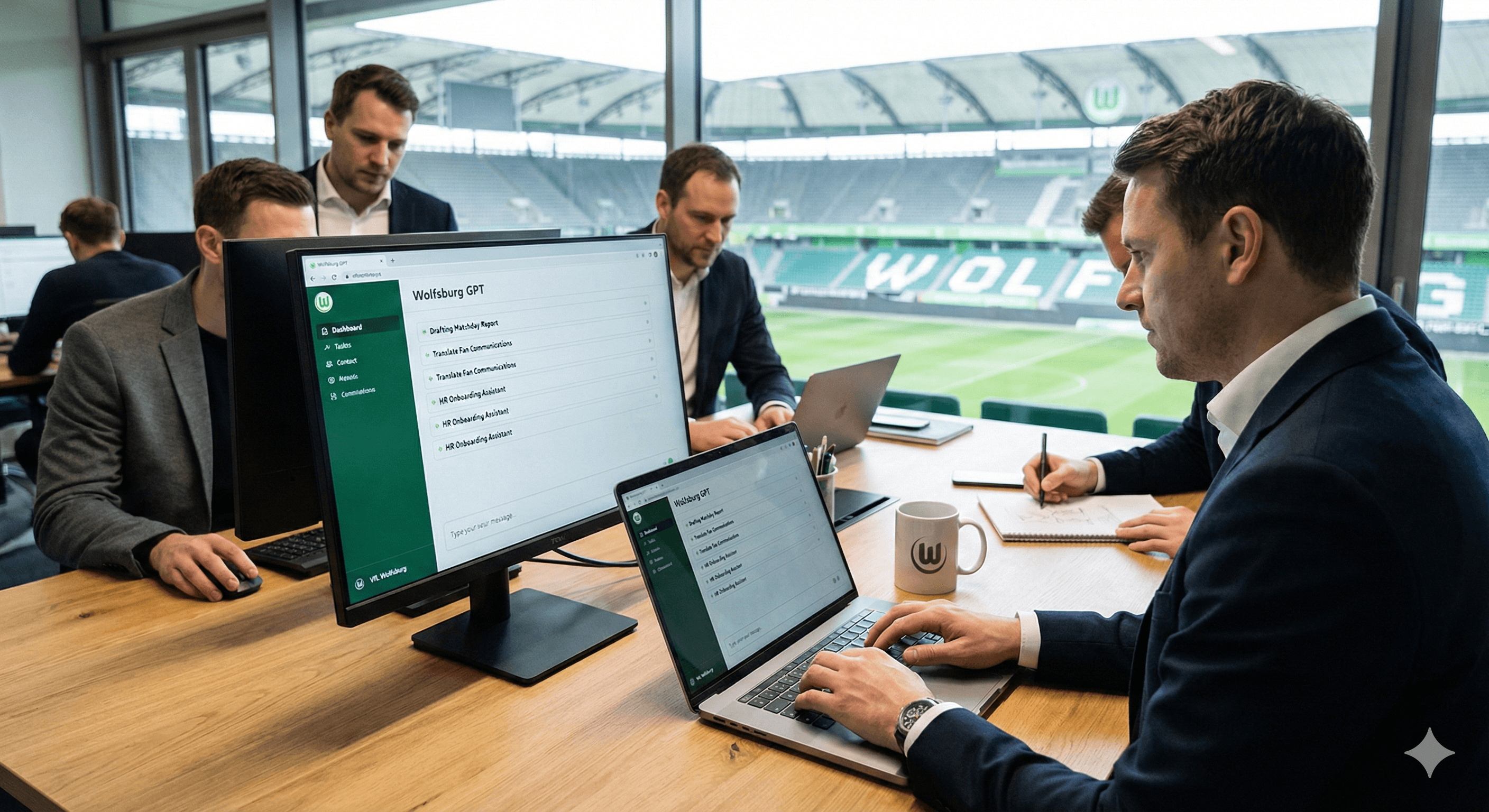
Le VfL Wolfsburg a dépassé les essais pilotes d'IA en déployant ChatGPT Enterprise comme une capacité à l'échelle du club pour environ 350 employés. Le club rapporte plus de 50 GPT personnalisés utilisés quotidiennement, des économies annuelles à six chiffres grâce à une réduction de la dépendance aux agences externes, et une rédaction, une traduction et une standardisation plus rapides des flux de travail essentiels.
Les clubs de football modernes ne se définissent plus uniquement par les performances sur le terrain. Les attentes des fans, des partenaires et des parties prenantes internes continuent d’augmenter—tandis que les budgets et les effectifs ne peuvent pas évoluer indéfiniment.
C’est ce dilemme que le VfL Wolfsburg a voulu résoudre en transformant l'IA générative en une capacité à l'échelle du club, et non en une simple expérience unique. Avec ChatGPT Enterprise, Wolfsburg augmente l'efficacité, la créativité et le partage des connaissances—sans perdre son identité footballistique.
Pourquoi "les gens, pas les pilotes" est important
De nombreuses organisations abordent l'IA comme une série de petits essais pilotes. Wolfsburg a adopté une approche différente : si l'IA va créer un avantage durable, elle doit être compréhensible et utilisable par tous, pas seulement par les spécialistes.
Plutôt que de débuter par des stratégies théoriques, le club a commencé par le travail concret :
des ateliers et des expérimentations concrètes,
des cas d'utilisation dirigés par les départements,
et des flux de travail reproductibles que les équipes connaissaient déjà.
L'objectif était pragmatique : gagner du temps, réduire les coûts externes et améliorer la qualité et la cohérence.
Qu'est-ce qui change réellement à l'intérieur du club
Les premiers défis de Wolfsburg étaient familiers à toute organisation axée sur la connaissance :
la rédaction, la traduction, le reporting et la documentation répétitifs ralentissent les équipes,
la concentration du savoir chez quelques spécialistes crée des goulots d'étranglement,
et les agences externes gérant des travaux de routine à un coût élevé—sans renforcer les compétences internes.
ChatGPT est devenu la couche qui permet aux gens de produire des résultats plus solides plus rapidement, et de partager les connaissances plus uniformément entre les départements.
Pourquoi ChatGPT Enterprise (et pourquoi maintenant)
Après avoir acquis une expérience avec les licences ChatGPT Team/Business, Wolfsburg a décidé que la prochaine contrainte n’était pas de savoir si l'IA fonctionnait—c'était comment la mettre à l'échelle correctement et de manière responsable.
Passer à ChatGPT Enterprise a créé une base cohérente que le club pouvait déployer largement—élargissant l'accès à environ 350 employés et renforçant la gouvernance.
Rendre l'IA tangible : des GPT personnalisés construits autour des flux de travail quotidiens
L'adoption s'est accélérée lorsque Wolfsburg a cessé de parler d'« IA » et a commencé à créer des assistants pour des tâches spécifiques.
Aujourd'hui, le club rapporte :
Plus de 50 GPT personnalisés en utilisation quotidienne active dans les opérations, la communication, le marketing, les RH et l'administration
un écosystème plus large de près de 100 GPT personnalisés (certains soutenus par l'équipe d'innovation centrale, beaucoup créés indépendamment au sein des départements)
Cela devient un modèle opérationnel reproductible :
Identifier un goulot d'étranglement
Le transformer en un GPT
Le mettre à l'échelle aux équipes qui en ont besoin
Pour que l'adoption soit accessible, de nombreux assistants se voient attribuer des noms à consonance humaine en interne—sans confondre responsabilité et décisions.
Résultats : économies, rapidité et adoption autoalimentée
Wolfsburg rapporte des résultats qui vont au-delà du "sympathique d'avoir" :
Économies annuelles à six chiffres en réduisant la dépendance aux agences externes pour des travaux répétitifs
Rédaction, traduction et standardisation plus rapides des flux de travail essentiels
Adoption à grande échelle, incluant des rôles non techniques et d'anciens joueurs—favorisant une utilisation autoalimentée
Comment Wolfsburg développe les compétences : les Champions GPT (« GPTlers »)
Pour favoriser une adoption durable, le club développe un réseau de champions internes formés. Ces collègues aident leurs départements à appliquer l'IA efficacement, à construire des GPT et à partager des modèles qui fonctionnent.
Ceci est important car la plus grande contrainte à l'échelle n'est rarement la technologie. C'est la gestion du changement : formation cohérente, normes et utilisation sécuritaire dans une organisation diversifiée.
Ce que d'autres organisations peuvent apprendre du VfL Wolfsburg
L'approche de Wolfsburg est un plan clair pour aller au-delà des pilotes :
Commencez avec des travaux récurrents (modèles, résultats reproductibles, flux de travail standard)
Rendez l'adoption fluide (des outils que les gens n'ont pas peur d'utiliser)
Convertissez les cas d'utilisation en actifs partagés (des GPT personnalisés que d'autres peuvent réutiliser)
Créez des experts locaux (des champions dans chaque département)
Considérez la gouvernance comme un facilitateur (afin que l'expérimentation puisse se développer de manière responsable)
Résumé & prochaines étapes
Le déploiement de VfL Wolfsburg montre à quoi ressemble l'« IA comme une capacité » : des flux de travail pratiques, des assistants réutilisables, des économies mesurables, et un modèle centré sur les personnes qui se répand.
Prochaine étape : Si vous voulez adopter une approche similaire—construire l'adoption, la gouvernance et des résultats mesurables—Generation Digital peut vous aider à concevoir votre plan de déploiement.
FAQs
Comment ChatGPT est-il utilisé chez VfL Wolfsburg ?
Dans les opérations, la communication, le marketing, les RH et l'administration—principalement pour des tâches répétitives telles que la rédaction, la traduction, le reporting et la standardisation, livrées via des GPT personnalisés.
Pourquoi se concentrer sur les gens plutôt que sur les pilotes ?
Parce que la valeur durable vient d'une adoption large et du développement des capacités. Les pilotes prouvent la possibilité ; l'habilitation centrée sur les personnes construit un impact reproductible.
Cela affectera-t-il l'identité footballistique du club ?
Non. L'approche de Wolfsburg est que l'IA soutient les personnes qui travaillent en coulisses, tandis que les valeurs footballistiques fondamentales du club restent inchangées.
Quels résultats Wolfsburg a-t-il rapportés ?
Le club rapporte plus de 50 GPT personnalisés en usage quotidien, des économies annuelles à six chiffres grâce à une dépendance réduite aux agences, et des flux de travail plus rapides dans la rédaction et la traduction.
Recevez chaque semaine des nouvelles et des conseils sur l'IA directement dans votre boîte de réception
En vous abonnant, vous consentez à ce que Génération Numérique stocke et traite vos informations conformément à notre politique de confidentialité. Vous pouvez lire la politique complète sur gend.co/privacy.



Génération
Numérique

Bureau du Royaume-Uni
Génération Numérique Ltée
33 rue Queen,
Londres
EC4R 1AP
Royaume-Uni
Bureau au Canada
Génération Numérique Amériques Inc
181 rue Bay, Suite 1800
Toronto, ON, M5J 2T9
Canada
Bureau aux États-Unis
Generation Digital Americas Inc
77 Sands St,
Brooklyn, NY 11201,
États-Unis
Bureau de l'UE
Génération de logiciels numériques
Bâtiment Elgee
Dundalk
A91 X2R3
Irlande
Bureau du Moyen-Orient
6994 Alsharq 3890,
An Narjis,
Riyad 13343,
Arabie Saoudite







Numéro d'entreprise : 256 9431 77 | Droits d'auteur 2026 | Conditions générales | Politique de confidentialité