AI Drives Cost-Effective COBOL Modernisation Solutions

AI Drives Cost-Effective COBOL Modernisation Solutions
AI

Feb 23, 2026

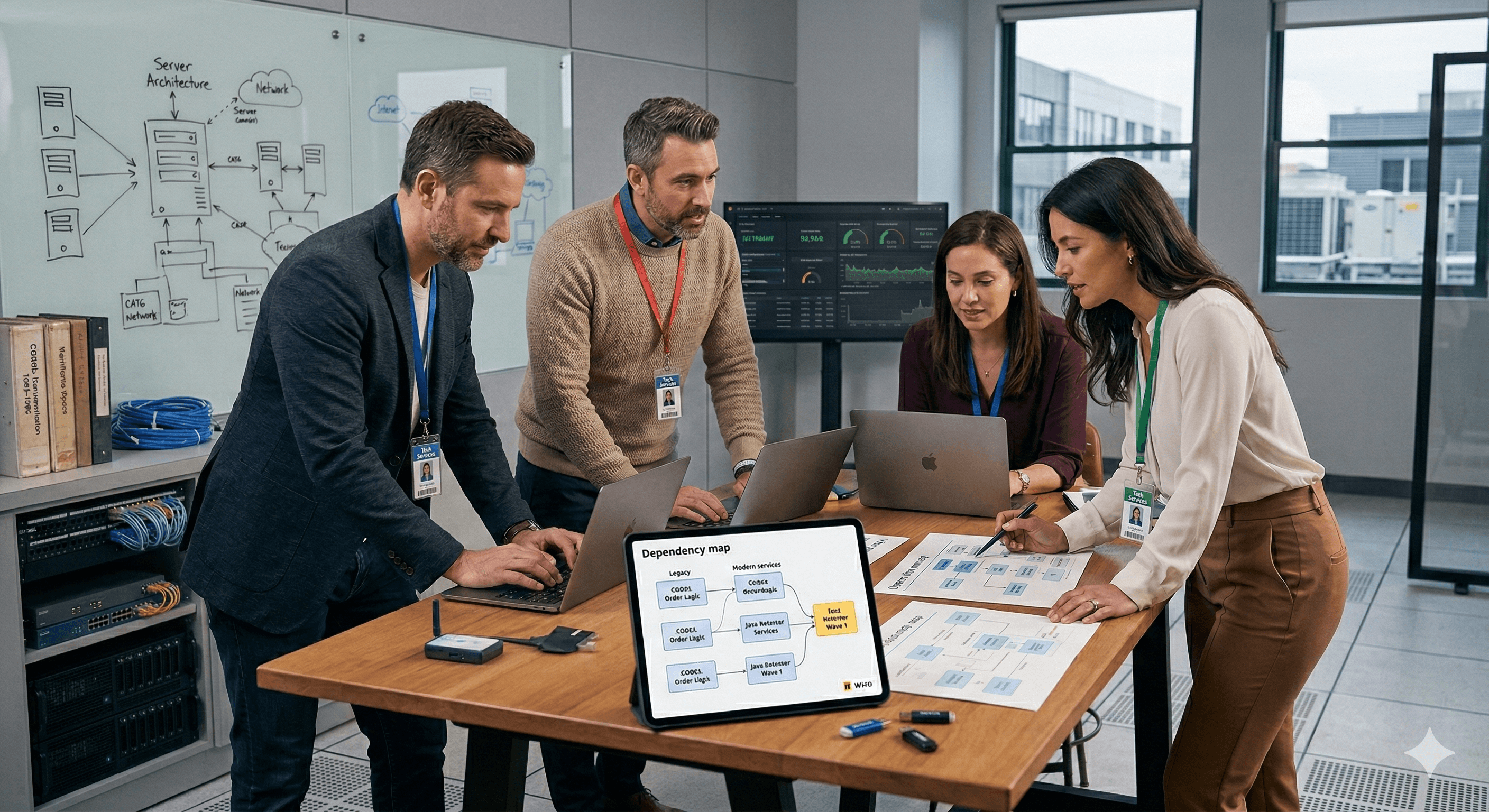
A group of professionals collaborates around a conference table displaying a digital dependency map on a laptop, illustrating strategies for cost-effective COBOL modernization solutions, with technical diagrams and data monitors in the background.

Not sure where to start with AI?
Assess readiness, risk, and priorities in under an hour.

Not sure where to start with AI?
Assess readiness, risk, and priorities in under an hour.

➔ Download Our Free AI Readiness Pack

AI is changing COBOL modernisation by automating the most time-consuming work: application discovery, documentation, business-logic extraction, refactoring and test updates. This reduces dependence on large consultant teams and makes modernisation programmes more cost-effective—when combined with human review, robust testing, and clear governance to protect critical logic and data integrity.

COBOL modernisation has historically been expensive for one reason: complexity is hidden.

Large mainframe estates tend to include decades of tightly coupled logic, limited documentation, and specialist knowledge that lives in people’s heads. Traditional modernisation programmes often relied on long discovery phases and large consulting teams to map dependencies, interpret business logic, and safely refactor systems.

AI is shifting that cost curve.

Today’s AI-assisted modernisation tools can accelerate discovery, generate documentation, extract logic, and support refactoring—reducing the volume of manual analysis and making modernisation feasible for more organisations.

What’s changed: the economics of modernisation
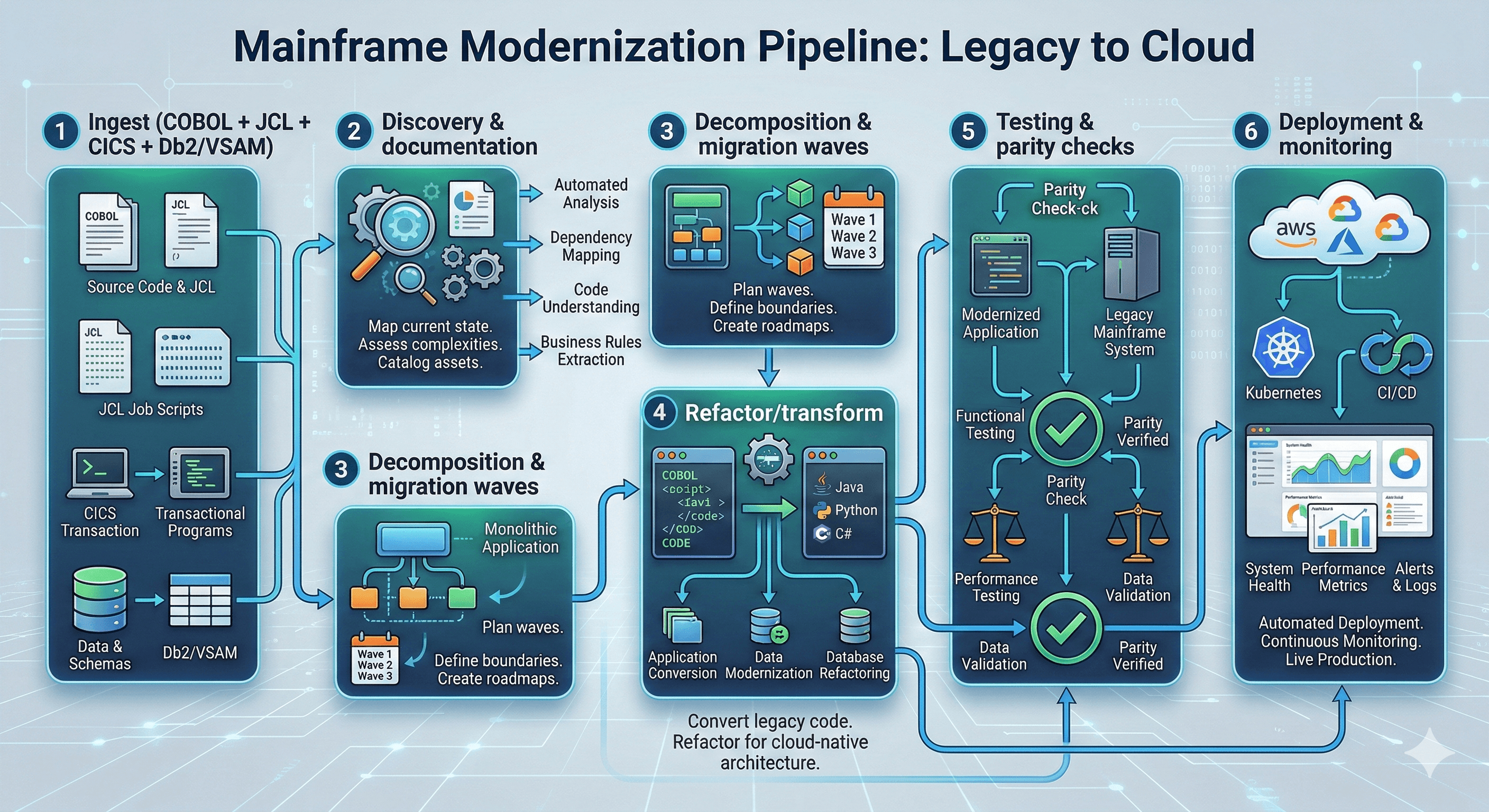
The biggest savings don’t come from “COBOL to X” translation alone. They come from compressing the phases that used to consume time and people:

  • Discovery and analysis: understanding what the system does and how components interact.

  • Documentation: capturing business rules, acronyms, workflows, and data relationships.

  • Decomposition: breaking monoliths into manageable units and planning migration waves.

  • Refactoring / transformation: creating modern equivalents while preserving critical logic.

  • Testing and validation: updating tests and proving functional equivalence.

When these phases are automated or accelerated, programmes require fewer specialist hours—and delivery becomes less dependent on scarce expertise.

How AI supports COBOL modernisation in practice

AI-driven modernisation typically includes four capabilities.

1) Faster understanding of the codebase

Tools can ingest COBOL (and related artefacts such as JCL, CICS, BMS, Db2 schemas and VSAM files), then produce structured summaries and dependency maps.

This reduces the “knowledge gap” that slows modernisation and creates delivery risk.

2) Documentation you can actually use

AI can generate documentation that explains:

  • what modules do,

  • what business rules are embedded,

  • how data flows,

  • and where key integrations sit.

That documentation becomes a shared foundation for engineering teams, stakeholders and auditors.

3) Safer refactoring and transformation

In many programmes, the goal is not a literal rewrite. It’s a controlled transformation that preserves logic while making the system easier to maintain.

Modernisation platforms now support refactoring pathways such as transforming COBOL applications into modern Java-based applications, with human review and validation.

4) Testing and verification at scale

Reliable modernisation depends on proving outcomes: functional equivalence, performance, security, and operational readiness.

AI can help update tests, identify gaps, and reduce manual effort—but it should be paired with strict acceptance criteria and regression coverage.

A practical modernisation playbook (that doesn’t bet the business)

If you want cost-effective modernisation, the goal is to reduce risk while accelerating learning.

Step 1: Start with discovery, not conversion

Begin by building a map of:

  • applications and dependencies,

  • critical business processes,

  • data stores and interfaces,

  • and operational constraints.

Outcome: a modernisation backlog and a migration wave plan.

Step 2: Prioritise by business impact and feasibility

Pick candidates with:

  • clear ownership,

  • measurable outcomes,

  • manageable dependencies,

  • and strong testability.

Avoid starting with the most critical, most entangled system.

Step 3: Choose the right strategy (not every system needs the same approach)

Common patterns include:

  • Refactor and modernise in place (improve maintainability without a full rewrite)

  • Re-platform (move runtime while keeping logic)

  • Re-architect (decompose into services where it adds value)

  • Replace (where a modern package is a better fit)

Step 4: Implement human-in-the-loop controls

Treat AI outputs as accelerators, not final answers.

Define:

  • review responsibilities,

  • approval gates,

  • and evidence required for sign-off (tests, parity checks, logs).

Step 5: Prove equivalence, then scale

Scale only once you can demonstrate:

  • functional equivalence,

  • performance parity (or improvement),

  • security compliance,

  • and operational readiness.

Reliability: is AI “safe enough” for COBOL systems?

AI can be reliable when it’s used correctly.

The risk is not that AI “gets it wrong”—it’s that programmes deploy changes without sufficient verification.

A safe approach includes:

  • strong regression tests and test data management,

  • parallel run where feasible,

  • audit trails for changes,

  • and clear rollback procedures.

With these controls, AI becomes a force multiplier: it shortens cycles while preserving rigour.

Where collaboration tools help modernisation programmes

Mainframe modernisation is a cross-functional change programme.

  • Use Asana to manage workstreams, owners, dependencies and programme reporting.

  • Use Miro to map processes, dependencies, migration waves and decision points.

Summary

AI is changing COBOL modernisation economics by automating discovery, documentation, refactoring support and test updates—reducing reliance on large consultant teams and making modernisation programmes more achievable.

The organisations that succeed pair AI acceleration with disciplined controls: human review, strong testing, governance, and phased rollout.

Next steps

  • Run a discovery sprint to map dependencies and risk.

  • Select one migration wave with measurable outcomes.

  • Define verification gates (tests, parity, security).

  • Scale only after you can prove equivalence.

FAQ

Q1: How does AI reduce costs in COBOL modernisation?
AI reduces costs by automating discovery, documentation, business-logic extraction, refactoring support, and parts of testing—cutting the time and specialist effort needed to understand and change large COBOL estates.

Q2: What are the benefits of using AI for COBOL updates?
Faster discovery, more consistent documentation, reduced manual analysis, quicker refactoring cycles, and improved accessibility for teams who don’t have deep mainframe expertise.

Q3: Is AI reliable for handling COBOL systems?
It can be—when paired with human review and strong validation. Treat AI as an accelerator, then prove equivalence through regression testing, data parity checks, audit trails, and phased rollout.

Q4: Does modernisation always mean converting COBOL to Java?
No. Many programmes succeed with a mix of approaches: refactoring in place, re-platforming, re-architecting, or selective replacement—depending on risk, dependencies and value.

Q5: What should we modernise first?
Start with a workflow or application that has clear ownership, measurable outcomes, manageable dependencies and good testability—so you can prove success and scale.

AI is changing COBOL modernisation by automating the most time-consuming work: application discovery, documentation, business-logic extraction, refactoring and test updates. This reduces dependence on large consultant teams and makes modernisation programmes more cost-effective—when combined with human review, robust testing, and clear governance to protect critical logic and data integrity.

COBOL modernisation has historically been expensive for one reason: complexity is hidden.

Large mainframe estates tend to include decades of tightly coupled logic, limited documentation, and specialist knowledge that lives in people’s heads. Traditional modernisation programmes often relied on long discovery phases and large consulting teams to map dependencies, interpret business logic, and safely refactor systems.

AI is shifting that cost curve.

Today’s AI-assisted modernisation tools can accelerate discovery, generate documentation, extract logic, and support refactoring—reducing the volume of manual analysis and making modernisation feasible for more organisations.

What’s changed: the economics of modernisation

The biggest savings don’t come from “COBOL to X” translation alone. They come from compressing the phases that used to consume time and people:

  • Discovery and analysis: understanding what the system does and how components interact.

  • Documentation: capturing business rules, acronyms, workflows, and data relationships.

  • Decomposition: breaking monoliths into manageable units and planning migration waves.

  • Refactoring / transformation: creating modern equivalents while preserving critical logic.

  • Testing and validation: updating tests and proving functional equivalence.

When these phases are automated or accelerated, programmes require fewer specialist hours—and delivery becomes less dependent on scarce expertise.

How AI supports COBOL modernisation in practice

AI-driven modernisation typically includes four capabilities.

1) Faster understanding of the codebase

Tools can ingest COBOL (and related artefacts such as JCL, CICS, BMS, Db2 schemas and VSAM files), then produce structured summaries and dependency maps.

This reduces the “knowledge gap” that slows modernisation and creates delivery risk.

2) Documentation you can actually use

AI can generate documentation that explains:

  • what modules do,

  • what business rules are embedded,

  • how data flows,

  • and where key integrations sit.

That documentation becomes a shared foundation for engineering teams, stakeholders and auditors.

3) Safer refactoring and transformation

In many programmes, the goal is not a literal rewrite. It’s a controlled transformation that preserves logic while making the system easier to maintain.

Modernisation platforms now support refactoring pathways such as transforming COBOL applications into modern Java-based applications, with human review and validation.

4) Testing and verification at scale

Reliable modernisation depends on proving outcomes: functional equivalence, performance, security, and operational readiness.

AI can help update tests, identify gaps, and reduce manual effort—but it should be paired with strict acceptance criteria and regression coverage.

A practical modernisation playbook (that doesn’t bet the business)

If you want cost-effective modernisation, the goal is to reduce risk while accelerating learning.

Step 1: Start with discovery, not conversion

Begin by building a map of:

  • applications and dependencies,

  • critical business processes,

  • data stores and interfaces,

  • and operational constraints.

Outcome: a modernisation backlog and a migration wave plan.

Step 2: Prioritise by business impact and feasibility

Pick candidates with:

  • clear ownership,

  • measurable outcomes,

  • manageable dependencies,

  • and strong testability.

Avoid starting with the most critical, most entangled system.

Step 3: Choose the right strategy (not every system needs the same approach)

Common patterns include:

  • Refactor and modernise in place (improve maintainability without a full rewrite)

  • Re-platform (move runtime while keeping logic)

  • Re-architect (decompose into services where it adds value)

  • Replace (where a modern package is a better fit)

Step 4: Implement human-in-the-loop controls

Treat AI outputs as accelerators, not final answers.

Define:

  • review responsibilities,

  • approval gates,

  • and evidence required for sign-off (tests, parity checks, logs).

Step 5: Prove equivalence, then scale

Scale only once you can demonstrate:

  • functional equivalence,

  • performance parity (or improvement),

  • security compliance,

  • and operational readiness.

Reliability: is AI “safe enough” for COBOL systems?

AI can be reliable when it’s used correctly.

The risk is not that AI “gets it wrong”—it’s that programmes deploy changes without sufficient verification.

A safe approach includes:

  • strong regression tests and test data management,

  • parallel run where feasible,

  • audit trails for changes,

  • and clear rollback procedures.

With these controls, AI becomes a force multiplier: it shortens cycles while preserving rigour.

Where collaboration tools help modernisation programmes

Mainframe modernisation is a cross-functional change programme.

  • Use Asana to manage workstreams, owners, dependencies and programme reporting.

  • Use Miro to map processes, dependencies, migration waves and decision points.

Summary

AI is changing COBOL modernisation economics by automating discovery, documentation, refactoring support and test updates—reducing reliance on large consultant teams and making modernisation programmes more achievable.

The organisations that succeed pair AI acceleration with disciplined controls: human review, strong testing, governance, and phased rollout.

Next steps

  • Run a discovery sprint to map dependencies and risk.

  • Select one migration wave with measurable outcomes.

  • Define verification gates (tests, parity, security).

  • Scale only after you can prove equivalence.

FAQ

Q1: How does AI reduce costs in COBOL modernisation?
AI reduces costs by automating discovery, documentation, business-logic extraction, refactoring support, and parts of testing—cutting the time and specialist effort needed to understand and change large COBOL estates.

Q2: What are the benefits of using AI for COBOL updates?
Faster discovery, more consistent documentation, reduced manual analysis, quicker refactoring cycles, and improved accessibility for teams who don’t have deep mainframe expertise.

Q3: Is AI reliable for handling COBOL systems?
It can be—when paired with human review and strong validation. Treat AI as an accelerator, then prove equivalence through regression testing, data parity checks, audit trails, and phased rollout.

Q4: Does modernisation always mean converting COBOL to Java?
No. Many programmes succeed with a mix of approaches: refactoring in place, re-platforming, re-architecting, or selective replacement—depending on risk, dependencies and value.

Q5: What should we modernise first?
Start with a workflow or application that has clear ownership, measurable outcomes, manageable dependencies and good testability—so you can prove success and scale.

Get weekly AI news and advice delivered to your inbox

By subscribing you consent to Generation Digital storing and processing your details in line with our privacy policy. You can read the full policy at gend.co/privacy.


Upcoming Workshops and Webinars

A diverse group of professionals collaborating around a table in a bright, modern office setting.

Operational Clarity at Scale - Asana

Virtual Webinar
Weds 25th February 2026
Online

A diverse group of professionals collaborating around a table in a bright, modern office setting.

Work With AI Teammates - Asana

In-Person Workshop
Thurs 26th February 2026
London, UK

A diverse group of professionals collaborating around a table in a bright, modern office setting.

From Idea to Prototype - AI in Miro

Virtual Webinar
Weds 18th February 2026
Online

Generation
Digital

UK Office

Generation Digital Ltd
33 Queen St,
London
EC4R 1AP
United Kingdom

Canada Office

Generation Digital Americas Inc
181 Bay St., Suite 1800
Toronto, ON, M5J 2T9
Canada

USA Office

Generation Digital Americas Inc
77 Sands St,
Brooklyn, NY 11201,
United States

EU Office

Generation Digital Software
Elgee Building
Dundalk
A91 X2R3
Ireland

Middle East Office

6994 Alsharq 3890,
An Narjis,
Riyadh 13343,
Saudi Arabia

UK Fast Growth Index UBS Logo
Financial Times FT 1000 Logo
Febe Growth 100 Logo (Background Removed)

Company No: 256 9431 77 | Copyright 2026 | Terms and Conditions | Privacy Policy

Generation
Digital

UK Office

Generation Digital Ltd
33 Queen St,
London
EC4R 1AP
United Kingdom

Canada Office

Generation Digital Americas Inc
181 Bay St., Suite 1800
Toronto, ON, M5J 2T9
Canada

USA Office

Generation Digital Americas Inc
77 Sands St,
Brooklyn, NY 11201,
United States

EU Office

Generation Digital Software
Elgee Building
Dundalk
A91 X2R3
Ireland

Middle East Office

6994 Alsharq 3890,
An Narjis,
Riyadh 13343,
Saudi Arabia

UK Fast Growth Index UBS Logo
Financial Times FT 1000 Logo
Febe Growth 100 Logo (Background Removed)


Company No: 256 9431 77
Terms and Conditions
Privacy Policy
Copyright 2026




