Enhance Science & Maths with GPT-5.2’s Advanced Tools
OpenAI
ChatGPT
Dec 15, 2025


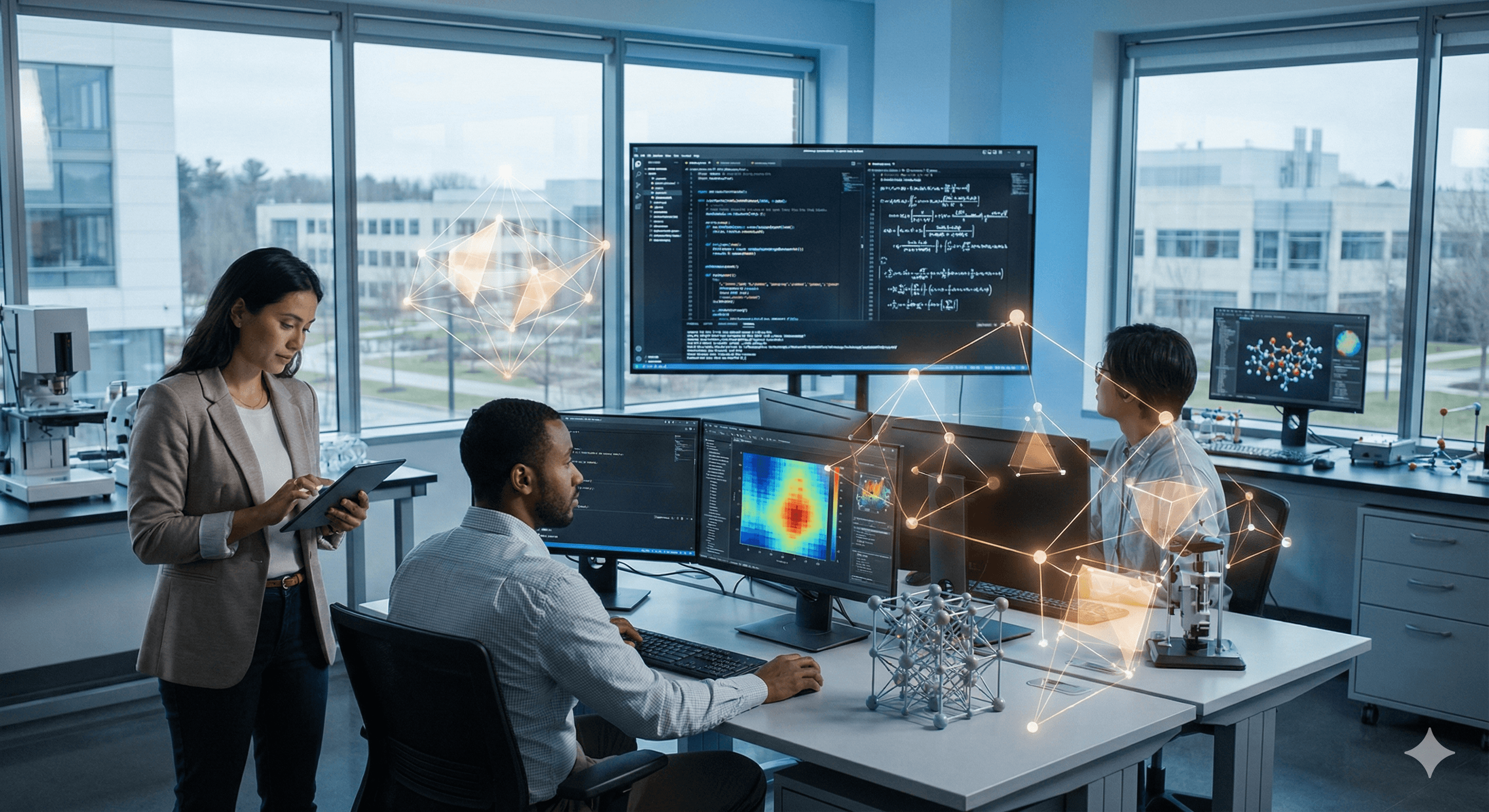
GPT-5.2 is OpenAI’s latest frontier model family designed for precision-critical work in science and mathematics. It strengthens formal reasoning, supports step-by-step solutions with Python/Advanced Data Analysis (ADA), and handles larger inputs—ideal for research workflows, modelling, and technical documentation.
Why it matters for researchers now
Modern labs and analytics teams juggle long PDFs, datasets, and equations. GPT-5.2 improves reasoning and tooling for this reality: it can walk through complex maths, run controlled Python code via ADA, and maintain fidelity across long contexts—reducing rework and speeding up iteration cycles.
What’s new for science & maths
Stronger mathematical performance: On FrontierMath (expert-level maths), GPT-5.2 Thinking set a new state of the art (40.3% solved).
Verified step-by-step workflows: Release notes highlight improvements in “walking through complex maths and logic step by step,” with clearer structure for proofs and derivations.
Chart & paper comprehension: Early coverage reports better chart interpretation in scientific papers, aiding literature review and replication.
Tool use (Python/ADA): Safely execute code for numerical experiments, data cleaning and plotting within ChatGPT’s ADA environment.
Governance transparency: The GPT-5.2 System Card documents evaluation areas and safety mitigations helpful for institutional review boards and data protection leads.
Where GPT-5.2 helps most
Modelling & simulation support: Prototype equations, generate baseline models, and validate assumptions with step-by-step reasoning, then test numerically via Python.
Data analysis & visualisation: Clean datasets, run statistics, and produce publication-ready plots faster inside ADA.
Literature synthesis: Summarise long papers, extract equations, and compare methods across dozens of PDFs in one pass (long-context support).
Proof assistance: Explore proof ideas in a narrow, well-specified setting—then verify claims with independent tooling and human review.
Chart understanding: Ask targeted questions of figures/tables in papers to accelerate review.
Important: For high-stakes outputs (e.g., lab protocols, regulatory submissions), keep a human-in-the-loop and document verification steps. The System Card provides context on limitations and safety posture.
Practical steps to implement in your workflow
Select a contained use case (e.g., “clean CSVs and produce regression plots” or “derive and check a transformation”). Define acceptance tests.
Set up ADA (Python) and tool policies—enable file uploads, specify permitted libraries/datasets, and restrict credentials.
Create a reproducible prompt template with structure: Objective → Inputs → Steps → Constraints → Output schema. (OpenAI’s prompting guide shows patterns that improve correctness and latency.)
Evaluate with a small harness: log prompts, expected answers, and numeric checks (e.g., unit tests for calculations). Track error modes.
Add retrieval for context (e.g., Glean for internal papers; Notion for lab notes) to ground long-context summaries and reduce hallucinations.
Governance & review: map your process to the GPT-5.2 System Card topics; record sign-off for externally shared results. Examples you can run this week
Parameter sweep prototype: Upload a dataset, ask GPT-5.2 to write a short Python function for grid search, produce a chart with labelled optima, and export a CSV of results.
Paper-to-plot replication: Paste a method section and a figure; have GPT-5.2 outline steps, implement code, then explain deviations from the reported result.
Proof sketching (with caution): In a narrow, well-specified setting, request a proof strategy and have the model generate a candidate proof, then verify with independent tools/experts.
Compatibility and integrations
GPT-5.2 is rolling out across paid ChatGPT plans and the API, with Instant/Thinking variants. Most teams pair it with ADA (Python) and, optionally, external computation like Wolfram for symbolic maths and curated facts.
FAQs
How does GPT-5.2 improve scientific research?
It delivers stronger mathematical reasoning, better chart/paper comprehension, and built-in Python/ADA to run numerical checks—accelerating analysis and replication while keeping humans in the loop. OpenAI+2SiliconANGLE+2
What makes GPT-5.2 suitable for maths?
State-of-the-art results on expert-level benchmarks (e.g., FrontierMath), structured step-by-step solutions, and tool integrations for verification. OpenAI+1
Can GPT-5.2 automate research tasks?
Yes—for scoped tasks like cleaning data, plotting, parameter sweeps, and literature triage. Maintain review gates for anything safety-critical. MIT Sloan Teaching Technologies
Does it support long documents and datasets?
Yes—release notes call out better long-document handling and Q&A on uploaded files, which helps with multi-paper reviews and larger CSVs. OpenAI Help Center
How does governance work?
Use the GPT-5.2 System Card as a reference for mitigations and evaluations; combine with your institution’s data and ethics policies. OpenAI
GPT-5.2 is OpenAI’s latest frontier model family designed for precision-critical work in science and mathematics. It strengthens formal reasoning, supports step-by-step solutions with Python/Advanced Data Analysis (ADA), and handles larger inputs—ideal for research workflows, modelling, and technical documentation.
Why it matters for researchers now
Modern labs and analytics teams juggle long PDFs, datasets, and equations. GPT-5.2 improves reasoning and tooling for this reality: it can walk through complex maths, run controlled Python code via ADA, and maintain fidelity across long contexts—reducing rework and speeding up iteration cycles.
What’s new for science & maths
Stronger mathematical performance: On FrontierMath (expert-level maths), GPT-5.2 Thinking set a new state of the art (40.3% solved).
Verified step-by-step workflows: Release notes highlight improvements in “walking through complex maths and logic step by step,” with clearer structure for proofs and derivations.
Chart & paper comprehension: Early coverage reports better chart interpretation in scientific papers, aiding literature review and replication.
Tool use (Python/ADA): Safely execute code for numerical experiments, data cleaning and plotting within ChatGPT’s ADA environment.
Governance transparency: The GPT-5.2 System Card documents evaluation areas and safety mitigations helpful for institutional review boards and data protection leads.
Where GPT-5.2 helps most
Modelling & simulation support: Prototype equations, generate baseline models, and validate assumptions with step-by-step reasoning, then test numerically via Python.
Data analysis & visualisation: Clean datasets, run statistics, and produce publication-ready plots faster inside ADA.
Literature synthesis: Summarise long papers, extract equations, and compare methods across dozens of PDFs in one pass (long-context support).
Proof assistance: Explore proof ideas in a narrow, well-specified setting—then verify claims with independent tooling and human review.
Chart understanding: Ask targeted questions of figures/tables in papers to accelerate review.
Important: For high-stakes outputs (e.g., lab protocols, regulatory submissions), keep a human-in-the-loop and document verification steps. The System Card provides context on limitations and safety posture.
Practical steps to implement in your workflow
Select a contained use case (e.g., “clean CSVs and produce regression plots” or “derive and check a transformation”). Define acceptance tests.
Set up ADA (Python) and tool policies—enable file uploads, specify permitted libraries/datasets, and restrict credentials.
Create a reproducible prompt template with structure: Objective → Inputs → Steps → Constraints → Output schema. (OpenAI’s prompting guide shows patterns that improve correctness and latency.)
Evaluate with a small harness: log prompts, expected answers, and numeric checks (e.g., unit tests for calculations). Track error modes.
Add retrieval for context (e.g., Glean for internal papers; Notion for lab notes) to ground long-context summaries and reduce hallucinations.
Governance & review: map your process to the GPT-5.2 System Card topics; record sign-off for externally shared results. Examples you can run this week
Parameter sweep prototype: Upload a dataset, ask GPT-5.2 to write a short Python function for grid search, produce a chart with labelled optima, and export a CSV of results.
Paper-to-plot replication: Paste a method section and a figure; have GPT-5.2 outline steps, implement code, then explain deviations from the reported result.
Proof sketching (with caution): In a narrow, well-specified setting, request a proof strategy and have the model generate a candidate proof, then verify with independent tools/experts.
Compatibility and integrations
GPT-5.2 is rolling out across paid ChatGPT plans and the API, with Instant/Thinking variants. Most teams pair it with ADA (Python) and, optionally, external computation like Wolfram for symbolic maths and curated facts.
FAQs
How does GPT-5.2 improve scientific research?
It delivers stronger mathematical reasoning, better chart/paper comprehension, and built-in Python/ADA to run numerical checks—accelerating analysis and replication while keeping humans in the loop. OpenAI+2SiliconANGLE+2
What makes GPT-5.2 suitable for maths?
State-of-the-art results on expert-level benchmarks (e.g., FrontierMath), structured step-by-step solutions, and tool integrations for verification. OpenAI+1
Can GPT-5.2 automate research tasks?
Yes—for scoped tasks like cleaning data, plotting, parameter sweeps, and literature triage. Maintain review gates for anything safety-critical. MIT Sloan Teaching Technologies
Does it support long documents and datasets?
Yes—release notes call out better long-document handling and Q&A on uploaded files, which helps with multi-paper reviews and larger CSVs. OpenAI Help Center
How does governance work?
Use the GPT-5.2 System Card as a reference for mitigations and evaluations; combine with your institution’s data and ethics policies. OpenAI
Get practical advice delivered to your inbox
By subscribing you consent to Generation Digital storing and processing your details in line with our privacy policy. You can read the full policy at gend.co/privacy.


Notion vs Confluence (2026): features, pricing, migration

From AI silos to systems: Miro workflows that scale

Notion in healthcare: military-grade decision templates & governance

Claude Skills and CLAUDE.md: a practical 2026 guide for teams

Perplexity partners with Cristiano Ronaldo: what it means for AI search

Gemini 3 Deep Think: how it works and how to turn it on

Stop Repeating Yourself: AI Assistants that Remember Your Work

Stop the Hype, Start the Handbook: Making Enterprise AI Work (Securely) at Scale

Asana for Manufacturing: Build an Intelligent Operational Backbone

From Excitement to Assurance: Making Your AI Programme Compliant by Design

Notion vs Confluence (2026): features, pricing, migration

From AI silos to systems: Miro workflows that scale

Notion in healthcare: military-grade decision templates & governance

Claude Skills and CLAUDE.md: a practical 2026 guide for teams

Perplexity partners with Cristiano Ronaldo: what it means for AI search

Gemini 3 Deep Think: how it works and how to turn it on

Stop Repeating Yourself: AI Assistants that Remember Your Work

Stop the Hype, Start the Handbook: Making Enterprise AI Work (Securely) at Scale

Asana for Manufacturing: Build an Intelligent Operational Backbone

From Excitement to Assurance: Making Your AI Programme Compliant by Design
Generation
Digital

UK Office
33 Queen St,
London
EC4R 1AP
United Kingdom
Canada Office
1 University Ave,
Toronto,
ON M5J 1T1,
Canada
NAMER Office
77 Sands St,
Brooklyn,
NY 11201,
United States
EMEA Office
Charlemont St, Saint Kevin's, Dublin,
D02 VN88,
Ireland
Middle East Office
6994 Alsharq 3890,
An Narjis,
Riyadh 13343,
Saudi Arabia

Company No: 256 9431 77 | Copyright 2026 | Terms and Conditions | Privacy Policy
Generation
Digital

UK Office
33 Queen St,
London
EC4R 1AP
United Kingdom
Canada Office
1 University Ave,
Toronto,
ON M5J 1T1,
Canada
NAMER Office
77 Sands St,
Brooklyn,
NY 11201,
United States
EMEA Office
Charlemont St, Saint Kevin's, Dublin,
D02 VN88,
Ireland
Middle East Office
6994 Alsharq 3890,
An Narjis,
Riyadh 13343,
Saudi Arabia








