Enhance Learning with Gemini’s Interactive Images

Enhance Learning with Gemini’s Interactive Images

Google

Gemini

Nov 20, 2025

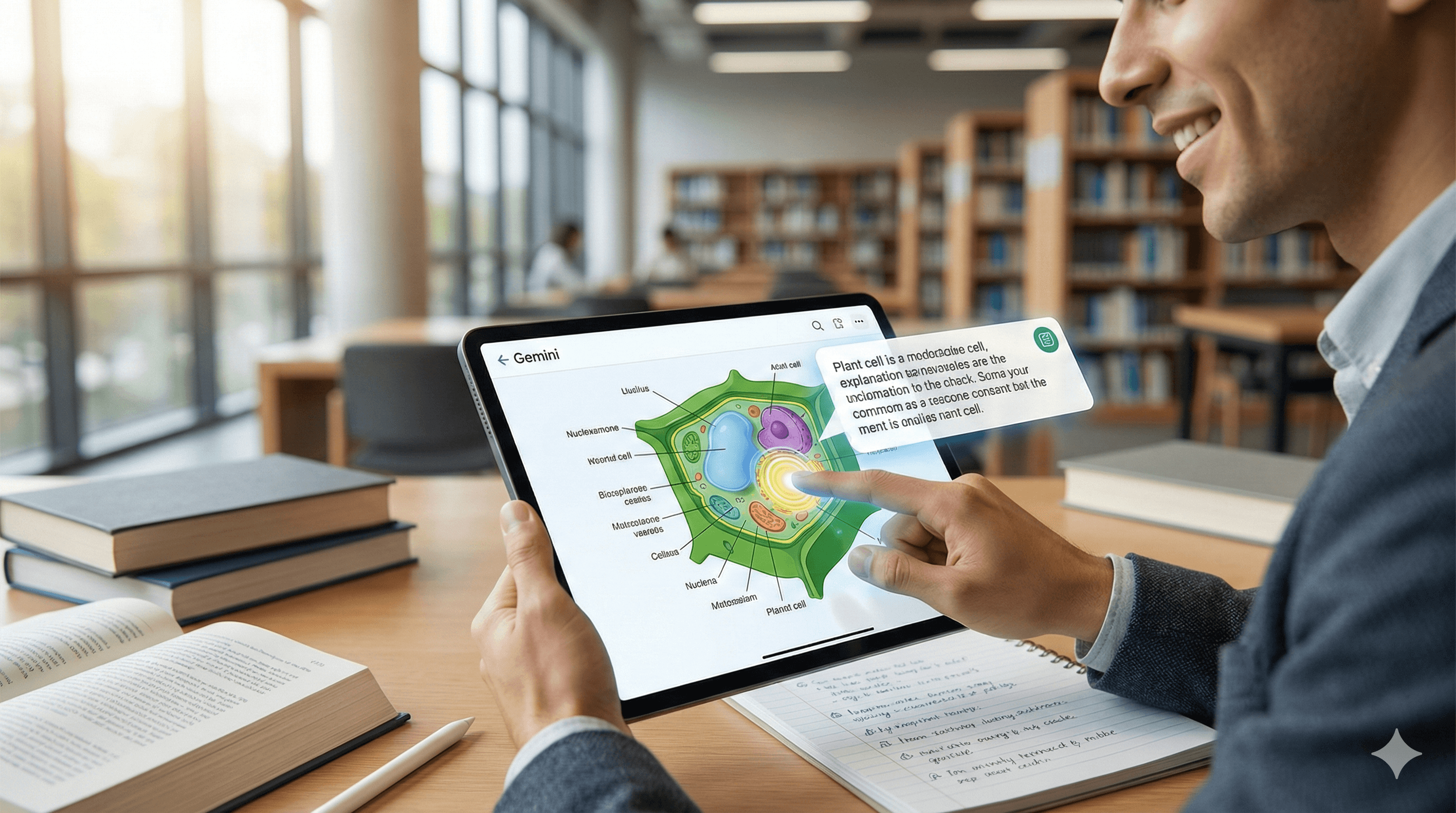
A person in a library interacts with an iPad displaying a Gemini app featuring colorful interactive images, while taking notes on paper beside stacked books.

What are Gemini’s interactive images?
A new Gemini app capability that turns static diagrams into explorable visuals. Learners can tap labelled parts to reveal explanations, applying learning-science principles from LearnLM to deepen understanding and retention. Available as the feature rolls out across Gemini experiences.

Learning works best when you actively engage with ideas. Gemini now helps you do exactly that with interactive images—diagrams and visuals you can explore, not just look at. Instead of reading a wall of text, you tap a label, reveal an explanation, and build understanding step by step.

Why it matters

  • From passive to active learning. LearnLM—the research-driven approach behind Gemini’s learning features—focuses on questioning, feedback, and multisensory cues that improve comprehension and recall. Interactive images bring those principles to everyday study.

  • Clarity for complex topics. Visual explanations shorten the path from “I don’t get it” to “I see how this works,” whether you’re studying biology, circuits, or timelines.

  • Built into Gemini. You don’t need extra software; the capability is rolling out within the Gemini app with supporting “visual layout” modules that present richer, more interactive responses.

How it works

When you ask Gemini for a diagram (e.g., “Explain a plant cell with a labelled diagram”), Gemini can return an interactive image. Each hotspot/label can be tapped to expand a definition, example, or relationship, helping you build a mental model. This sits alongside other learning tools in Gemini (e.g., adding images to explanations, guided steps).

Practical examples

  • Biology: Tap each organelle in a plant or animal cell to see function, analogies, and common misconceptions.

  • Physics: Explore a circuit diagram; select components to learn what changes if resistance or voltage varies.

  • History: Interact with a timeline image; tap events for causes, consequences, and key figures.

  • Geography: Click layers on a tectonic plate diagram to reveal boundaries, hazards, and case studies.

Quick start: prompts to try

  1. “Create an interactive image of a plant cell with tappable labels and brief explanations.”

  2. “Show a timeline of the Industrial Revolution as an interactive image; let me tap to see causes and effects.”

  3. “Make an interactive circuit diagram and explain what happens if I double the voltage.”

  4. “Generate a map-based interactive image of plate boundaries with examples.”

Tip: If you don’t see interactivity yet, ask Gemini to “use visual layout” for a richer, modular response while the feature finishes rolling out.

Best practices for learners & teachers

  • Chunk content. Keep each hotspot focused on one concept; add examples and a misconception note to strengthen recall (LearnLM guidance).

  • Test understanding. After exploring an image, ask: “Quiz me on the parts I tapped,” or “Create flashcards from this diagram.”

  • Pair with notes. Export summaries to your notes/wiki so study materials stay searchable and shareable across your class or team.

  • Check sources. For factual topics, ask Gemini to cite sources or add links for further reading.

Where it shows up

  • Gemini app (web and mobile) as the feature roll-out progresses.

  • Complementary learning features appear in Gemini for Education (institutional context) and in support articles describing learning with images in Gemini Apps.

FAQs

Q1: How do interactive images enhance learning?
They turn diagrams into explorable lessons. Tapping labels triggers concise explanations that follow learning-science principles (chunking, retrieval cues), improving comprehension and retention.

Q2: What makes Gemini’s approach unique?
Gemini ties interactivity to LearnLM—Google’s research-informed models for education—so visuals, prompts, and feedback are designed to promote active learning rather than passive reading.

Q3: Can interactive images be used in all subjects?
Yes. Google’s examples span science, history, and more, and the visual layout capability supports modular, image-rich explanations across topics.

Q4: How do I try it today?
Use the Gemini app and prompt for an interactive image (e.g., “labelled diagram with tappable parts”). If interactivity hasn’t reached you yet, ask for visual layout or request a labelled diagram plus follow-up questions.

What are Gemini’s interactive images?
A new Gemini app capability that turns static diagrams into explorable visuals. Learners can tap labelled parts to reveal explanations, applying learning-science principles from LearnLM to deepen understanding and retention. Available as the feature rolls out across Gemini experiences.

Learning works best when you actively engage with ideas. Gemini now helps you do exactly that with interactive images—diagrams and visuals you can explore, not just look at. Instead of reading a wall of text, you tap a label, reveal an explanation, and build understanding step by step.

Why it matters

  • From passive to active learning. LearnLM—the research-driven approach behind Gemini’s learning features—focuses on questioning, feedback, and multisensory cues that improve comprehension and recall. Interactive images bring those principles to everyday study.

  • Clarity for complex topics. Visual explanations shorten the path from “I don’t get it” to “I see how this works,” whether you’re studying biology, circuits, or timelines.

  • Built into Gemini. You don’t need extra software; the capability is rolling out within the Gemini app with supporting “visual layout” modules that present richer, more interactive responses.

How it works

When you ask Gemini for a diagram (e.g., “Explain a plant cell with a labelled diagram”), Gemini can return an interactive image. Each hotspot/label can be tapped to expand a definition, example, or relationship, helping you build a mental model. This sits alongside other learning tools in Gemini (e.g., adding images to explanations, guided steps).

Practical examples

  • Biology: Tap each organelle in a plant or animal cell to see function, analogies, and common misconceptions.

  • Physics: Explore a circuit diagram; select components to learn what changes if resistance or voltage varies.

  • History: Interact with a timeline image; tap events for causes, consequences, and key figures.

  • Geography: Click layers on a tectonic plate diagram to reveal boundaries, hazards, and case studies.

Quick start: prompts to try

  1. “Create an interactive image of a plant cell with tappable labels and brief explanations.”

  2. “Show a timeline of the Industrial Revolution as an interactive image; let me tap to see causes and effects.”

  3. “Make an interactive circuit diagram and explain what happens if I double the voltage.”

  4. “Generate a map-based interactive image of plate boundaries with examples.”

Tip: If you don’t see interactivity yet, ask Gemini to “use visual layout” for a richer, modular response while the feature finishes rolling out.

Best practices for learners & teachers

  • Chunk content. Keep each hotspot focused on one concept; add examples and a misconception note to strengthen recall (LearnLM guidance).

  • Test understanding. After exploring an image, ask: “Quiz me on the parts I tapped,” or “Create flashcards from this diagram.”

  • Pair with notes. Export summaries to your notes/wiki so study materials stay searchable and shareable across your class or team.

  • Check sources. For factual topics, ask Gemini to cite sources or add links for further reading.

Where it shows up

  • Gemini app (web and mobile) as the feature roll-out progresses.

  • Complementary learning features appear in Gemini for Education (institutional context) and in support articles describing learning with images in Gemini Apps.

FAQs

Q1: How do interactive images enhance learning?
They turn diagrams into explorable lessons. Tapping labels triggers concise explanations that follow learning-science principles (chunking, retrieval cues), improving comprehension and retention.

Q2: What makes Gemini’s approach unique?
Gemini ties interactivity to LearnLM—Google’s research-informed models for education—so visuals, prompts, and feedback are designed to promote active learning rather than passive reading.

Q3: Can interactive images be used in all subjects?
Yes. Google’s examples span science, history, and more, and the visual layout capability supports modular, image-rich explanations across topics.

Q4: How do I try it today?
Use the Gemini app and prompt for an interactive image (e.g., “labelled diagram with tappable parts”). If interactivity hasn’t reached you yet, ask for visual layout or request a labelled diagram plus follow-up questions.

Get practical advice delivered to your inbox

By subscribing you consent to Generation Digital storing and processing your details in line with our privacy policy. You can read the full policy at gend.co/privacy.


Ready to get the support your organisation needs to successfully use AI?

Miro Solutions Partner
Asana Platinum Solutions Partner
Notion Platinum Solutions Partner
Glean Certified Partner

Ready to get the support your organisation needs to successfully use AI?

Miro Solutions Partner
Asana Platinum Solutions Partner
Notion Platinum Solutions Partner
Glean Certified Partner

Generation
Digital

UK Office
33 Queen St,
London
EC4R 1AP
United Kingdom

Canada Office
1 University Ave,
Toronto,
ON M5J 1T1,
Canada

NAMER Office
77 Sands St,
Brooklyn,
NY 11201,
United States

EMEA Office
Charlemont St, Saint Kevin's, Dublin,
D02 VN88,
Ireland

Middle East Office
6994 Alsharq 3890,
An Narjis,
Riyadh 13343,
Saudi Arabia

UK Fast Growth Index UBS Logo
Financial Times FT 1000 Logo
Febe Growth 100 Logo (Background Removed)

Company No: 256 9431 77 | Copyright 2026 | Terms and Conditions | Privacy Policy

Generation
Digital

UK Office
33 Queen St,
London
EC4R 1AP
United Kingdom

Canada Office
1 University Ave,
Toronto,
ON M5J 1T1,
Canada

NAMER Office
77 Sands St,
Brooklyn,
NY 11201,
United States

EMEA Office
Charlemont St, Saint Kevin's, Dublin,
D02 VN88,
Ireland

Middle East Office
6994 Alsharq 3890,
An Narjis,
Riyadh 13343,
Saudi Arabia

UK Fast Growth Index UBS Logo
Financial Times FT 1000 Logo
Febe Growth 100 Logo (Background Removed)


Company No: 256 9431 77
Terms and Conditions
Privacy Policy
Copyright 2026