GPT‑5.2 Gluon Amplitude Breakthrough: What Changed

GPT‑5.2 Gluon Amplitude Breakthrough: What Changed

OpenAI
Feb 13, 2026

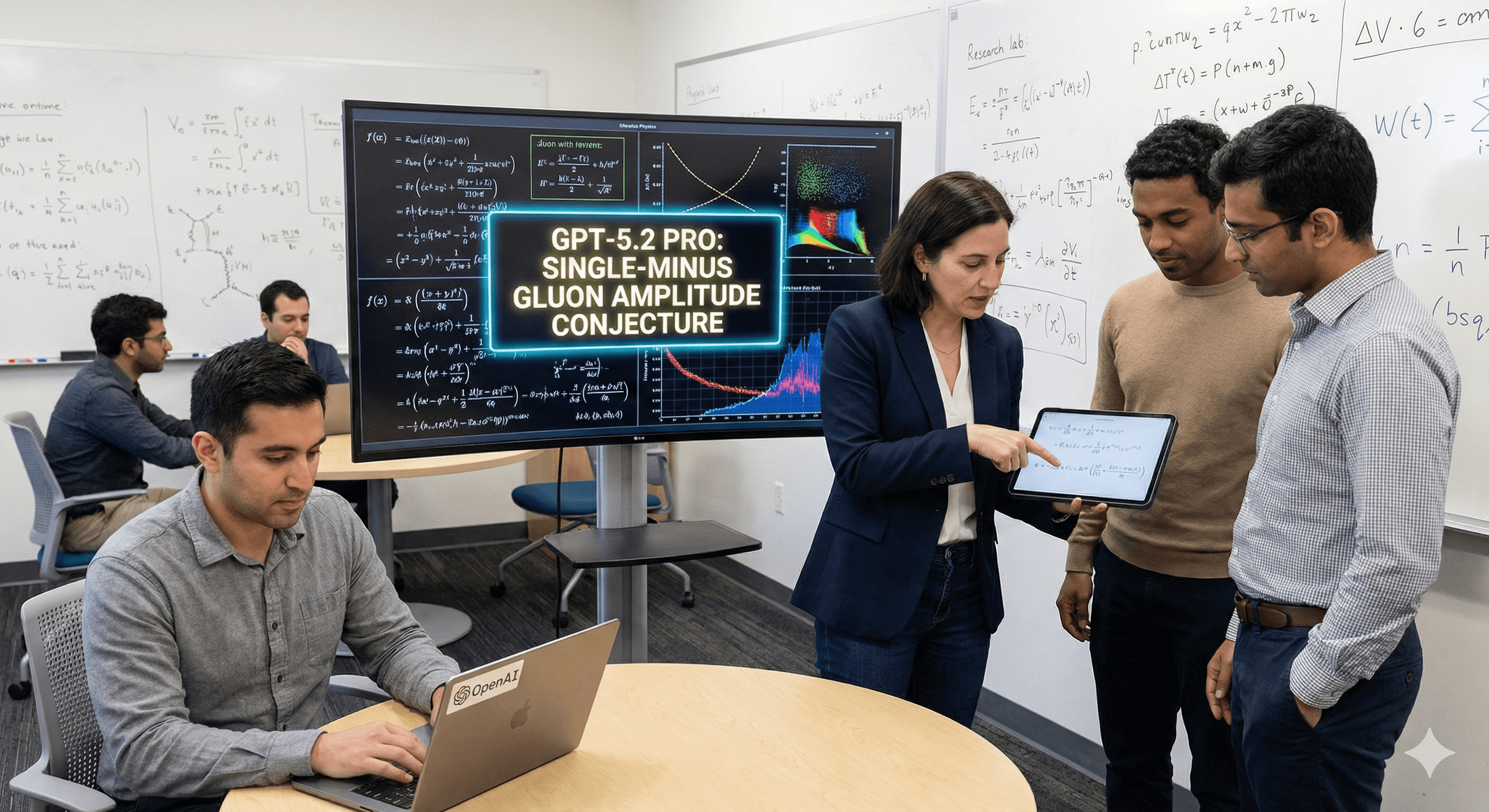
In a modern classroom, five researchers collaborate on a breakthrough project, with one person presenting a screen displaying complex equations related to the "GPT‑5.2 Gluon Amplitude Conjecture."

Not sure where to start with AI?
Assess readiness, risk, and priorities in under an hour.

Not sure where to start with AI?
Assess readiness, risk, and priorities in under an hour.

➔ Download Our Free AI Readiness Pack

A February 2026 preprint reports that GPT‑5.2 Pro proposed a compact formula for a single-minus gluon tree amplitude—an interaction often assumed to vanish at tree level. The authors then proved the expression formally and verified it against standard amplitude checks. The result highlights how AI can suggest new structure in theoretical physics when paired with rigorous validation.

AI is no longer just helping scientists write code, summarise papers, or speed up routine analysis. In at least one recent case, it helped propose a new candidate expression for a result in theoretical physics—then stood up to formal proof.

In February 2026, an OpenAI-linked collaboration released a preprint titled “Single-minus gluon tree amplitudes are nonzero”. The headline claim is straightforward: a class of gluon scattering amplitudes that many physicists expected to be zero at tree level can, under precisely defined conditions, be nonzero.

More interesting than the headline is the process: the paper reports that GPT‑5.2 Pro first conjectured the compact form of the final expression, after the authors had derived complicated low-point cases by hand.

This article explains what that means, why the result depends on a special regime, and how R&D teams can think about AI-assisted discovery without mistaking hype for science.

The background (in plain English): what’s a gluon amplitude?

In particle physics, a scattering amplitude is the quantity used to compute the probability that particles interact in a particular way. For gluons—the carriers of the strong nuclear force—tree-level amplitudes (the simplest calculations, with no quantum loops) often show unexpected simplicity.

Physicists classify gluon interactions by helicity, a spin-like property for massless particles. In many standard textbook arguments, the “single-minus” configuration—one gluon with negative helicity and the rest positive—is treated as vanishing at tree level.

The new preprint challenges that blanket conclusion.

What’s new: the half-collinear regime

The authors argue that the standard “it must be zero” reasoning relies on generic momenta (no special alignment of directions and energies). They identify a specific slice of momentum space—described as the half-collinear regime—where those assumptions no longer apply.

In that regime:

  • the amplitude does not vanish, and

  • the authors compute it in a special kinematic limit.

This doesn’t mean prior results were “wrong” in their intended domain. It means the usual argument is too strong when you move to a mathematically well-defined, non-generic alignment.

Where GPT‑5.2 comes in (and what was actually verified)

According to the OpenAI write-up accompanying the preprint, the human authors computed explicit results for low particle counts (up to six gluons) but obtained expressions that grow in complexity very quickly.

GPT‑5.2 Pro was then used to:

  1. simplify those low-point expressions into cleaner forms, and

  2. propose a compact general expression for the amplitude (reported in the preprint as the final formula).

The paper then reports two layers of validation:

  • a formal proof produced by an internal scaffolded version of GPT‑5.2 after extended reasoning, and

  • analytical checks against standard tools used in amplitude physics (including recursion relations and soft limits).

That combination—AI conjecture + formal proof + physics cross-checks—is the key point. Without the proof and verification, this would just be an interesting-looking pattern.

Why this matters (even if you’re not an amplitudes specialist)

There are two reasons this is worth paying attention to.

1) Scientific: it reopens a “set aside” configuration

A whole class of interactions had been treated as absent in typical tree-level discussions. Showing a nonzero amplitude in a precisely defined regime invites new questions—both technical (extensions, generalisations) and conceptual (what structure is hiding in the boundary cases of familiar arguments?).

2) Operational: it’s a case study in how AI can contribute

The outcome isn’t just “AI found a formula”. The more important lesson is methodological:

  • humans did the careful setup and computed explicit small cases,

  • the model spotted compressible structure,

  • the result was proven and checked using established physics techniques.

This is what “AI for science” looks like when it’s done responsibly: conjecture generation plus rigorous verification.

Practical takeaway: how to evaluate AI-for-science breakthroughs

If you’re leading R&D or innovation, you’ll see more claims like this. Here’s a simple checklist to separate real progress from clever-sounding output.

1) Is the claim anchored to a preprint and methods?

Look for an arXiv submission (or equivalent) and enough detail to reproduce the result.

2) Does it specify where the result holds?

Real physics results are conditional. Here, the key detail is the specific kinematic slice where usual assumptions fail.

3) Is there a proof (or at least independent verification)?

A neat expression isn’t the same as a result. A robust pipeline includes proof, independent checks, and known consistency tests.

4) Can domain experts explain the novelty without hand-waving?

You should be able to restate the “what changed” in one paragraph—without marketing language.

5) Is the AI’s role transparent?

Good collaborations document what the model did (suggestion, simplification, conjecture) and what humans verified.

What could come next

The preprint itself points towards natural extensions—especially whether analogous nonzero amplitudes appear in related theories (for example, gravitational analogues), and how broad the special regime can be made.

For organisations watching AI-for-science, the strategic implication is clear: the most valuable use of frontier models may be as pattern-finders and conjecture engines inside controlled research workflows.

Where Generation Digital helps

If you’re exploring AI for research, innovation, or knowledge work, the technology is only half the story. The hard part is building a workflow that is:

  • verifiable

  • auditable

  • safe to deploy

  • valuable to the teams using it

Generation Digital helps organisations design AI operating models that balance speed with governance—so you can adopt frontier tools without losing control.

Summary

A February 2026 preprint reports a nonzero result for a single-minus gluon tree amplitude in a precisely defined half-collinear regime, with GPT‑5.2 Pro credited for conjecturing the compact final expression later proved and verified.

Whether or not you work in amplitudes, it’s a useful template for what credible AI-assisted discovery can look like: AI suggests; experts prove; the community reviews.

Next steps

  1. If you’re building AI capability across the business, start with governance: /blog/ai-governance-evolving-board-strategies

  2. If you’re scaling AI with security and control, read: /blog/enterprise-ai-governance-security

  3. To talk about AI strategy, operating models, and responsible deployment: Contact Generation Digital.

FAQs

Question: What did GPT‑5.2 actually do in the gluon amplitude work?
Answer: The preprint reports that GPT‑5.2 Pro proposed a compact general expression after simplifying complicated low-point results derived by the authors. The expression was then proved and verified using standard amplitude checks.

Question: What is the half-collinear regime?
Answer: It’s a precisely defined slice of momentum space where particle momenta satisfy a special alignment condition. In this regime, the assumptions behind the usual “single-minus tree amplitude is zero” argument no longer hold.

Question: Does this mean textbooks are wrong?
Answer: Not necessarily. The standard result applies under the usual generic assumptions. The new claim is that the conclusion is too strong when you move to a non-generic but well-defined kinematic regime.

Question: Why is formal proof important for AI-generated physics claims?
Answer: Because pattern-matching can produce plausible expressions that fail in edge cases. Proof and independent checks are what turn a conjecture into a reliable result.

Question: Can AI contribute to other scientific fields?
Answer: Yes—particularly in proposing hypotheses, finding compressible structure in complex outputs, and accelerating analysis. The strongest results come when AI is embedded in workflows with rigorous verification.

A February 2026 preprint reports that GPT‑5.2 Pro proposed a compact formula for a single-minus gluon tree amplitude—an interaction often assumed to vanish at tree level. The authors then proved the expression formally and verified it against standard amplitude checks. The result highlights how AI can suggest new structure in theoretical physics when paired with rigorous validation.

AI is no longer just helping scientists write code, summarise papers, or speed up routine analysis. In at least one recent case, it helped propose a new candidate expression for a result in theoretical physics—then stood up to formal proof.

In February 2026, an OpenAI-linked collaboration released a preprint titled “Single-minus gluon tree amplitudes are nonzero”. The headline claim is straightforward: a class of gluon scattering amplitudes that many physicists expected to be zero at tree level can, under precisely defined conditions, be nonzero.

More interesting than the headline is the process: the paper reports that GPT‑5.2 Pro first conjectured the compact form of the final expression, after the authors had derived complicated low-point cases by hand.

This article explains what that means, why the result depends on a special regime, and how R&D teams can think about AI-assisted discovery without mistaking hype for science.

The background (in plain English): what’s a gluon amplitude?

In particle physics, a scattering amplitude is the quantity used to compute the probability that particles interact in a particular way. For gluons—the carriers of the strong nuclear force—tree-level amplitudes (the simplest calculations, with no quantum loops) often show unexpected simplicity.

Physicists classify gluon interactions by helicity, a spin-like property for massless particles. In many standard textbook arguments, the “single-minus” configuration—one gluon with negative helicity and the rest positive—is treated as vanishing at tree level.

The new preprint challenges that blanket conclusion.

What’s new: the half-collinear regime

The authors argue that the standard “it must be zero” reasoning relies on generic momenta (no special alignment of directions and energies). They identify a specific slice of momentum space—described as the half-collinear regime—where those assumptions no longer apply.

In that regime:

  • the amplitude does not vanish, and

  • the authors compute it in a special kinematic limit.

This doesn’t mean prior results were “wrong” in their intended domain. It means the usual argument is too strong when you move to a mathematically well-defined, non-generic alignment.

Where GPT‑5.2 comes in (and what was actually verified)

According to the OpenAI write-up accompanying the preprint, the human authors computed explicit results for low particle counts (up to six gluons) but obtained expressions that grow in complexity very quickly.

GPT‑5.2 Pro was then used to:

  1. simplify those low-point expressions into cleaner forms, and

  2. propose a compact general expression for the amplitude (reported in the preprint as the final formula).

The paper then reports two layers of validation:

  • a formal proof produced by an internal scaffolded version of GPT‑5.2 after extended reasoning, and

  • analytical checks against standard tools used in amplitude physics (including recursion relations and soft limits).

That combination—AI conjecture + formal proof + physics cross-checks—is the key point. Without the proof and verification, this would just be an interesting-looking pattern.

Why this matters (even if you’re not an amplitudes specialist)

There are two reasons this is worth paying attention to.

1) Scientific: it reopens a “set aside” configuration

A whole class of interactions had been treated as absent in typical tree-level discussions. Showing a nonzero amplitude in a precisely defined regime invites new questions—both technical (extensions, generalisations) and conceptual (what structure is hiding in the boundary cases of familiar arguments?).

2) Operational: it’s a case study in how AI can contribute

The outcome isn’t just “AI found a formula”. The more important lesson is methodological:

  • humans did the careful setup and computed explicit small cases,

  • the model spotted compressible structure,

  • the result was proven and checked using established physics techniques.

This is what “AI for science” looks like when it’s done responsibly: conjecture generation plus rigorous verification.

Practical takeaway: how to evaluate AI-for-science breakthroughs

If you’re leading R&D or innovation, you’ll see more claims like this. Here’s a simple checklist to separate real progress from clever-sounding output.

1) Is the claim anchored to a preprint and methods?

Look for an arXiv submission (or equivalent) and enough detail to reproduce the result.

2) Does it specify where the result holds?

Real physics results are conditional. Here, the key detail is the specific kinematic slice where usual assumptions fail.

3) Is there a proof (or at least independent verification)?

A neat expression isn’t the same as a result. A robust pipeline includes proof, independent checks, and known consistency tests.

4) Can domain experts explain the novelty without hand-waving?

You should be able to restate the “what changed” in one paragraph—without marketing language.

5) Is the AI’s role transparent?

Good collaborations document what the model did (suggestion, simplification, conjecture) and what humans verified.

What could come next

The preprint itself points towards natural extensions—especially whether analogous nonzero amplitudes appear in related theories (for example, gravitational analogues), and how broad the special regime can be made.

For organisations watching AI-for-science, the strategic implication is clear: the most valuable use of frontier models may be as pattern-finders and conjecture engines inside controlled research workflows.

Where Generation Digital helps

If you’re exploring AI for research, innovation, or knowledge work, the technology is only half the story. The hard part is building a workflow that is:

  • verifiable

  • auditable

  • safe to deploy

  • valuable to the teams using it

Generation Digital helps organisations design AI operating models that balance speed with governance—so you can adopt frontier tools without losing control.

Summary

A February 2026 preprint reports a nonzero result for a single-minus gluon tree amplitude in a precisely defined half-collinear regime, with GPT‑5.2 Pro credited for conjecturing the compact final expression later proved and verified.

Whether or not you work in amplitudes, it’s a useful template for what credible AI-assisted discovery can look like: AI suggests; experts prove; the community reviews.

Next steps

  1. If you’re building AI capability across the business, start with governance: /blog/ai-governance-evolving-board-strategies

  2. If you’re scaling AI with security and control, read: /blog/enterprise-ai-governance-security

  3. To talk about AI strategy, operating models, and responsible deployment: Contact Generation Digital.

FAQs

Question: What did GPT‑5.2 actually do in the gluon amplitude work?
Answer: The preprint reports that GPT‑5.2 Pro proposed a compact general expression after simplifying complicated low-point results derived by the authors. The expression was then proved and verified using standard amplitude checks.

Question: What is the half-collinear regime?
Answer: It’s a precisely defined slice of momentum space where particle momenta satisfy a special alignment condition. In this regime, the assumptions behind the usual “single-minus tree amplitude is zero” argument no longer hold.

Question: Does this mean textbooks are wrong?
Answer: Not necessarily. The standard result applies under the usual generic assumptions. The new claim is that the conclusion is too strong when you move to a non-generic but well-defined kinematic regime.

Question: Why is formal proof important for AI-generated physics claims?
Answer: Because pattern-matching can produce plausible expressions that fail in edge cases. Proof and independent checks are what turn a conjecture into a reliable result.

Question: Can AI contribute to other scientific fields?
Answer: Yes—particularly in proposing hypotheses, finding compressible structure in complex outputs, and accelerating analysis. The strongest results come when AI is embedded in workflows with rigorous verification.

Get weekly AI news and advice delivered to your inbox

By subscribing you consent to Generation Digital storing and processing your details in line with our privacy policy. You can read the full policy at gend.co/privacy.


Upcoming Workshops and Webinars

A diverse group of professionals collaborating around a table in a bright, modern office setting.

Operational Clarity at Scale - Asana

Virtual Webinar
Weds 25th February 2026
Online

A diverse group of professionals collaborating around a table in a bright, modern office setting.

Work With AI Teammates - Asana

In-Person Workshop
Thurs 26th February 2026
London, UK

A diverse group of professionals collaborating around a table in a bright, modern office setting.

From Idea to Prototype - AI in Miro

Virtual Webinar
Weds 18th February 2026
Online

Generation
Digital

UK Office

Generation Digital Ltd
33 Queen St,
London
EC4R 1AP
United Kingdom

Canada Office

Generation Digital Americas Inc
181 Bay St., Suite 1800
Toronto, ON, M5J 2T9
Canada

USA Office

Generation Digital Americas Inc
77 Sands St,
Brooklyn, NY 11201,
United States

EU Office

Generation Digital Software
Elgee Building
Dundalk
A91 X2R3
Ireland

Middle East Office

6994 Alsharq 3890,
An Narjis,
Riyadh 13343,
Saudi Arabia

UK Fast Growth Index UBS Logo
Financial Times FT 1000 Logo
Febe Growth 100 Logo (Background Removed)

Company No: 256 9431 77 | Copyright 2026 | Terms and Conditions | Privacy Policy

Generation
Digital

UK Office

Generation Digital Ltd
33 Queen St,
London
EC4R 1AP
United Kingdom

Canada Office

Generation Digital Americas Inc
181 Bay St., Suite 1800
Toronto, ON, M5J 2T9
Canada

USA Office

Generation Digital Americas Inc
77 Sands St,
Brooklyn, NY 11201,
United States

EU Office

Generation Digital Software
Elgee Building
Dundalk
A91 X2R3
Ireland

Middle East Office

6994 Alsharq 3890,
An Narjis,
Riyadh 13343,
Saudi Arabia

UK Fast Growth Index UBS Logo
Financial Times FT 1000 Logo
Febe Growth 100 Logo (Background Removed)


Company No: 256 9431 77
Terms and Conditions
Privacy Policy
Copyright 2026





