Horizon 1000: AI for Primary Care in Africa (2026)
OpenAI
Free AI at Work Playbook for managers using ChatGPT, Claude and Gemini.
➔ Download the Playbook
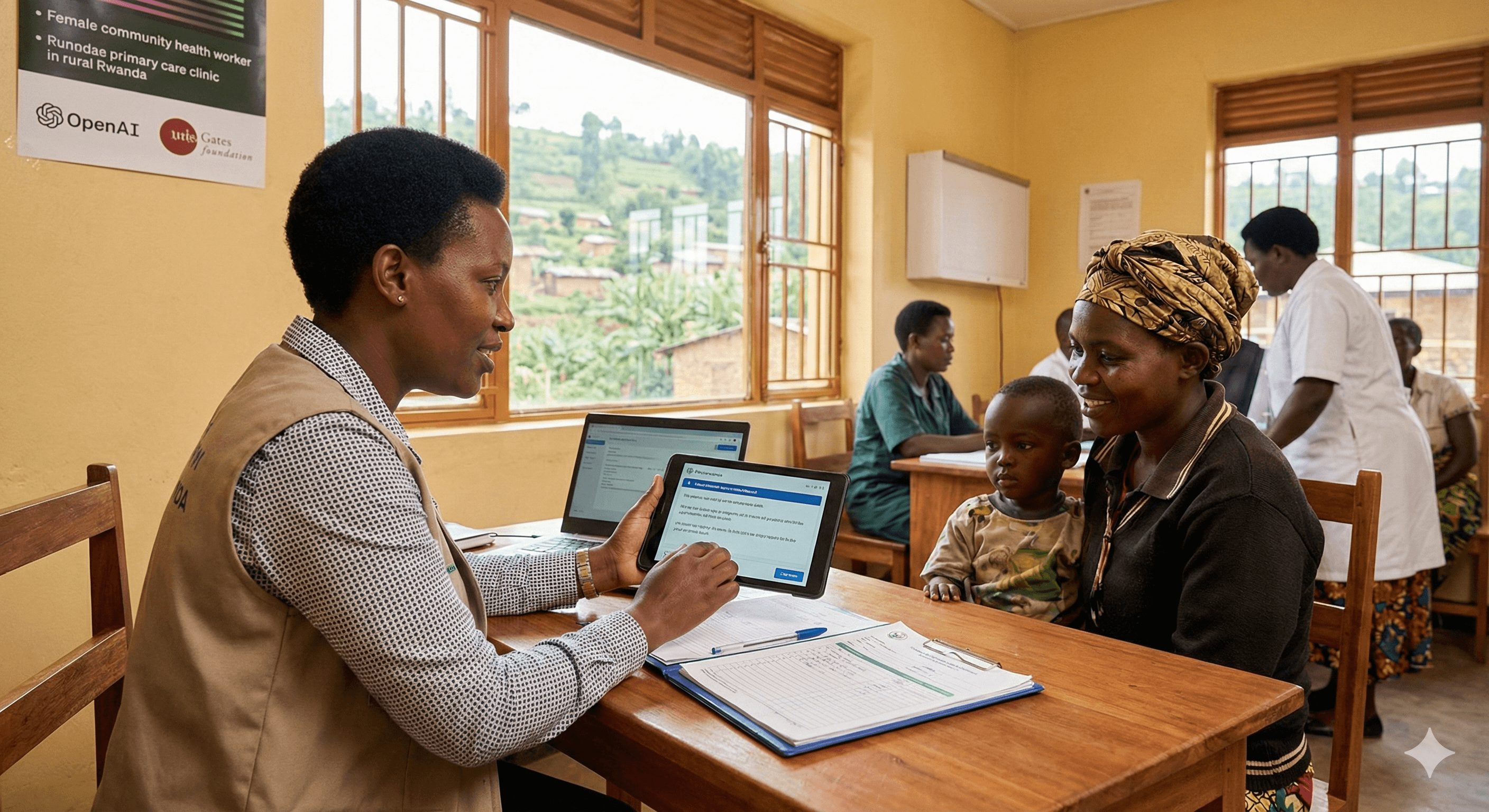
Horizon 1000 is a $50M OpenAI–Gates Foundation pilot to bring safe AI tools to primary care in Africa. Starting in Rwanda, the programme supports health workers with triage, documentation and follow‑up—aiming to reach 1,000 clinics by 2028 while prioritising training, local languages and rigorous governance.
What’s New & How It Works
From prototypes to practice. Horizon 1000 bundles funding, technology and technical support so local health systems can deploy AI where it helps most—triage, documentation, referral, and follow‑up—while keeping humans in the loop.
Start in Rwanda, scale to 1,000 clinics. Early deployments focus on frontline clinics and surrounding communities, with a 2028 target of 1,000 sites across multiple countries.
Assistive, not replacing. Tools help health workers make faster, better‑informed decisions; they do not take over clinical judgement.
Safety & trust by design. Local data governance, bias testing, version pinning, and continuous evaluation underpin each rollout. Language access (e.g., Kinyarwanda) is a priority.
Practical Rollout (Step‑by‑Step)
Define use cases with clinicians
Prioritise triage prompts, symptom summaries, stock/outreach lists, and referral support. Document exclusions (what the AI must not do).Prepare data & integration
Map clinic workflows; connect EHR/registers where available; set retention and consent policies; verify offline/low‑bandwidth modes.Train the workforce
Short modules for nurses, CHWs and supervisors; job‑aids; escalation rules; weekly case reviews.Governance & safety
Establish an ethics board; run bias/safety tests; pin model versions; enable incident reporting; publish model cards and guidance for use.Measure outcomes
KPIs: time‑to‑triage, documentation time, appropriate referral rate, continuity of care, stock‑out days, patient satisfaction, and equity indicators (gender, language, rural/urban).Scale responsibly
Stage‑gate expansion by clinic cohort; add languages; share open protocols and playbooks with partner countries.
Illustrative Use Cases
Triage & advice: Summarise symptoms, highlight risk signs, and generate a structured hand‑off to clinicians.
Clinical notes: Draft visit summaries and referrals; reduce admin time.
Continuity of care: Create follow‑up lists (e.g., immunisations, ANC, NCD check‑ups).
Community health: Support CHWs with on‑device guidance and data capture in local languages.
Risks & Mitigations
Bias & safety: Run local validation sets; include women’s health and minority languages; provide human oversight.
Privacy: Limit PII; apply data minimisation; comply with national policies; enable zero‑retention where possible.
Over‑reliance: Require explicit clinician sign‑off for diagnoses/medication; display limitations clearly.
Connectivity: Design for offline/low‑bandwidth; sync when available; maintain paper backups during outages.
FAQs
What is Horizon 1000?
A $50M pilot by OpenAI and the Gates Foundation to deploy assistive AI tools in African primary care, starting in Rwanda, with a goal of 1,000 clinics by 2028.
Who benefits?
Frontline health workers and patients in under‑resourced clinics and surrounding communities.
What will the AI do?
Assist with triage, documentation, referrals and follow‑up—under human oversight and national policy.
How are safety and language handled?
Through local governance, continuous evaluation, and support for local languages alongside English.
Get weekly AI news and advice delivered to your inbox
By subscribing you consent to Generation Digital storing and processing your details in line with our privacy policy. You can read the full policy at gend.co/privacy.



Generation
Digital

UK Office
Generation Digital Ltd
33 Queen St,
London
EC4R 1AP
United Kingdom
Canada Office
Generation Digital Americas Inc
181 Bay St., Suite 1800
Toronto, ON, M5J 2T9
Canada
USA Office
Generation Digital Americas Inc
77 Sands St,
Brooklyn, NY 11201,
United States
EU Office
Generation Digital Software
Elgee Building
Dundalk
A91 X2R3
Ireland
Middle East Office
6994 Alsharq 3890,
An Narjis,
Riyadh 13343,
Saudi Arabia







Company No: 256 9431 77 | Copyright 2026 | Terms and Conditions | Privacy Policy