Collaboration Is AI’s Biggest Opportunity - Forrester Report
Miro
AI
Free AI at Work Playbook for managers using ChatGPT, Claude and Gemini.
➔ Download the Playbook
Collaboration Is AI’s Biggest Opportunity is a November 2025 thought-leadership study by Forrester Consulting (commissioned by Miro). It surveyed 518 leaders across product/engineering, IT and line-of-business roles in North America, Europe and APAC to understand where AI creates the most value at work—and what gets in the way.
Why it’s for Miro
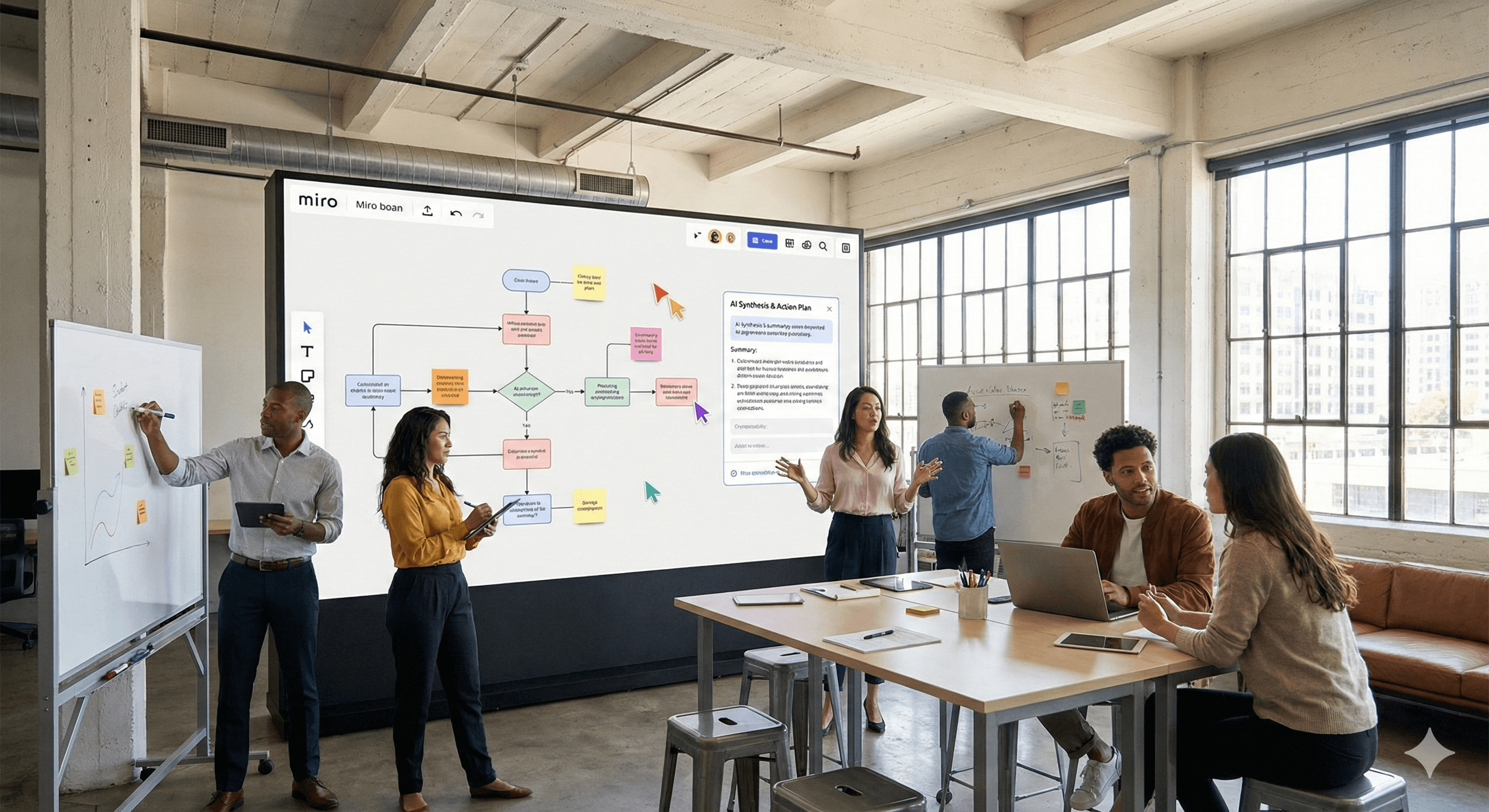
The research finds the biggest step-change comes from AI embedded in shared, canvas-based collaboration—not in isolated, individual tools. Work is already gravitating to visual canvases for workshops, planning, and hand-offs; that’s exactly where Miro sits, which is why the report positions a canvas + AI approach as the most practical path to team-level outcomes.
👉 Download the Forrester report to see the methodology, figures and recommendations in detail.Collaboration is the leverage point for AI
What the report says (at a glance)
Collaboration is the leverage point for AI: improving teamwork ranks among the most impactful routes to revenue growth and faster time-to-value.
Work has moved to the canvas: usage of visual collaboration tools is up sharply; many leaders now see them as critical to execution.
Point AI falls short: current AI tools skew to individual productivity and create friction when users switch between apps; teams want AI inside their shared workspace.
What teams want from AI: summarising workshops, turning ideas into plans, improving hand-offs, and connecting goals to delivery—all on the same board.
Business impact: organisations expect better customer experience and revenue, faster time-to-value, more automation, and more time for strategic work.
Leaders rank improving collaboration and teamwork among the most important drivers of organisational goals like revenue growth and faster time-to-value (pages 4–6; Fig. 1). Yet current stacks fragment work across chat/docs/point AI—slowing execution.
Work has moved to the canvas
79% say use of visual collaboration/digital canvases has increased; 43% call these tools critical—on par with chat and document co-creation (page 6–7; Fig. 2). That’s the moment to move AI onto the canvas where teams already coordinate.
Point AI misses team value
75% agree most AI tools focus too much on individual productivity; 69% say switching between AI and core tools causes friction (pages 8–10; Fig. 4). Embedding AI inside Miro reduces that tool-switching tax and keeps context intact.
What teams actually want from AI
Decision-makers want AI that:
Improves teamwork/collaboration (54% see strong potential).
Lives in shared, canvas-based workspaces (interest: 81–83%).
Ingests project context and materials for better prompts/answers (82–84%).
(See pages 12–13.)
Business impact you can measure
Top expected/seen benefits: better CX (52%), higher revenue (49%), improved time to value (46%) (page 14; Fig. 7). On the ground: more time for creative/strategic work (54%), more automation and cross-functional collaboration (51–48%) (page 15; Fig. 8).
Why Miro? The report’s Key Recommendations: “Think beyond individual productivity,” “connect goals to execution,” and invest in adoption/enablement—exactly what Miro’s canvas + AI supports (page 16).
How to Put the Findings into Practice with Miro
A. Embed AI where teamwork happens
Use Miro AI to summarise discovery sessions, extract themes from sticky notes, auto-create user-journey maps, and turn workshops into prioritised backlogs—all on the same board that product, design and engineering use. (Aligns with report guidance to embed AI in core teamwork tools; pages 12–13 & 16.)
B. Connect goals to execution
Link OKRs/roadmaps on a Miro board to delivery timelines. Use AI to turn decisions into next steps and owners; this closes the report’s gap between strategy and execution (pages 12–13).
C. Reduce tool-switching and speed hand-offs
Keep research artefacts, diagrams and flows in one shared canvas; let AI answer with citations to board content—cutting context loss the report flags (pages 8–10; 12–13).
D. Measure what matters
Track time-to-decision, time-to-handoff, meeting count, and AI-assisted tasks completed. These map to the report’s benefits: time-to-value, collaboration quality and strategic time (pages 14–15).
60-Day Rollout (Generation Digital playbook)
Weeks 1–2 — Baseline & IA
Audit where collaboration actually happens; consolidate key rituals into Miro boards (e.g., Design Sprint, PI Planning, Discovery, Research Ops). (Echoes the report’s “connect goals to execution”.)
Weeks 3–4 — AI inside the canvas
Enable Miro AI on pilot boards; standardise prompts for summarising workshops, clustering insights, drafting PRDs and creating diagrams. Reduce external doc churn (addresses point-solution sprawl; p.9–10).
Weeks 5–6 — Change & enablement
Champions programme + lunch-and-learns; job-aids per ritual. This mirrors the report’s recommendation to invest in learning and engagement to overcome skill/readiness gaps (p.16; plus challenges on p.11).
Weeks 7–8 — Prove value
Instrument KPIs: time-to-value, hand-off latency, % of meetings replaced by async boards, and time spent on strategic work (ties to Figs. 7–8).
Need help? Generation Digital designs your Miro information architecture, standard boards, AI prompt library and enablement journey—so the benefits Forrester describes show up in your metrics.
FAQs
Q1. Why not keep using point AI tools?
Forrester finds they skew to individual productivity and create friction when users jump between tools. Embedding AI in Miro keeps context and improves team outcomes. (p.8–10)
Q2. Where does Miro help most?
Cross-functional work: discovery, research synthesis, journey mapping, technical diagramming, roadmaps and hand-offs—exactly the areas respondents plan to augment with AI. (p.12–14)
Q3. What results should we expect?
Improved CX and revenue, faster time to value (business); more strategic time, more automation, and better cross-functional collaboration (team). (p.14–15)
Get weekly AI news and advice delivered to your inbox
By subscribing you consent to Generation Digital storing and processing your details in line with our privacy policy. You can read the full policy at gend.co/privacy.



Generation
Digital

UK Office
Generation Digital Ltd
33 Queen St,
London
EC4R 1AP
United Kingdom
Canada Office
Generation Digital Americas Inc
181 Bay St., Suite 1800
Toronto, ON, M5J 2T9
Canada
USA Office
Generation Digital Americas Inc
77 Sands St,
Brooklyn, NY 11201,
United States
EU Office
Generation Digital Software
Elgee Building
Dundalk
A91 X2R3
Ireland
Middle East Office
6994 Alsharq 3890,
An Narjis,
Riyadh 13343,
Saudi Arabia







Company No: 256 9431 77 | Copyright 2026 | Terms and Conditions | Privacy Policy