Mistral AI wins French defence AI framework agreement
Mistral
Free AI at Work Playbook for managers using ChatGPT, Claude and Gemini.
➔ Download the Playbook
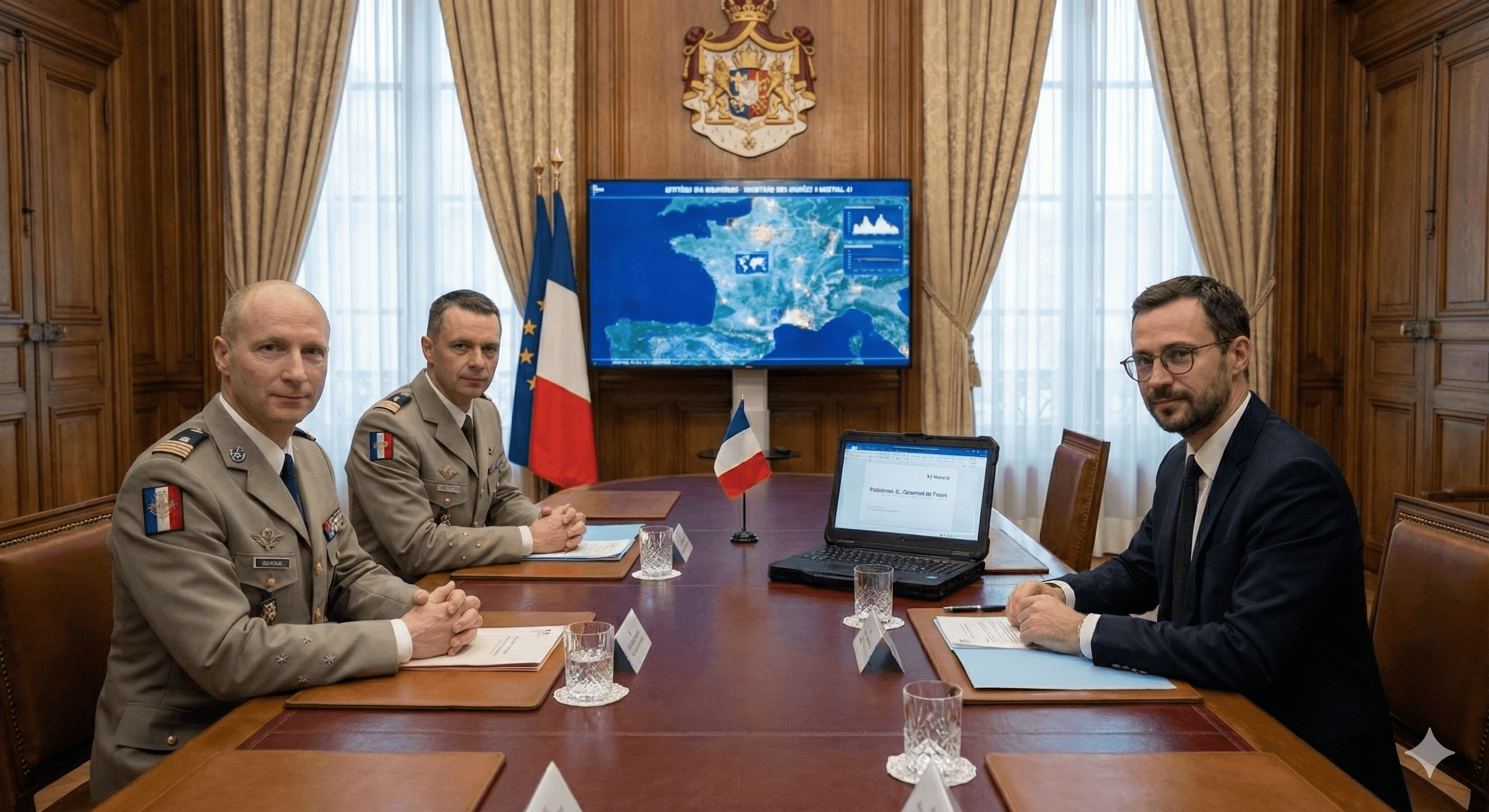
France’s Ministry of the Armed Forces has awarded Mistral AI a framework agreement giving military branches, directorates, and affiliated bodies (e.g., CEA, ONERA, SHOM) access to its AI models, software, and services. Overseen by AMIAD, solutions will run on French infrastructure and build on a 2025 cooperation agreement, reinforcing sovereign AI control.
What happened and why it matters
On 8 January 2026, Reuters reported that France’s Ministry of the Armed Forces had awarded Mistral AI a framework agreement to supply generative AI models, software, and services across the defence ecosystem. The move formalises access for the Ministry’s armed forces and directorates and extends to key affiliated public institutions, with AMIAD providing oversight. Hosting is committed on French infrastructure to preserve national control over sensitive data and technology. It follows a March 2025 cooperation agreement, signalling acceleration from pilot to scaled adoption.
Why a framework agreement is consequential
In European public procurement, a framework contract establishes pre-agreed commercial and legal terms so multiple units can call off services rapidly without renegotiating each time. For defence AI, that translates to speed-to-field: test, evaluate, and deploy model-backed tools without months of contractual work—while staying inside governance guardrails.
Scope and beneficiaries
Who can use it: The Ministry’s armed forces, directorates, services, and designated public bodies such as CEA (Atomic Energy Commission), ONERA (aerospace studies & research), and SHOM (naval hydrography & oceanography).
What’s included: Access to Mistral’s AI models, enterprise software, and professional services—including potential fine-tuning on defence data to meet operational needs.
Oversight: The Agency for Defence Artificial Intelligence (AMIAD) coordinates deployment standards, risk controls, and interoperability.
Sovereign AI: hosting and control
Location & control: Mistral indicates solutions will be hosted entirely on French infrastructure, supporting data residency, supply-chain assurance, and continuity under national policy.
Operational security: Expect strict identity and access controls (SSO, RBAC), logging of prompts/outputs, and separation from public training pipelines—i.e., no use of defence prompts/data to train public models.
Likely defence use cases
Intelligence & analysis – summarisation of multi-source reporting, cross-lingual triage, hypothesis generation with human validation.
Operations planning – checklists, procedure look-ups, and plan red-teaming; templated briefs with source citations.
Cyber & SecOps – log summarisation, incident narration drafts, and playbook guidance; high-precision retrieval over classified corpora.
Logistics & maintenance – technical manual search, fault-tree reasoning aids, and parts planning with human oversight.
Education & doctrine – training content generation, policy Q&A, and translation aligned to defence terminology.
Risk and governance considerations (defence context)
Model risk management: Register models, intended use, and safety constraints; measure performance drift and adversarial robustness.
Security boundaries: Enforce air-gapped or VPC-hosted inference as needed; verify data-path isolation.
Export controls and classification: Ensure controls for ITAR-like constraints where applicable and classification handling (metadata tagging, downgrading rules).
Auditability & provenance: Require source-grounded outputs, full prompt/response logging, and model/version pinning for after-action review.
Human oversight: Human-in-the-loop on any operational or targeting-adjacent decisions; AI outputs remain advisory.
How this compares and what buyers should watch
Acceleration mechanism: With a framework in place, units can pilot and adopt with less friction than bespoke contracts.
Sovereign positioning: Hosting within France supports policy goals of technological sovereignty and reduces dependency risk.
Ecosystem interplay: France has parallel initiatives (e.g., AMIAD-backed programmes and separate contracts for AI integration) that indicate broader institutionalisation of defence AI. Expect growing demand for interoperability with existing C2/ISR systems and compliance with NATO standards where relevant.
A pragmatic 90‑day evaluation plan for defence/secure agencies
Weeks 1–2: Intake & guardrails
Confirm classification boundaries; establish isolated environments; implement SSO/RBAC/logging; define red-team procedures.
Weeks 3–6: Pilot thin slices
Choose two workflows (e.g., intel summarisation; doctrine retrieval). Connect a read-only knowledge store; implement RAG; set evaluation metrics (latency, citation coverage, operator satisfaction).
Weeks 7–12: Scale cautiously
Expand to additional units; run tabletop exercises; formalise rollback/change control; draft benefits case and risk register.
UK/EU relevance for non-French buyers
Takeaway: The pattern—framework + sovereign hosting + AMIAD-style oversight—will influence other ministries and critical-national-infrastructure buyers. Outside France, adapt to national policy (e.g., UK DSIT/MoD guidance) and local security accreditations while keeping an exit strategy (model portability, open-weight options where appropriate).
Bottom line
The Mistral AI framework gives France’s defence ecosystem a fast, sovereign path to adopt generative AI while preserving national control. For government and regulated buyers across Europe, this is a signal to prioritise framework-based procurement, hosting sovereignty, and measurable governance when scaling AI.
Next Steps: Contact Generation Digital for supporting with secure LLM deployments in government and regulated sectors including governance, architecture, and benefits tracking.
FAQ
Q1. What does the framework agreement cover?
A. Access to Mistral AI’s models, software, and services for the Ministry’s armed forces, directorates, services, and affiliates (CEA, ONERA, SHOM), overseen by AMIAD, with hosting on French infrastructure.
Q2. Is defence data used to train public models?
A. Enterprise/sovereign deployments typically exclude customer data from public model training; confirm this contractually and in technical controls.
Q3. What hosting options apply?
A. French infrastructure (provider- or self‑hosted/VPC) with strict identity, logging, and data-residency controls; air‑gapped options for higher classifications.
Q4. How fast can units adopt tools?
A. Frameworks pre-agree commercial/legal terms, enabling faster call‑offs and pilots compared with bespoke contracts.
Q5. What are near‑term use cases?
A. Intel summarisation, multilingual triage, doctrine search, incident narration, logistics knowledge retrieval, and training content—always with human‑in‑the‑loop.
Get weekly AI news and advice delivered to your inbox
By subscribing you consent to Generation Digital storing and processing your details in line with our privacy policy. You can read the full policy at gend.co/privacy.



Generation
Digital

UK Office
Generation Digital Ltd
33 Queen St,
London
EC4R 1AP
United Kingdom
Canada Office
Generation Digital Americas Inc
181 Bay St., Suite 1800
Toronto, ON, M5J 2T9
Canada
USA Office
Generation Digital Americas Inc
77 Sands St,
Brooklyn, NY 11201,
United States
EU Office
Generation Digital Software
Elgee Building
Dundalk
A91 X2R3
Ireland
Middle East Office
6994 Alsharq 3890,
An Narjis,
Riyadh 13343,
Saudi Arabia







Company No: 256 9431 77 | Copyright 2026 | Terms and Conditions | Privacy Policy