Strategic Planning: No‑Fluff 4‑Step Routine for Success
Asana
Free AI at Work Playbook for managers using ChatGPT, Claude and Gemini.
➔ Download the Playbook
Why this routine works
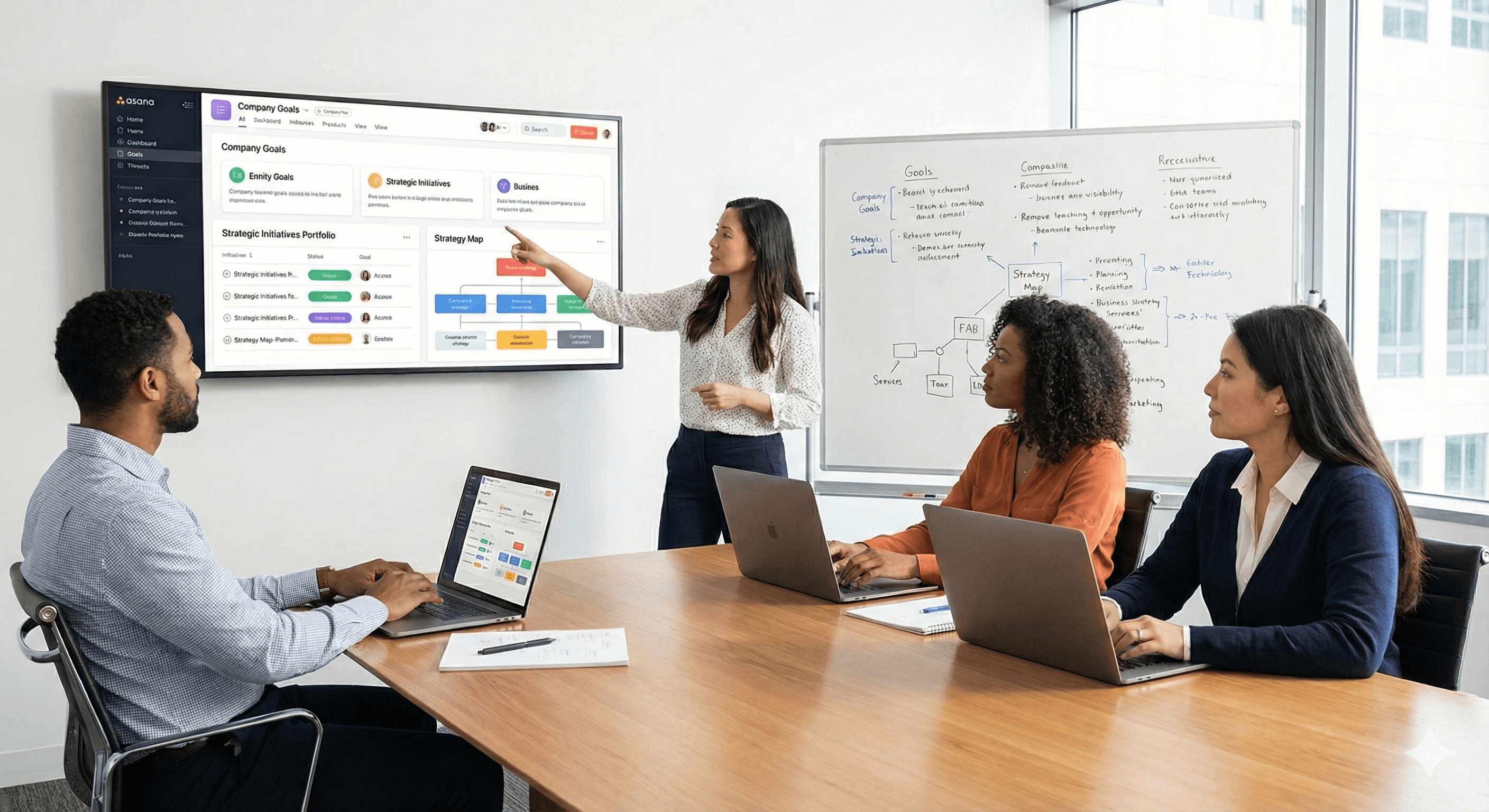
Leaders don’t need another jargon‑heavy framework—they need a repeatable cadence that links strategy to day‑to‑day work. This 4‑step approach mirrors Asana’s guidance and maps directly to features like Goals, Portfolios, Projects, Reports, and the Strategy Map, so you can plan and execute in the same system.
The 4‑step routine
1) Assess your position (2–10 days)
Clarify where you are before deciding where to go.
Capture market, customer and internal insights in a project or Portfolio.
Summarise key risks/opportunities; assign owners to fill gaps.
Draft a short narrative (one page) that informs goal choices.
Asana moves: Create a project “2026 Planning – Inputs”, add sections for Trends, Risks, Opportunities, Capabilities; tag items with custom fields for priority and confidence.
2) Set objectives & outcomes (OKRs) (1–2 days)
Define 3–5 company objectives and measurable key results; cascade to departments.
Asana moves: Use Goals to create company and team goals; link work (projects/tasks) to key results. Add goal owners, due dates, and update cadence.
3) Build the plan (2–3 weeks)
Translate objectives into funded initiatives, timelines and resourcing.
Spin up projects for each initiative; define scope, milestones and risks.
Group initiatives into a Portfolio; add custom fields for RAG status, budget, impact.
Create a Strategy Map view to visualise how goals connect to work.
Asana moves: In each project, set milestones, responsibilities (RACI), and timeline. Use Workload for capacity, Forms for intake, and Automation for status hygiene.
4) Share, monitor and manage (weekly–quarterly)
Operationalise strategy with a steady drumbeat.
Publish a dashboard: progress vs. goals, risk list, next decisions.
Hold monthly reviews; adjust scope, budget and sequencing as needed.
Close the loop with a quarterly retrospective and plan refresh.
Asana moves: Use Dashboards/Reporting for KPIs, Portfolios for roll‑ups, and Status Updates with rich text and charts. Keep the Strategy Map current as goals evolve.
Practical examples
Customer NPS uplift: Objective: +6pt NPS in Q2. Projects: “Ticket deflection”, “Onboarding revamp”. KR links: deflect 25% of repeat questions; cut onboarding time from 9→5 days.
Operating margin +3%: Objective with projects “SKU rationalisation”, “Self‑serve analytics”. KRs: reduce vendor costs 6%; 75% adoption of self‑serve.
Release reliability: Objective: <1% rollback rate. Projects: “Release helper”, “Observability upgrade”. KRs: increase automated checks 30%; MTTR < 30m.
Templates & cadence
Planning inputs project (duplicate each year)
Company Goals (annual; reviewed monthly)
Initiatives Portfolio (rolling; update weekly)
Exec dashboard (live KPIs; reviewed monthly)
Cadence tip: set reminders for goal updates (bi‑weekly) and portfolio reviews (monthly), with a quarterly reset to add or retire initiatives.
FAQs
What is strategic planning?
A repeatable process for setting objectives, choosing initiatives, and aligning resources to achieve measurable outcomes.
How does Asana simplify strategic planning?
It connects Goals to the projects and tasks that drive them, rolls up progress in Portfolios/Dashboards, and visualises alignment in the Strategy Map—keeping strategy and execution in one place.
Why is strategic planning important?
It aligns teams, focuses investment on what matters, and creates accountability through visible goals and real‑time progress.
How many objectives should we set?
Aim for 3–5 company objectives per cycle, each with 2–5 key results and clear ownership.
Next Steps
Want this routine set up in your workspace? Contact Generation Digital to implement Goals, Portfolios and dashboards—and coach your teams on a quarterly cadence.
Get weekly AI news and advice delivered to your inbox
By subscribing you consent to Generation Digital storing and processing your details in line with our privacy policy. You can read the full policy at gend.co/privacy.



Generation
Digital

UK Office
Generation Digital Ltd
33 Queen St,
London
EC4R 1AP
United Kingdom
Canada Office
Generation Digital Americas Inc
181 Bay St., Suite 1800
Toronto, ON, M5J 2T9
Canada
USA Office
Generation Digital Americas Inc
77 Sands St,
Brooklyn, NY 11201,
United States
EU Office
Generation Digital Software
Elgee Building
Dundalk
A91 X2R3
Ireland
Middle East Office
6994 Alsharq 3890,
An Narjis,
Riyadh 13343,
Saudi Arabia







Company No: 256 9431 77 | Copyright 2026 | Terms and Conditions | Privacy Policy