VfL Wolfsburg + ChatGPT Enterprise: Club-Wide AI Adoption

VfL Wolfsburg + ChatGPT Enterprise: Club-Wide AI Adoption

ChatGPT
Jan 29, 2026

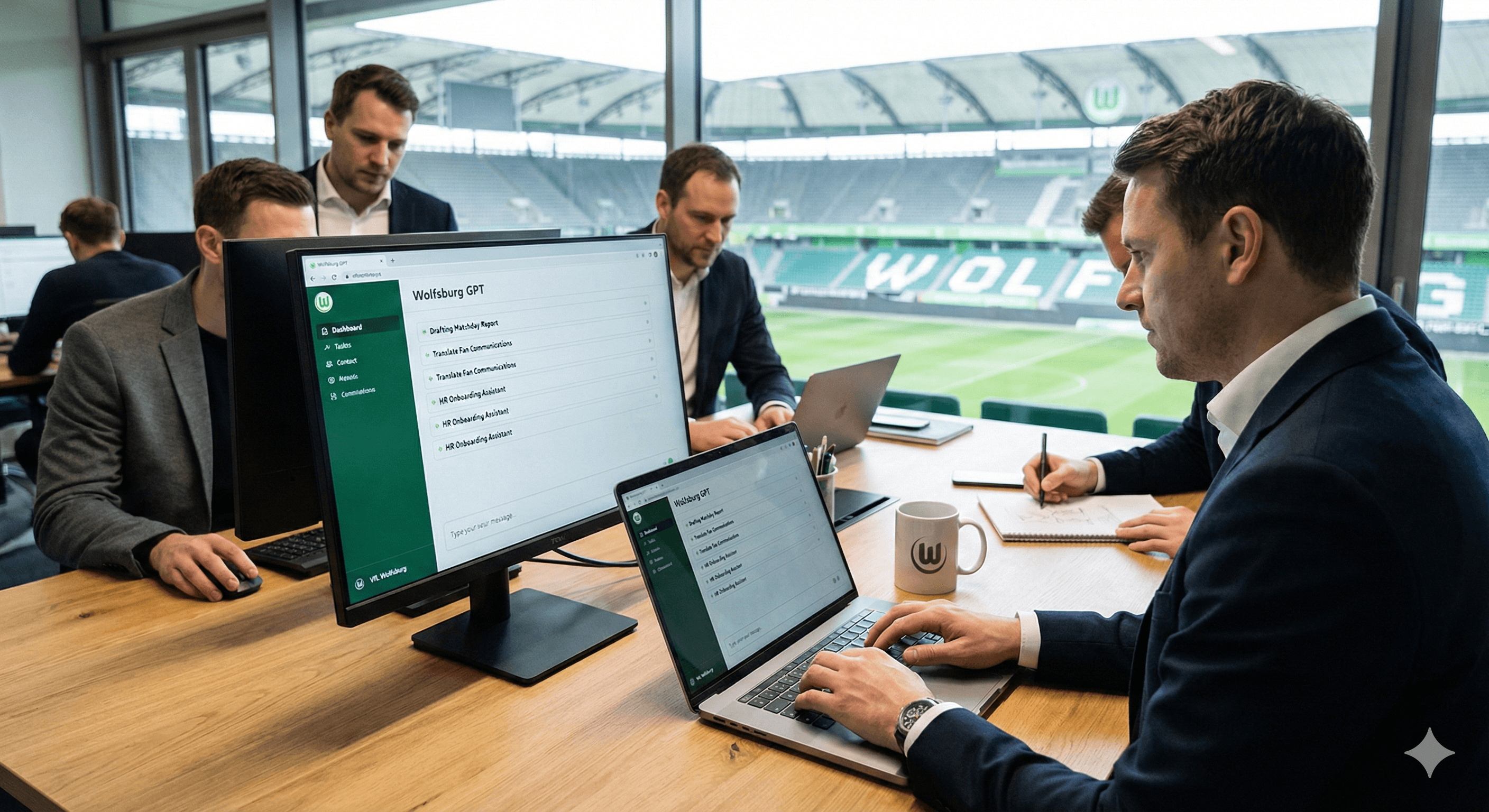
An office environment with professionals working on laptops and discussing, with visible screens displaying AI software "Wolfsburg GPT" in a modern workspace overlooking the VfL Wolfsburg stadium.

Not sure what to do next with AI?
Assess readiness, risk, and priorities in under an hour.

Not sure what to do next with AI?
Assess readiness, risk, and priorities in under an hour.

➔ Download Our Free AI Readiness Pack

VfL Wolfsburg has moved beyond AI pilots by rolling out ChatGPT Enterprise as a club-wide capability for around 350 employees. The club reports 50+ custom GPTs in daily use, six-figure annual cost savings from reduced reliance on external agencies, and faster drafting, translation, and standardisation across core workflows.

Modern football clubs are no longer defined by performance on the pitch alone. Expectations from fans, partners and internal stakeholders keep rising—while budgets and headcount can’t scale indefinitely.

That’s the tension VfL Wolfsburg set out to solve by turning generative AI into a club-wide capability, not a one-off experiment. With ChatGPT Enterprise, Wolfsburg is scaling efficiency, creativity and knowledge sharing—without losing its football identity.

Why “people, not pilots” matters

Many organisations approach AI as a series of small pilots. Wolfsburg took a different stance: if AI is going to create sustainable advantage, it has to be understandable and usable for everyone, not just specialists.

Instead of launching with strategy decks, the club started with real work:

  • workshops and hands-on experimentation,

  • department-led use cases,

  • and repeatable workflows that teams already understood.

The goal was pragmatic: save time, reduce external costs, and improve quality and consistency.

What’s actually changing inside the club

Wolfsburg’s early challenges looked familiar to any knowledge-heavy organisation:

  • repetitive drafting, translation, reporting and documentation slowing teams down,

  • knowledge concentrated with a few specialists creating bottlenecks,

  • and external agencies handling routine work at high cost—without building internal capability.

ChatGPT became the layer that helps people produce stronger outputs faster, and share knowledge more evenly across departments.

Why ChatGPT Enterprise (and why now)

After building experience with ChatGPT Team/Business licences, Wolfsburg decided the next constraint wasn’t whether AI worked—it was how to scale it properly and responsibly.

Moving to ChatGPT Enterprise created a consistent foundation the club could roll out broadly—expanding access to roughly 350 employees and strengthening governance.

Making AI tangible: custom GPTs built around everyday workflows

Adoption accelerated when Wolfsburg stopped talking about “AI” and started building assistants for specific jobs.

Today, the club reports:

  • 50+ custom GPTs in active daily use across operations, communications, marketing, HR and administration

  • a wider ecosystem of nearly 100 custom GPTs (some supported by the central innovation team, many created independently within departments)

This becomes a repeatable operating model:

  1. Identify a bottleneck

  2. Turn it into a GPT

  3. Scale it to the teams that need it

To make adoption feel approachable, many assistants are given human-like names internally—without blurring accountability for decisions.

Results: savings, speed and self-propelled adoption

Wolfsburg reports outcomes that go beyond “nice to have”:

  • Six-figure annual cost savings by reducing reliance on external agencies for repeatable work

  • Faster drafting, translation and standardisation across core workflows

  • Broad-based adoption, including non-technical roles and former players—helping usage become self-propelling

How Wolfsburg is scaling skills: GPT Champions (“GPTlers”)

To support sustainable adoption, the club is building a network of trained internal champions. These colleagues help their departments apply AI effectively, build GPTs, and share patterns that work.

This matters because the biggest constraint at scale is rarely the technology. It’s change management: consistent training, standards and safe use across a diverse organisation.

What other organisations can learn from VfL Wolfsburg

Wolfsburg’s approach is a clear blueprint for moving beyond pilots:

  1. Start with recurring work (templates, repeatable outputs, standard workflows)

  2. Make adoption frictionless (tools people aren’t afraid to use)

  3. Turn use cases into shared assets (custom GPTs others can reuse)

  4. Create local experts (champions in every department)

  5. Treat governance as an enabler (so experimentation can scale responsibly)

Summary & next steps

VfL Wolfsburg’s rollout shows what “AI as a capability” looks like: practical workflows, reusable assistants, measurable savings, and a people-first model that spreads.

Next step: If you want to take a similar approach—building adoption, governance and measurable outcomes—Generation Digital can help design your rollout plan.

FAQs

How is ChatGPT used at VfL Wolfsburg?

Across operations, communications, marketing, HR and administration—primarily for repeatable tasks like drafting, translation, reporting and standardisation, delivered through custom GPTs.

Why focus on people over pilots?

Because sustainable value comes from broad adoption and capability building. Pilots prove possibility; people-first enablement builds repeatable impact.

Will this affect the club’s football identity?

No. Wolfsburg’s framing is that AI supports the people doing the work behind the scenes, while the club’s core football values remain unchanged.

What results has Wolfsburg reported?

The club reports 50+ custom GPTs in daily use, six-figure annual cost savings from reduced agency reliance, and faster workflows across drafting and translation.

VfL Wolfsburg has moved beyond AI pilots by rolling out ChatGPT Enterprise as a club-wide capability for around 350 employees. The club reports 50+ custom GPTs in daily use, six-figure annual cost savings from reduced reliance on external agencies, and faster drafting, translation, and standardisation across core workflows.

Modern football clubs are no longer defined by performance on the pitch alone. Expectations from fans, partners and internal stakeholders keep rising—while budgets and headcount can’t scale indefinitely.

That’s the tension VfL Wolfsburg set out to solve by turning generative AI into a club-wide capability, not a one-off experiment. With ChatGPT Enterprise, Wolfsburg is scaling efficiency, creativity and knowledge sharing—without losing its football identity.

Why “people, not pilots” matters

Many organisations approach AI as a series of small pilots. Wolfsburg took a different stance: if AI is going to create sustainable advantage, it has to be understandable and usable for everyone, not just specialists.

Instead of launching with strategy decks, the club started with real work:

  • workshops and hands-on experimentation,

  • department-led use cases,

  • and repeatable workflows that teams already understood.

The goal was pragmatic: save time, reduce external costs, and improve quality and consistency.

What’s actually changing inside the club

Wolfsburg’s early challenges looked familiar to any knowledge-heavy organisation:

  • repetitive drafting, translation, reporting and documentation slowing teams down,

  • knowledge concentrated with a few specialists creating bottlenecks,

  • and external agencies handling routine work at high cost—without building internal capability.

ChatGPT became the layer that helps people produce stronger outputs faster, and share knowledge more evenly across departments.

Why ChatGPT Enterprise (and why now)

After building experience with ChatGPT Team/Business licences, Wolfsburg decided the next constraint wasn’t whether AI worked—it was how to scale it properly and responsibly.

Moving to ChatGPT Enterprise created a consistent foundation the club could roll out broadly—expanding access to roughly 350 employees and strengthening governance.

Making AI tangible: custom GPTs built around everyday workflows

Adoption accelerated when Wolfsburg stopped talking about “AI” and started building assistants for specific jobs.

Today, the club reports:

  • 50+ custom GPTs in active daily use across operations, communications, marketing, HR and administration

  • a wider ecosystem of nearly 100 custom GPTs (some supported by the central innovation team, many created independently within departments)

This becomes a repeatable operating model:

  1. Identify a bottleneck

  2. Turn it into a GPT

  3. Scale it to the teams that need it

To make adoption feel approachable, many assistants are given human-like names internally—without blurring accountability for decisions.

Results: savings, speed and self-propelled adoption

Wolfsburg reports outcomes that go beyond “nice to have”:

  • Six-figure annual cost savings by reducing reliance on external agencies for repeatable work

  • Faster drafting, translation and standardisation across core workflows

  • Broad-based adoption, including non-technical roles and former players—helping usage become self-propelling

How Wolfsburg is scaling skills: GPT Champions (“GPTlers”)

To support sustainable adoption, the club is building a network of trained internal champions. These colleagues help their departments apply AI effectively, build GPTs, and share patterns that work.

This matters because the biggest constraint at scale is rarely the technology. It’s change management: consistent training, standards and safe use across a diverse organisation.

What other organisations can learn from VfL Wolfsburg

Wolfsburg’s approach is a clear blueprint for moving beyond pilots:

  1. Start with recurring work (templates, repeatable outputs, standard workflows)

  2. Make adoption frictionless (tools people aren’t afraid to use)

  3. Turn use cases into shared assets (custom GPTs others can reuse)

  4. Create local experts (champions in every department)

  5. Treat governance as an enabler (so experimentation can scale responsibly)

Summary & next steps

VfL Wolfsburg’s rollout shows what “AI as a capability” looks like: practical workflows, reusable assistants, measurable savings, and a people-first model that spreads.

Next step: If you want to take a similar approach—building adoption, governance and measurable outcomes—Generation Digital can help design your rollout plan.

FAQs

How is ChatGPT used at VfL Wolfsburg?

Across operations, communications, marketing, HR and administration—primarily for repeatable tasks like drafting, translation, reporting and standardisation, delivered through custom GPTs.

Why focus on people over pilots?

Because sustainable value comes from broad adoption and capability building. Pilots prove possibility; people-first enablement builds repeatable impact.

Will this affect the club’s football identity?

No. Wolfsburg’s framing is that AI supports the people doing the work behind the scenes, while the club’s core football values remain unchanged.

What results has Wolfsburg reported?

The club reports 50+ custom GPTs in daily use, six-figure annual cost savings from reduced agency reliance, and faster workflows across drafting and translation.

Get weekly AI news and advice delivered to your inbox

By subscribing you consent to Generation Digital storing and processing your details in line with our privacy policy. You can read the full policy at gend.co/privacy.


Upcoming Workshops and Webinars

A diverse group of professionals collaborating around a table in a bright, modern office setting.

Operational Clarity at Scale - Asana

Virtual Webinar
Weds 25th February 2026
Online

A diverse group of professionals collaborating around a table in a bright, modern office setting.

Work With AI Teammates - Asana

In-Person Workshop
Thurs 26th February 2026
London, UK

A diverse group of professionals collaborating around a table in a bright, modern office setting.

From Idea to Prototype - AI in Miro

Virtual Webinar
Weds 18th February 2026
Online

Generation
Digital

UK Office

Generation Digital Ltd
33 Queen St,
London
EC4R 1AP
United Kingdom

Canada Office

Generation Digital Americas Inc
181 Bay St., Suite 1800
Toronto, ON, M5J 2T9
Canada

USA Office

Generation Digital Americas Inc
77 Sands St,
Brooklyn, NY 11201,
United States

EU Office

Generation Digital Software
Elgee Building
Dundalk
A91 X2R3
Ireland

Middle East Office

6994 Alsharq 3890,
An Narjis,
Riyadh 13343,
Saudi Arabia

UK Fast Growth Index UBS Logo
Financial Times FT 1000 Logo
Febe Growth 100 Logo (Background Removed)

Company No: 256 9431 77 | Copyright 2026 | Terms and Conditions | Privacy Policy

Generation
Digital

UK Office

Generation Digital Ltd
33 Queen St,
London
EC4R 1AP
United Kingdom

Canada Office

Generation Digital Americas Inc
181 Bay St., Suite 1800
Toronto, ON, M5J 2T9
Canada

USA Office

Generation Digital Americas Inc
77 Sands St,
Brooklyn, NY 11201,
United States

EU Office

Generation Digital Software
Elgee Building
Dundalk
A91 X2R3
Ireland

Middle East Office

6994 Alsharq 3890,
An Narjis,
Riyadh 13343,
Saudi Arabia

UK Fast Growth Index UBS Logo
Financial Times FT 1000 Logo
Febe Growth 100 Logo (Background Removed)


Company No: 256 9431 77
Terms and Conditions
Privacy Policy
Copyright 2026





