AI Agent Skills: Turn Generalists into Specialist Experts
AI
Free AI at Work Playbook for managers using ChatGPT, Claude and Gemini.
➔ Download the Playbook
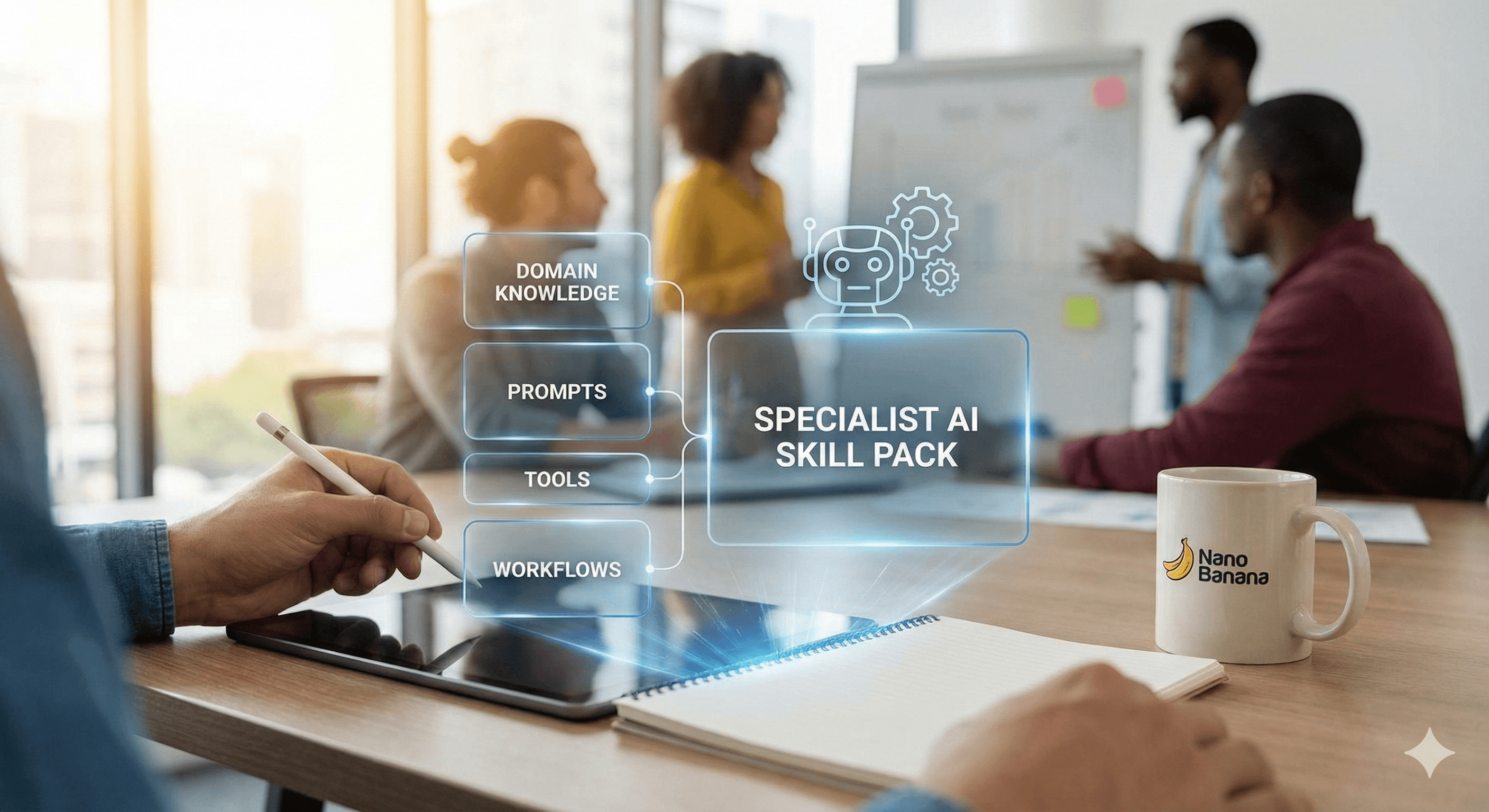
AI agent skills are curated packages of domain knowledge, prompts, tools, and workflows that transform a general-purpose model into a reliable specialist. By standardising inputs (SOPs, data sources) and outputs (policies, formats), teams achieve faster, higher-quality results with measurable accuracy, governance, and repeatability.
Equip AI Agents with Skills for Specialised Expertise
General-purpose AI is impressive, but real business value arrives when agents behave like trained specialists. The fastest route is to package skills: combine domain knowledge, prompts, tools, and workflows into a reusable kit that any agent can load. This article shows you how to design skill packs, wire them into orchestration, and measure outcomes so specialists stay accurate, fast and compliant.
Why specialise AI agents?
Specialisation turns “helpful but inconsistent” responses into reliable performance against your rules, data and definitions. With skill packs, agents:
Use approved knowledge (not the open web).
Follow standard operating procedures and formats.
Call the right tools (search, ticketing, spreadsheets, APIs) at the right time.
Escalate when confidence is low or policy is triggered.
The result is predictable quality, faster time-to-value, and clearer ownership across functions.
What is an AI agent skill pack?
A skill pack is a structured bundle that includes:
Domain knowledge: curated source material (policies, playbooks, product docs), indexed for retrieval.
Prompts & guardrails: role, tone, response structure, banned topics, escalation rules.
Tools & connectors: the APIs or apps the agent may call (e.g., ticket creation, CRM lookup, spreadsheet math).
Workflows: the steps, inputs/outputs, and handoffs to humans or other agents.
Policies & compliance: data handling rules, PII controls, and audit requirements.
Evaluation & telemetry: tests, quality thresholds, and dashboards (accuracy, latency, resolution, escalations).
Treat skill packs like products: versioned, documented, and tested before deployment.
How it works (end-to-end)
Define the job-to-be-done
Pick a narrow, valuable scope: “triage Level-1 IT tickets” or “draft SoW from approved template”.Curate the knowledge base
Centralise source-of-truth documents. Chunk and tag them, then index in a vector store for retrieval. Mark stale or untrusted content out of scope.Design prompts and guardrails
Establish role (e.g., “IT Support Triage Agent”), tone, formats (tables, JSON), and do/don’t lists. Include escalation triggers (uncertainty, policy conflict, missing data).Add tools and permissions
Connect only what’s needed—e.g., create_ticket(), get_customer(), update_sheet(). Enforce least-privilege access.Map the workflow
Describe each step: intake → retrieve → reason → act → summarise → log → escalate if necessary. Identify human-in-the-loop moments.Test with evaluation sets
Build a representative test suite (easy/edge/error cases). Track accuracy, first-contact resolution, average handle time, hallucination rate, and human escalations.Deploy with observability
Run in a monitored environment. Log prompts, retrievals, tool calls and outcomes. Review weekly; promote only when KPIs hold steady.Iterate and version
Fold real-world feedback into the pack. Version changes and communicate what’s new to stakeholders.
Practical examples
Customer Support (L1 triage): The agent classifies, retrieves policy excerpts, proposes a response, and either closes the ticket or escalates with a structured summary and confidence score.
PMO & Operations: Drafts Statements of Work using approved clauses, checks risks, and fills a cost table from a pricing sheet before routing for sign-off.
Finance Ops: Pre-validates expense reports, flags policy exceptions, and requests missing receipts via templated emails.
HR: Answers policy questions from a vetted handbook, then logs interactions for reporting and improvement.
Governance and risk controls
Specialists must be governable. Apply:
Content provenance: Only approved sources are retrievable; everything else is blocked.
Policy enforcement: Red-lines (e.g., legal disclaimers) and escalation rules live in the pack.
PII handling: Masking, retention limits, and access logging by default.
Human oversight: Clear thresholds where a person must review or approve.
Measurement that matters
Don’t optimise for “wow”—optimise for business KPIs:
Quality: accuracy, task success, policy compliance.
Speed: latency, average handle time.
Cost: tokens, tool calls, human minutes saved.
Trust: escalation rate, user satisfaction, audit completeness.
A lightweight dashboard tracking these signals will tell you when to promote, retrain, or roll back a pack.
Implementation checklist
Job-to-be-done defined and in scope.
Knowledge curated, indexed, and labelled.
Prompts/guardrails agreed with stakeholders.
Tools connected with least privilege.
Workflow mapped with human fail-safes.
Evaluation set built; baseline recorded.
Observability and dashboards live.
Versioning and release notes in place.
Working with Generation Digital
We help teams translate this framework into production: from discovery and knowledge audits to agent design, evaluation, and ongoing optimisation. If you’re ready to turn generalists into dependable specialists, we can help.
Next Steps: Contact Generation Digital to equip your AI agents with specialist skills and measurable governance.
FAQ
Q1. What are AI agent skills?
Curated bundles of domain knowledge, prompts, tools and workflows that make an agent operate like a trained specialist rather than a generalist.
Q2. How do skills improve efficiency?
They standardise how an agent retrieves information, follows SOPs, and executes tools—reducing rework, latency and errors while boosting accuracy and compliance.
Q3. Do we need fine-tuning?
Not always. Many teams start with retrieval-augmented generation and strong prompts/guardrails, then fine-tune only when volume and variance justify it.
Q4. How do we measure success?
Track accuracy, time-to-complete, escalation rate, policy compliance and user satisfaction. Promote versions when KPIs meet thresholds.
Get weekly AI news and advice delivered to your inbox
By subscribing you consent to Generation Digital storing and processing your details in line with our privacy policy. You can read the full policy at gend.co/privacy.



Generation
Digital

UK Office
Generation Digital Ltd
33 Queen St,
London
EC4R 1AP
United Kingdom
Canada Office
Generation Digital Americas Inc
181 Bay St., Suite 1800
Toronto, ON, M5J 2T9
Canada
USA Office
Generation Digital Americas Inc
77 Sands St,
Brooklyn, NY 11201,
United States
EU Office
Generation Digital Software
Elgee Building
Dundalk
A91 X2R3
Ireland
Middle East Office
6994 Alsharq 3890,
An Narjis,
Riyadh 13343,
Saudi Arabia







Company No: 256 9431 77 | Copyright 2026 | Terms and Conditions | Privacy Policy