Asana: Align Teamwork to Your Organisation’s Mission

Asana: Align Teamwork to Your Organisation’s Mission

Asana
Mar 2, 2026

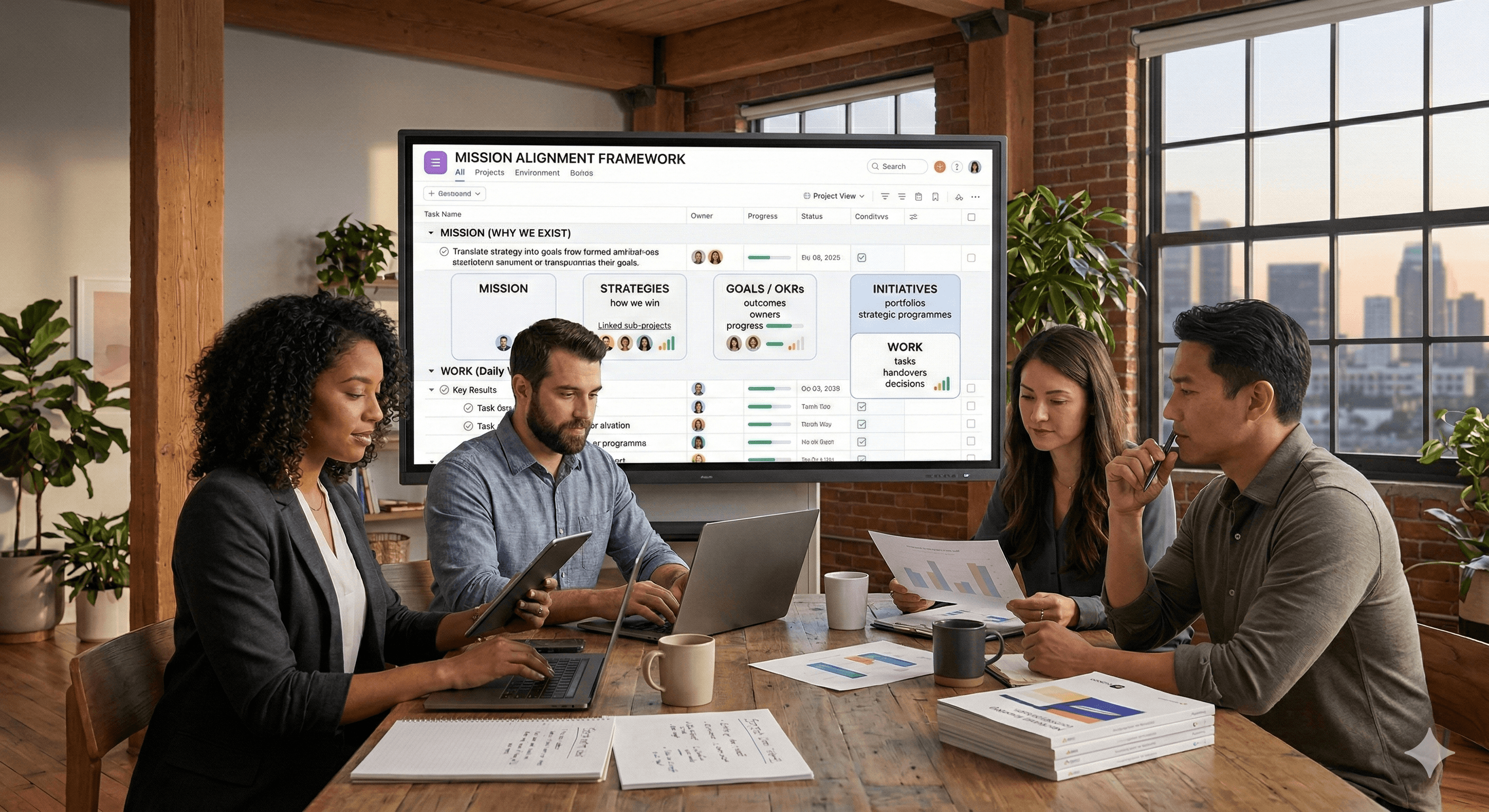
Four people collaborate around a wooden table in a modern office with a large screen displaying an "Asana: Align Teamwork to Your Organisation’s Mission" framework, featuring organized tasks and charts, with cityscape visible through the windows.

Not sure where to start with AI?
Assess readiness, risk, and priorities in under an hour.

Not sure where to start with AI?
Assess readiness, risk, and priorities in under an hour.

➔ Download Our Free AI Readiness Pack

Aligning teamwork to your organisation’s mission means translating strategy into measurable goals, then connecting every project and task to those goals—so people understand the “why”, leaders can see progress, and teams can prioritise with confidence. In Asana, this is done by linking Goals, portfolios and projects into one visible system.

Most organisations don’t have a mission problem—they have a translation problem.

Leaders can explain where the organisation is heading, but somewhere between the strategy deck and the weekly stand-up, priorities blur. Work multiplies. Requests arrive from every direction. Teams do their best, yet it’s hard to prove that today’s tasks are moving the mission forward.

This page is a practical guide to building organisational clarity with Asana: a way to connect mission → goals → initiatives → delivery, so everyone can see what matters, who owns it, and what success looks like.

Updated: 02/03/2026

Why mission alignment breaks down (even in strong teams)

Misalignment rarely comes from lack of effort. It usually comes from one (or more) of these issues:

1) Strategy lives in documents, not in the flow of work.
The mission is clear on a slide, but invisible when teams plan their week.

2) Goals exist, but they’re not connected to delivery.
Teams set OKRs, then run projects elsewhere. Progress becomes manual reporting.

3) Cross-functional work has no single owner.
When outcomes depend on multiple teams, accountability gets fuzzy.

4) Priorities change, but work doesn’t stop.
Without a system for trade-offs, “urgent” work quietly replaces “important” work.

5) Leadership visibility relies on status chasing.
If updates are requested in meetings, you’re always seeing yesterday’s reality.

The fix is not more meetings. It’s a clearer structure—supported by a tool that makes alignment visible.

A simple framework: Mission → Goals → Initiatives → Work
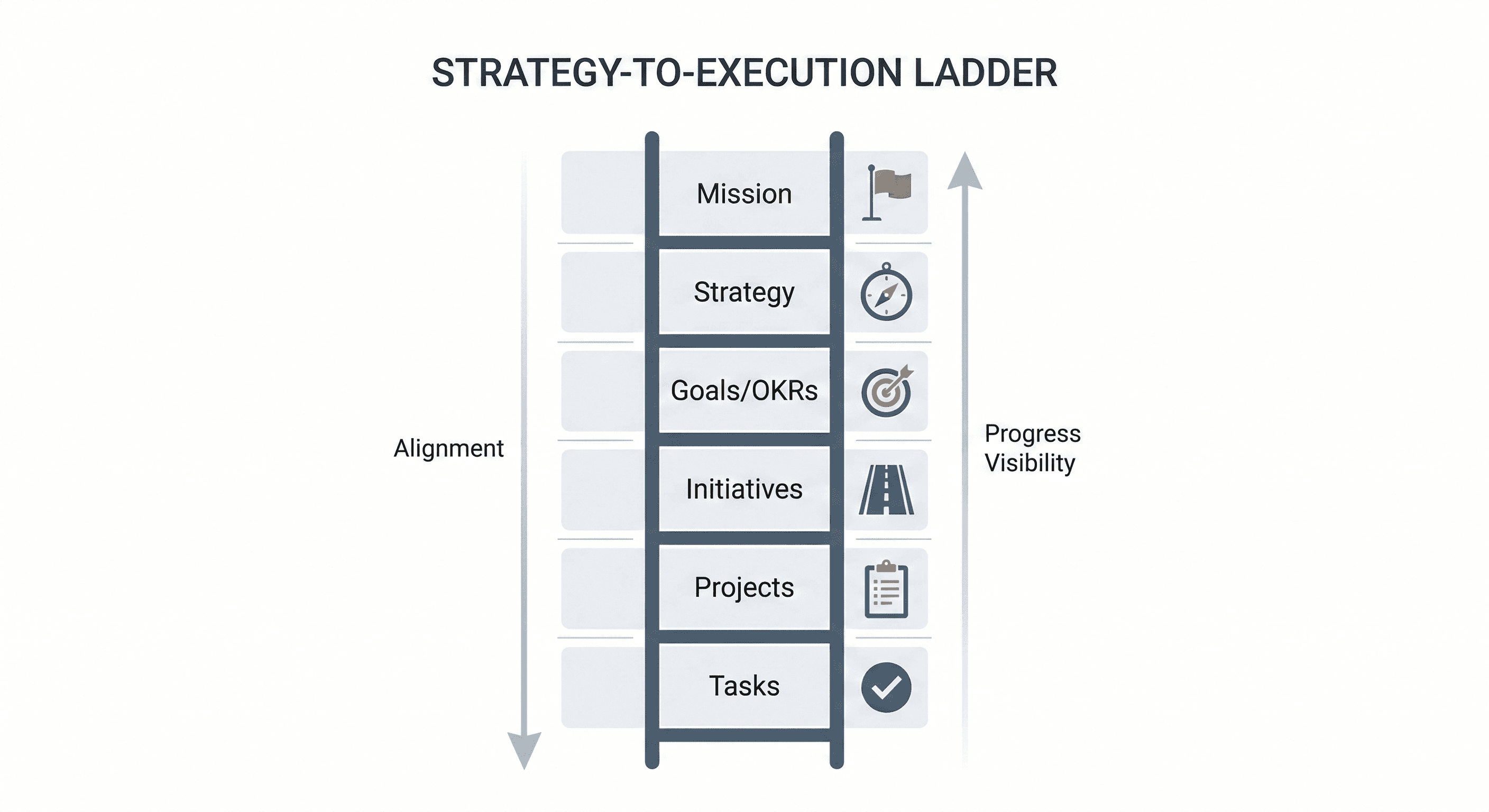
Think of alignment as a ladder:

  • Mission (why we exist): the enduring purpose.

  • Strategy (how we win): the choices that define focus.

  • Goals / OKRs (what success looks like): measurable outcomes.

  • Initiatives (how we’ll move the needle): programmes and projects.

  • Work (what people do daily): tasks, handovers, decisions.

The key is connection. If work can’t be linked to a goal, it should trigger a decision:

  • Is it truly necessary?

  • Should it be paused, stopped, or deprioritised?

  • Does a goal need updating because reality changed?

Asana helps because it can act as a system of record for work—not just a task list.

How Asana supports mission alignment in practice

1) Make goals visible and owned

In Asana, goals aren’t just text. They have:

  • a clear owner (one person accountable),

  • contributors (teams who drive progress),

  • a timeframe,

  • measurable targets,

  • and regular updates that keep context in one place.

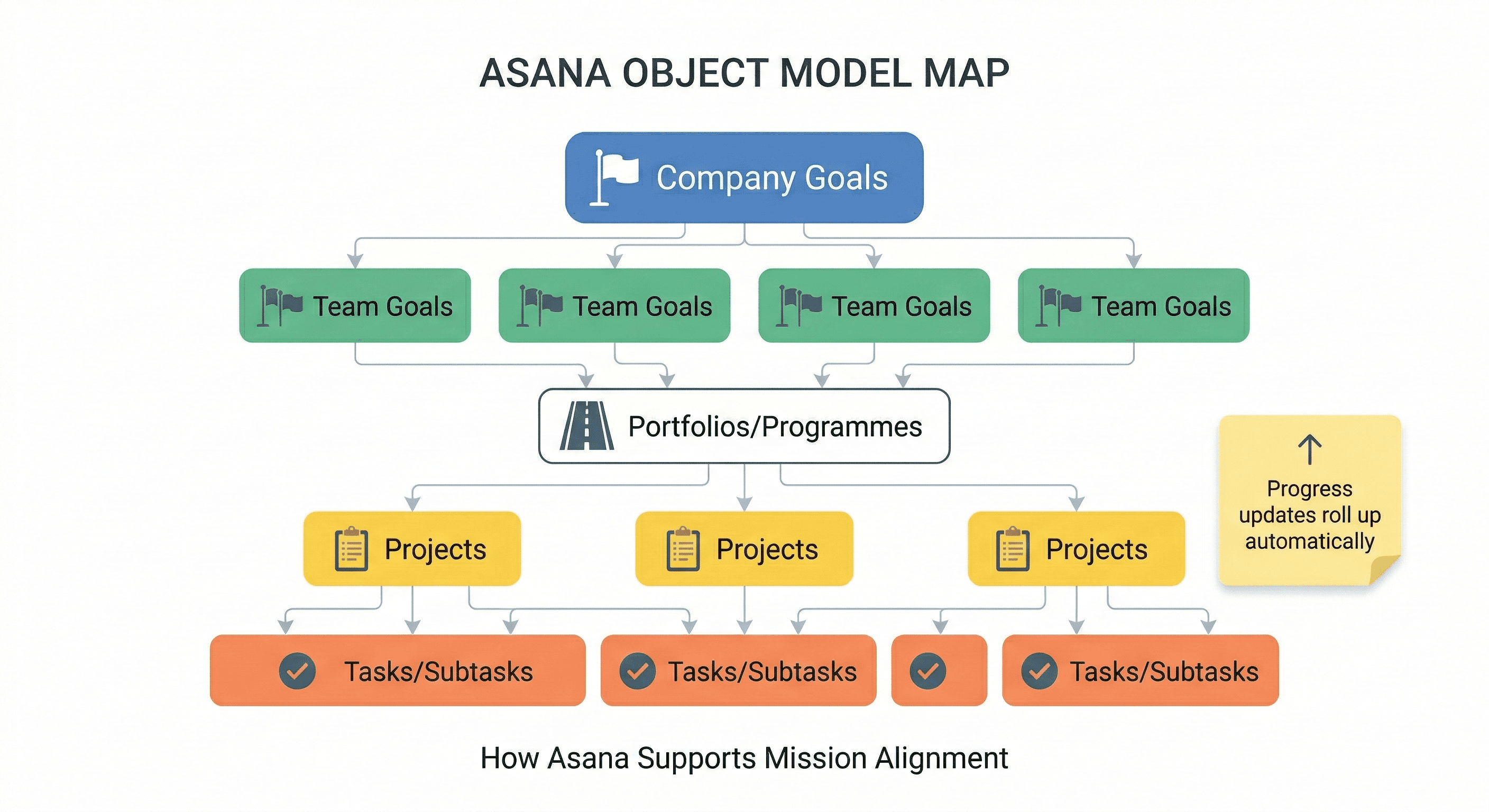
The important move is linking goals together so teams can see how their outcomes ladder up to company objectives.

Tip: Keep company goals limited. Most organisations over-goal and under-deliver. Choose what you can actually focus on.

2) Connect initiatives to goals (so progress isn’t a guessing game)

Once goals exist, connect them to the initiatives doing the real work:

  • link strategic programmes and portfolios to goals,

  • connect projects to the key results they support,

  • and ensure every project has a measurable definition of “done”.

This is where alignment becomes operational. When leaders ask, “Are we on track?” the answer lives in the work—without spreadsheet roll-ups.
3) Standardise workflows that match how you deliver

Alignment fails when work is inconsistent. Asana supports repeatable patterns:

  • intake and triage for requests,

  • stage-based workflows for delivery,

  • approvals for governance,

  • and clear handovers across functions.

When your workflow is consistent, reporting becomes simple—and teams spend less time working out how to work.

4) Improve prioritisation with visibility and trade-offs

Teams can’t align if everything is “top priority”. Asana helps you create rational trade-offs by making:

  • workload and ownership clear,

  • dependencies visible,

  • and initiative status consistent.

This is essential for cross‑functional programmes where the bottleneck is often coordination, not capability.

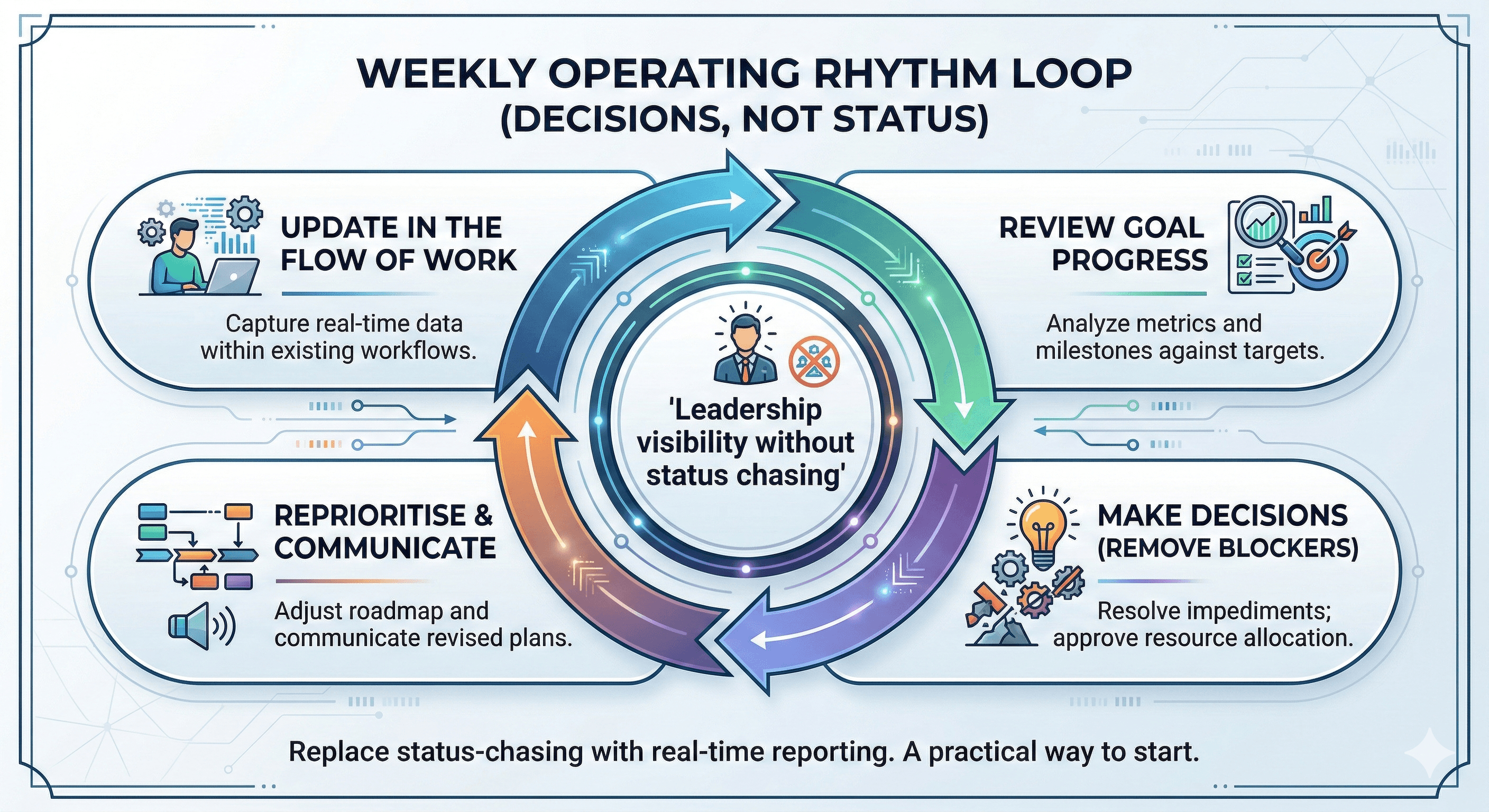
5) Replace status-chasing with real-time reporting

Leaders need progress and risk signals without creating reporting overhead.

With connected goals, portfolios and projects, Asana can surface:

  • what’s on track vs at risk,

  • where work is blocked,

  • and what needs a leadership decision.

Done well, your weekly exec update becomes a quick review of reality—then decisions.
What “good” looks like (a quick maturity check)

Use these checkpoints to assess whether your organisation is truly aligned:

  1. Every strategic goal has one accountable owner.

  2. Each goal has 3–5 measurable outcomes (not activities).

  3. Key initiatives are linked to the goals they support.

  4. Cross-functional work has clear decision rights.

  5. Teams can say “no” to work that doesn’t map to a goal.

  6. Leadership reporting comes from the system, not from chasing updates.

If you’re missing two or more, the issue is likely structural—fixable with a better model and a cleaner Asana setup.

A practical way to start (without a huge transformation)

If you want alignment quickly, start small and build credibility.

Step 1: Define 3–5 company goals for the next quarter

Write them in outcome language, assign owners, and agree how progress will be measured.

Step 2: Choose one cross-functional initiative to pilot

Pick something visible and valuable (e.g., a product launch, customer onboarding improvement, or compliance programme).

Step 3: Build the initiative in Asana with a consistent workflow

Create a clear project structure, define stages, add dependencies, and standardise status updates.

Step 4: Link the initiative to the goal it supports

Ensure progress is visible without manual reporting.

Step 5: Review weekly, and only escalate decisions

If the system is working, meetings become shorter—and more useful.

How Generation Digital helps

Technology doesn’t create alignment on its own. Design and adoption do.

As an Asana Platinum Solutions Partner, Generation Digital helps organisations turn strategy into a working system:

  • goal and portfolio design that reflects how your organisation actually runs,

  • workflow architecture (intake, delivery, governance),

  • dashboards and reporting for leadership visibility,

  • adoption programmes that stick (training, champions, rollout plans),

  • and AI-enabled ways of working using modern Asana capabilities.

If you want to rebuild mission alignment on a solid foundation, we can help you get there—quickly and pragmatically.

Next step: Talk to us about aligning goals and execution in Asana → /contact

Related reading

FAQ

What does it mean to align teamwork to a mission?
It means connecting day‑to‑day projects and tasks to measurable goals that directly support the organisation’s mission—so teams can prioritise confidently and leaders can see real progress.

How does Asana help with mission alignment?
Asana links company goals to portfolios, projects and tasks. That connection improves prioritisation, ownership and reporting—without relying on manual status updates.

Should we use OKRs in Asana?
If you already use OKRs (or want to), Asana is a good way to make them operational. The key is to link key results to the initiatives doing the work and update progress in the flow of delivery.

What’s the fastest way to start improving alignment?
Start with a small set of quarterly goals, pilot one cross‑functional initiative in Asana, connect it to those goals, and review progress weekly with decisions—not status chasing.

Can Generation Digital help set this up?
Yes. We design goal structures, build scalable workflows, and run adoption programmes so Asana becomes a working system—not just another tool.

Aligning teamwork to your organisation’s mission means translating strategy into measurable goals, then connecting every project and task to those goals—so people understand the “why”, leaders can see progress, and teams can prioritise with confidence. In Asana, this is done by linking Goals, portfolios and projects into one visible system.

Most organisations don’t have a mission problem—they have a translation problem.

Leaders can explain where the organisation is heading, but somewhere between the strategy deck and the weekly stand-up, priorities blur. Work multiplies. Requests arrive from every direction. Teams do their best, yet it’s hard to prove that today’s tasks are moving the mission forward.

This page is a practical guide to building organisational clarity with Asana: a way to connect mission → goals → initiatives → delivery, so everyone can see what matters, who owns it, and what success looks like.

Updated: 02/03/2026

Why mission alignment breaks down (even in strong teams)

Misalignment rarely comes from lack of effort. It usually comes from one (or more) of these issues:

1) Strategy lives in documents, not in the flow of work.
The mission is clear on a slide, but invisible when teams plan their week.

2) Goals exist, but they’re not connected to delivery.
Teams set OKRs, then run projects elsewhere. Progress becomes manual reporting.

3) Cross-functional work has no single owner.
When outcomes depend on multiple teams, accountability gets fuzzy.

4) Priorities change, but work doesn’t stop.
Without a system for trade-offs, “urgent” work quietly replaces “important” work.

5) Leadership visibility relies on status chasing.
If updates are requested in meetings, you’re always seeing yesterday’s reality.

The fix is not more meetings. It’s a clearer structure—supported by a tool that makes alignment visible.

A simple framework: Mission → Goals → Initiatives → Work

Think of alignment as a ladder:

  • Mission (why we exist): the enduring purpose.

  • Strategy (how we win): the choices that define focus.

  • Goals / OKRs (what success looks like): measurable outcomes.

  • Initiatives (how we’ll move the needle): programmes and projects.

  • Work (what people do daily): tasks, handovers, decisions.

The key is connection. If work can’t be linked to a goal, it should trigger a decision:

  • Is it truly necessary?

  • Should it be paused, stopped, or deprioritised?

  • Does a goal need updating because reality changed?

Asana helps because it can act as a system of record for work—not just a task list.

How Asana supports mission alignment in practice

1) Make goals visible and owned

In Asana, goals aren’t just text. They have:

  • a clear owner (one person accountable),

  • contributors (teams who drive progress),

  • a timeframe,

  • measurable targets,

  • and regular updates that keep context in one place.

The important move is linking goals together so teams can see how their outcomes ladder up to company objectives.

Tip: Keep company goals limited. Most organisations over-goal and under-deliver. Choose what you can actually focus on.

2) Connect initiatives to goals (so progress isn’t a guessing game)

Once goals exist, connect them to the initiatives doing the real work:

  • link strategic programmes and portfolios to goals,

  • connect projects to the key results they support,

  • and ensure every project has a measurable definition of “done”.

This is where alignment becomes operational. When leaders ask, “Are we on track?” the answer lives in the work—without spreadsheet roll-ups.

3) Standardise workflows that match how you deliver

Alignment fails when work is inconsistent. Asana supports repeatable patterns:

  • intake and triage for requests,

  • stage-based workflows for delivery,

  • approvals for governance,

  • and clear handovers across functions.

When your workflow is consistent, reporting becomes simple—and teams spend less time working out how to work.

4) Improve prioritisation with visibility and trade-offs

Teams can’t align if everything is “top priority”. Asana helps you create rational trade-offs by making:

  • workload and ownership clear,

  • dependencies visible,

  • and initiative status consistent.

This is essential for cross‑functional programmes where the bottleneck is often coordination, not capability.

5) Replace status-chasing with real-time reporting

Leaders need progress and risk signals without creating reporting overhead.

With connected goals, portfolios and projects, Asana can surface:

  • what’s on track vs at risk,

  • where work is blocked,

  • and what needs a leadership decision.

Done well, your weekly exec update becomes a quick review of reality—then decisions.

What “good” looks like (a quick maturity check)

Use these checkpoints to assess whether your organisation is truly aligned:

  1. Every strategic goal has one accountable owner.

  2. Each goal has 3–5 measurable outcomes (not activities).

  3. Key initiatives are linked to the goals they support.

  4. Cross-functional work has clear decision rights.

  5. Teams can say “no” to work that doesn’t map to a goal.

  6. Leadership reporting comes from the system, not from chasing updates.

If you’re missing two or more, the issue is likely structural—fixable with a better model and a cleaner Asana setup.

A practical way to start (without a huge transformation)

If you want alignment quickly, start small and build credibility.

Step 1: Define 3–5 company goals for the next quarter

Write them in outcome language, assign owners, and agree how progress will be measured.

Step 2: Choose one cross-functional initiative to pilot

Pick something visible and valuable (e.g., a product launch, customer onboarding improvement, or compliance programme).

Step 3: Build the initiative in Asana with a consistent workflow

Create a clear project structure, define stages, add dependencies, and standardise status updates.

Step 4: Link the initiative to the goal it supports

Ensure progress is visible without manual reporting.

Step 5: Review weekly, and only escalate decisions

If the system is working, meetings become shorter—and more useful.

How Generation Digital helps

Technology doesn’t create alignment on its own. Design and adoption do.

As an Asana Platinum Solutions Partner, Generation Digital helps organisations turn strategy into a working system:

  • goal and portfolio design that reflects how your organisation actually runs,

  • workflow architecture (intake, delivery, governance),

  • dashboards and reporting for leadership visibility,

  • adoption programmes that stick (training, champions, rollout plans),

  • and AI-enabled ways of working using modern Asana capabilities.

If you want to rebuild mission alignment on a solid foundation, we can help you get there—quickly and pragmatically.

Next step: Talk to us about aligning goals and execution in Asana → /contact

Related reading

FAQ

What does it mean to align teamwork to a mission?
It means connecting day‑to‑day projects and tasks to measurable goals that directly support the organisation’s mission—so teams can prioritise confidently and leaders can see real progress.

How does Asana help with mission alignment?
Asana links company goals to portfolios, projects and tasks. That connection improves prioritisation, ownership and reporting—without relying on manual status updates.

Should we use OKRs in Asana?
If you already use OKRs (or want to), Asana is a good way to make them operational. The key is to link key results to the initiatives doing the work and update progress in the flow of delivery.

What’s the fastest way to start improving alignment?
Start with a small set of quarterly goals, pilot one cross‑functional initiative in Asana, connect it to those goals, and review progress weekly with decisions—not status chasing.

Can Generation Digital help set this up?
Yes. We design goal structures, build scalable workflows, and run adoption programmes so Asana becomes a working system—not just another tool.

Get weekly AI news and advice delivered to your inbox

By subscribing you consent to Generation Digital storing and processing your details in line with our privacy policy. You can read the full policy at gend.co/privacy.


Upcoming Workshops and Webinars

A diverse group of professionals collaborating around a table in a bright, modern office setting.

Operational Clarity at Scale - Asana

Virtual Webinar
Weds 25th February 2026
Online

A diverse group of professionals collaborating around a table in a bright, modern office setting.

Work With AI Teammates - Asana

In-Person Workshop
Thurs 26th February 2026
London, UK

A diverse group of professionals collaborating around a table in a bright, modern office setting.

From Idea to Prototype - AI in Miro

Virtual Webinar
Weds 18th February 2026
Online

Generation
Digital

UK Office

Generation Digital Ltd
33 Queen St,
London
EC4R 1AP
United Kingdom

Canada Office

Generation Digital Americas Inc
181 Bay St., Suite 1800
Toronto, ON, M5J 2T9
Canada

USA Office

Generation Digital Americas Inc
77 Sands St,
Brooklyn, NY 11201,
United States

EU Office

Generation Digital Software
Elgee Building
Dundalk
A91 X2R3
Ireland

Middle East Office

6994 Alsharq 3890,
An Narjis,
Riyadh 13343,
Saudi Arabia

UK Fast Growth Index UBS Logo
Financial Times FT 1000 Logo
Febe Growth 100 Logo (Background Removed)

Company No: 256 9431 77 | Copyright 2026 | Terms and Conditions | Privacy Policy

Generation
Digital

UK Office

Generation Digital Ltd
33 Queen St,
London
EC4R 1AP
United Kingdom

Canada Office

Generation Digital Americas Inc
181 Bay St., Suite 1800
Toronto, ON, M5J 2T9
Canada

USA Office

Generation Digital Americas Inc
77 Sands St,
Brooklyn, NY 11201,
United States

EU Office

Generation Digital Software
Elgee Building
Dundalk
A91 X2R3
Ireland

Middle East Office

6994 Alsharq 3890,
An Narjis,
Riyadh 13343,
Saudi Arabia

UK Fast Growth Index UBS Logo
Financial Times FT 1000 Logo
Febe Growth 100 Logo (Background Removed)


Company No: 256 9431 77
Terms and Conditions
Privacy Policy
Copyright 2026




