Did the US Military use Claude in Venezuela Raid?

Did the US Military use Claude in Venezuela Raid?

Claude

Anthropic
Feb 16, 2026

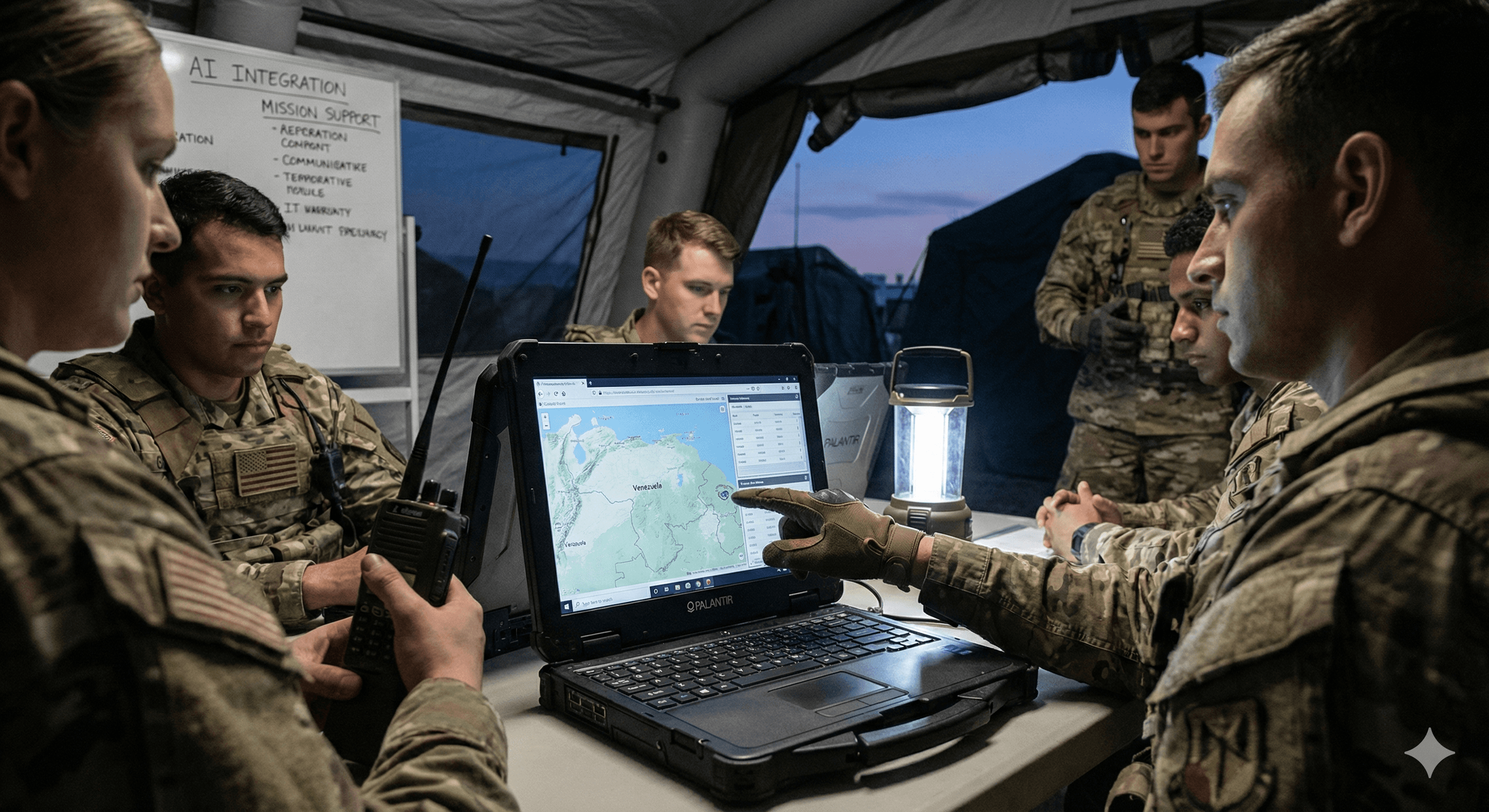
A group of military personnel in uniform gather around a laptop displaying a map, discussing strategy inside a tent with dim lighting, emphasizing the technological setup and focused operation within a temporary command post.

Not sure where to start with AI?
Assess readiness, risk, and priorities in under an hour.

Not sure where to start with AI?
Assess readiness, risk, and priorities in under an hour.

➔ Download Our Free AI Readiness Pack

Reports claim the US military used Anthropic’s AI model Claude in a covert operation in Venezuela, despite Anthropic policies that prohibit facilitating violence or surveillance. While key details remain unconfirmed, the story highlights the real governance challenge in defence AI: controlling how models are accessed, integrated via partners, and used in classified settings.

AI in defence is no longer a hypothetical. It is already being integrated into intelligence workflows, planning, and decision-support systems — often through complex supply chains that include prime contractors, cloud platforms, and specialist analytics providers.

A new report has pushed that debate into the spotlight. The Guardian reports (citing The Wall Street Journal) that the US military used Anthropic’s Claude in an operation in Venezuela. Several parties have declined to confirm details, but the claim has reignited questions about where vendor policies end and operational realities begin.

What’s been reported so far

According to the reporting, Claude was used in a classified context tied to a US operation involving Venezuela. The coverage suggests the model may have been accessed through Palantir, a major defence contractor that has worked with the US government for years.

Two important points here:

  • The core allegation is about usage, not a security breach. This is not presented as “Claude was hacked”. It is about how a model was integrated and used through a defence supply chain.

  • Details remain contested or unconfirmed. Public reporting includes strong claims about operational specifics and casualties; however, none of the key vendors have publicly confirmed the model’s role in operational decision-making.

Why this is newsworthy

This story sits at the intersection of three themes that matter to any organisation deploying AI at scale:

1) Acceptable-use policies vs real-world deployment

AI providers typically publish restrictions around weapons development, violence, and surveillance. The reported use (if accurate) would create a visible clash between public commitments and end-user behaviour.

2) The partner and contractor pathway

Even when a model provider restricts usage, models often reach customers via:

  • platform integrations

  • resellers

  • contractors and subcontractors

  • custom deployments and procurement programmes

That supply chain complexity is one reason it’s difficult to enforce policy purely through “terms of service”.

3) Defence AI governance is now a commercial risk

If your AI product can be used in defence contexts — directly or indirectly — you need to think about:

  • reputational risk

  • investor and customer scrutiny

  • staff and stakeholder expectations

  • legal and contractual enforceability

For buyers, the inverse risk also applies: if a vendor can change policies, restrict access, or terminate service in response to controversy, your operational continuity may be exposed.

What organisations should take away

Whether or not every detail in the reporting is ultimately confirmed, the governance lesson is immediate: policy statements are not controls.

If you operate or depend on AI systems that could be used in sensitive contexts, you need:

  • Clear contractual language on permitted use, audit, and enforcement

  • Technical controls that match the policy (access management, allowlisting, logging, and segmentation)

  • Supply chain clarity: who can access what model, through which integrations, under what approvals

  • Escalation playbooks: what happens if a partner or customer uses your model in a prohibited way

Summary

The reported use of Anthropic’s Claude in a US operation in Venezuela is controversial because it tests the boundary between AI ethics policy and defence reality. Even with incomplete confirmation, it illustrates a growing truth: as AI becomes embedded into operational systems, governance depends on enforceable contracts and technical controls — not just principles.

Next steps: Generation Digital can help you audit AI supply chains, define policy-to-control mappings, and design a governance model that holds up in high-stakes environments.

FAQs

Q1: Did the US military definitely use Claude in Venezuela?
The claim has been reported by major outlets, but key parties have not publicly confirmed operational details. Treat this as a developing story.

Q2: Why would this be a problem for an AI vendor?
Most AI providers publish acceptable-use policies restricting violence, weapons development, and certain surveillance uses. If a model is used in prohibited contexts, it creates governance, contractual, and reputational risk.

Q3: How can models be used in restricted contexts if policies prohibit it?
Often through complex supply chains and integrations — for example, via contractors, platforms, or embedded tools — where enforcement depends on contracts and technical controls.

Q4: What should enterprises do if they’re buying AI tools?
Ask for clarity on permitted use, auditability, access controls, data handling, and continuity plans if a vendor changes policy or restricts access.

Reports claim the US military used Anthropic’s AI model Claude in a covert operation in Venezuela, despite Anthropic policies that prohibit facilitating violence or surveillance. While key details remain unconfirmed, the story highlights the real governance challenge in defence AI: controlling how models are accessed, integrated via partners, and used in classified settings.

AI in defence is no longer a hypothetical. It is already being integrated into intelligence workflows, planning, and decision-support systems — often through complex supply chains that include prime contractors, cloud platforms, and specialist analytics providers.

A new report has pushed that debate into the spotlight. The Guardian reports (citing The Wall Street Journal) that the US military used Anthropic’s Claude in an operation in Venezuela. Several parties have declined to confirm details, but the claim has reignited questions about where vendor policies end and operational realities begin.

What’s been reported so far

According to the reporting, Claude was used in a classified context tied to a US operation involving Venezuela. The coverage suggests the model may have been accessed through Palantir, a major defence contractor that has worked with the US government for years.

Two important points here:

  • The core allegation is about usage, not a security breach. This is not presented as “Claude was hacked”. It is about how a model was integrated and used through a defence supply chain.

  • Details remain contested or unconfirmed. Public reporting includes strong claims about operational specifics and casualties; however, none of the key vendors have publicly confirmed the model’s role in operational decision-making.

Why this is newsworthy

This story sits at the intersection of three themes that matter to any organisation deploying AI at scale:

1) Acceptable-use policies vs real-world deployment

AI providers typically publish restrictions around weapons development, violence, and surveillance. The reported use (if accurate) would create a visible clash between public commitments and end-user behaviour.

2) The partner and contractor pathway

Even when a model provider restricts usage, models often reach customers via:

  • platform integrations

  • resellers

  • contractors and subcontractors

  • custom deployments and procurement programmes

That supply chain complexity is one reason it’s difficult to enforce policy purely through “terms of service”.

3) Defence AI governance is now a commercial risk

If your AI product can be used in defence contexts — directly or indirectly — you need to think about:

  • reputational risk

  • investor and customer scrutiny

  • staff and stakeholder expectations

  • legal and contractual enforceability

For buyers, the inverse risk also applies: if a vendor can change policies, restrict access, or terminate service in response to controversy, your operational continuity may be exposed.

What organisations should take away

Whether or not every detail in the reporting is ultimately confirmed, the governance lesson is immediate: policy statements are not controls.

If you operate or depend on AI systems that could be used in sensitive contexts, you need:

  • Clear contractual language on permitted use, audit, and enforcement

  • Technical controls that match the policy (access management, allowlisting, logging, and segmentation)

  • Supply chain clarity: who can access what model, through which integrations, under what approvals

  • Escalation playbooks: what happens if a partner or customer uses your model in a prohibited way

Summary

The reported use of Anthropic’s Claude in a US operation in Venezuela is controversial because it tests the boundary between AI ethics policy and defence reality. Even with incomplete confirmation, it illustrates a growing truth: as AI becomes embedded into operational systems, governance depends on enforceable contracts and technical controls — not just principles.

Next steps: Generation Digital can help you audit AI supply chains, define policy-to-control mappings, and design a governance model that holds up in high-stakes environments.

FAQs

Q1: Did the US military definitely use Claude in Venezuela?
The claim has been reported by major outlets, but key parties have not publicly confirmed operational details. Treat this as a developing story.

Q2: Why would this be a problem for an AI vendor?
Most AI providers publish acceptable-use policies restricting violence, weapons development, and certain surveillance uses. If a model is used in prohibited contexts, it creates governance, contractual, and reputational risk.

Q3: How can models be used in restricted contexts if policies prohibit it?
Often through complex supply chains and integrations — for example, via contractors, platforms, or embedded tools — where enforcement depends on contracts and technical controls.

Q4: What should enterprises do if they’re buying AI tools?
Ask for clarity on permitted use, auditability, access controls, data handling, and continuity plans if a vendor changes policy or restricts access.

Get weekly AI news and advice delivered to your inbox

By subscribing you consent to Generation Digital storing and processing your details in line with our privacy policy. You can read the full policy at gend.co/privacy.


Upcoming Workshops and Webinars

A diverse group of professionals collaborating around a table in a bright, modern office setting.

Operational Clarity at Scale - Asana

Virtual Webinar
Weds 25th February 2026
Online

A diverse group of professionals collaborating around a table in a bright, modern office setting.

Work With AI Teammates - Asana

In-Person Workshop
Thurs 26th February 2026
London, UK

A diverse group of professionals collaborating around a table in a bright, modern office setting.

From Idea to Prototype - AI in Miro

Virtual Webinar
Weds 18th February 2026
Online

Generation
Digital

UK Office

Generation Digital Ltd
33 Queen St,
London
EC4R 1AP
United Kingdom

Canada Office

Generation Digital Americas Inc
181 Bay St., Suite 1800
Toronto, ON, M5J 2T9
Canada

USA Office

Generation Digital Americas Inc
77 Sands St,
Brooklyn, NY 11201,
United States

EU Office

Generation Digital Software
Elgee Building
Dundalk
A91 X2R3
Ireland

Middle East Office

6994 Alsharq 3890,
An Narjis,
Riyadh 13343,
Saudi Arabia

UK Fast Growth Index UBS Logo
Financial Times FT 1000 Logo
Febe Growth 100 Logo (Background Removed)

Company No: 256 9431 77 | Copyright 2026 | Terms and Conditions | Privacy Policy

Generation
Digital

UK Office

Generation Digital Ltd
33 Queen St,
London
EC4R 1AP
United Kingdom

Canada Office

Generation Digital Americas Inc
181 Bay St., Suite 1800
Toronto, ON, M5J 2T9
Canada

USA Office

Generation Digital Americas Inc
77 Sands St,
Brooklyn, NY 11201,
United States

EU Office

Generation Digital Software
Elgee Building
Dundalk
A91 X2R3
Ireland

Middle East Office

6994 Alsharq 3890,
An Narjis,
Riyadh 13343,
Saudi Arabia

UK Fast Growth Index UBS Logo
Financial Times FT 1000 Logo
Febe Growth 100 Logo (Background Removed)


Company No: 256 9431 77
Terms and Conditions
Privacy Policy
Copyright 2026





