Scale AI Delivery Fast with Miro’s AI Innovation Workspace - Endava Case Study

Scale AI Delivery Fast with Miro’s AI Innovation Workspace - Endava Case Study

Miro
Mar 5, 2026

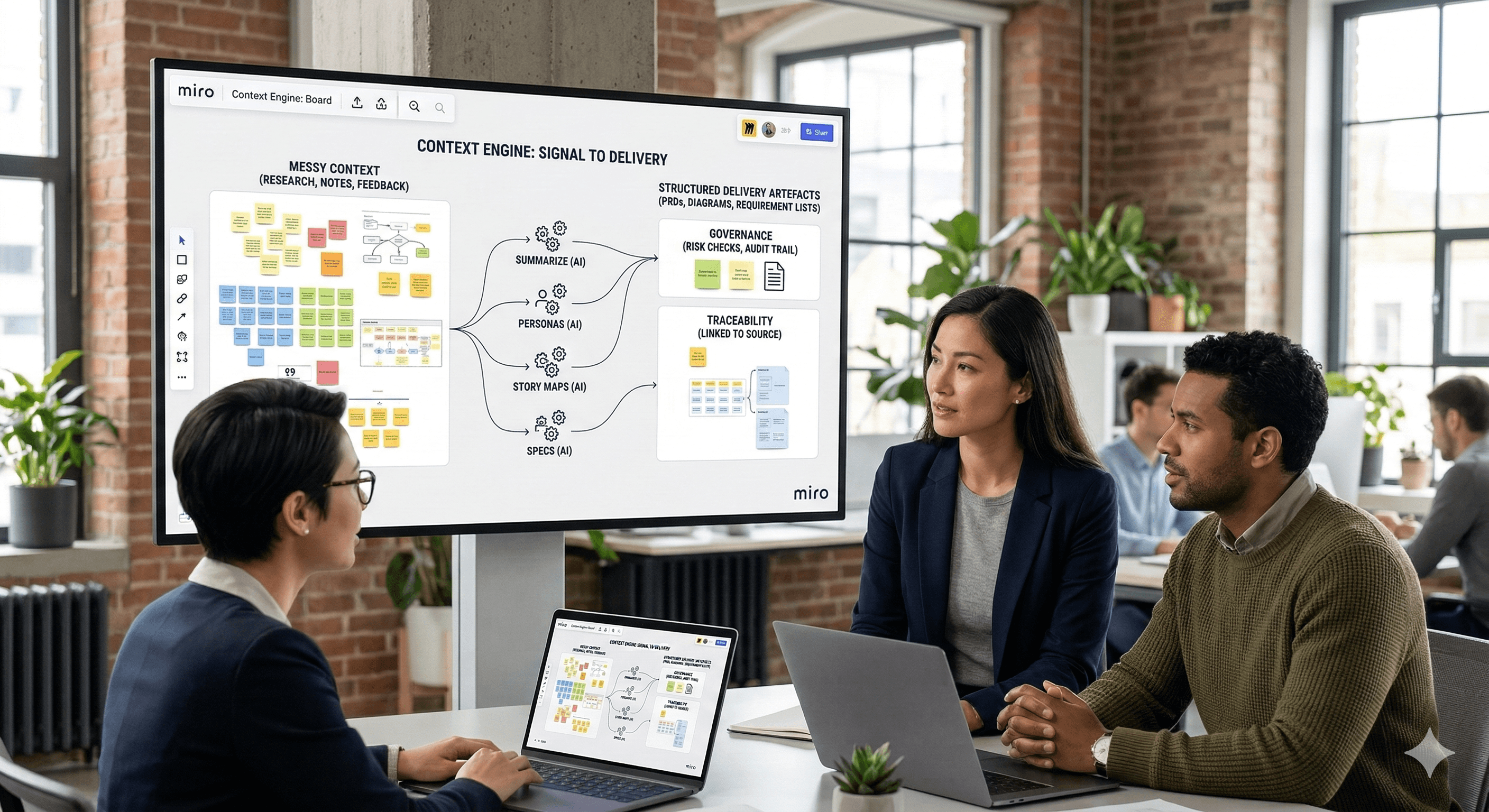
Three people are collaborating in a modern office space, using laptops and a large digital display showcasing a Miro workspace's features, highlighting concepts like 'Context Engine: Signal to Delivery'; this setting exemplifies the theme of scaling AI delivery fast with innovative tools.

Free AI at Work Playbook for managers using ChatGPT, Claude and Gemini.

Free AI at Work Playbook for managers using ChatGPT, Claude and Gemini.

➔ Download the Playbook

Miro’s AI Innovation Workspace helps organisations scale AI delivery by keeping teams, decisions, and artefacts in one shared visual context. Endava embeds Miro as a “context engine” inside its Dava.Flow AI‑native delivery model, using collaborative AI workflows to move from idea to definition and engineering faster — while maintaining governance and traceability.

Most organisations can run AI pilots. Far fewer can scale AI delivery in a way that’s repeatable, governed, and fast enough to matter.

The bottleneck is rarely the model. It’s the work around the model: alignment, requirements, traceability, handovers, decision logs, and the messy human context that determines whether something ships.

That’s why Endava’s approach is interesting. In early 2026, Endava announced a strategic partnership with Miro to embed Miro’s AI Innovation Workspace into its AI‑native delivery model, Dava.Flow™ — positioning Miro as a shared “context engine” for how work moves from signal to delivery.

This article explains what’s actually happening, why it compresses cycle times, and how UK/EU delivery teams can replicate the pattern.
What is Miro’s AI Innovation Workspace?

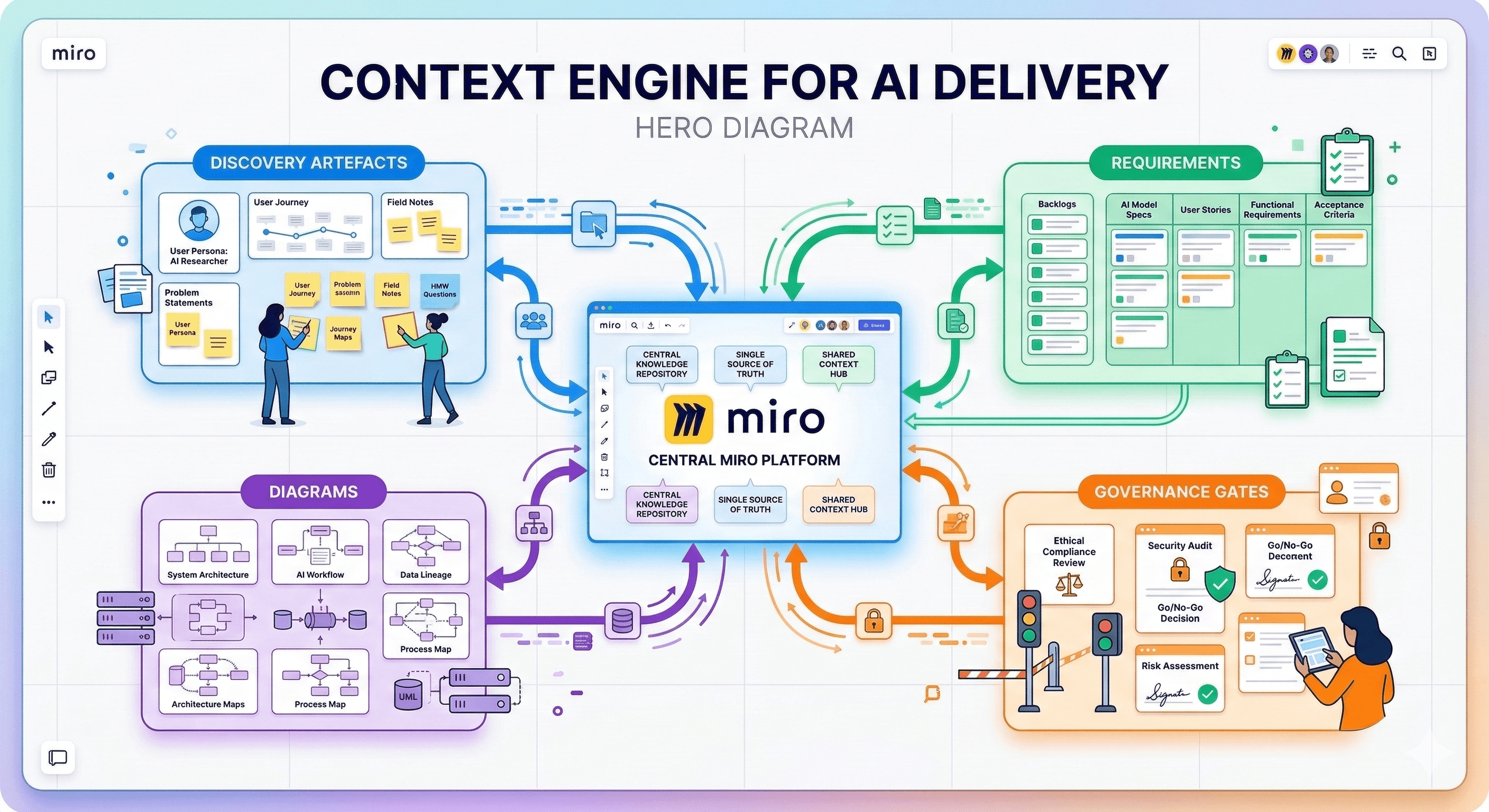
Miro’s AI Innovation Workspace is not “just a digital whiteboard”. It’s a single collaboration layer where teams can bring together:

  • discovery artefacts (research, notes, feedback)

  • product definition (journeys, story maps, PRDs)

  • engineering context (diagrams, specifications)

  • and AI-assisted workflows that turn context into structured outputs

The practical advantage is shared, persistent context — the one thing AI tools struggle with when every artefact is scattered across docs, tickets, decks, and chat.

What is Dava.Flow™ and why does it matter?

Dava.Flow™ is Endava’s AI-native engagement system designed to deliver change “faster, safer, and more accountable” in the AI era.

Rather than treating delivery as a set of disconnected phases, Dava.Flow describes a continuous, AI‑enhanced flow across four phases:

  • Signal (spot what matters)

  • Explore (shape the opportunity)

  • Govern (manage risk and decisions)

  • Evolve (iterate in production)

In other words: an operating model for delivery that assumes AI is normal — and that governance must keep pace.

How Endava uses Miro to compress cycle times

From what Endava and Miro describe publicly, the key move is simple:

Use Miro as the shared space where humans and AI collaborate on the artefacts that normally slow delivery down.

That typically includes:

1) From idea to definition — faster

In many organisations, discovery outputs remain unstructured: workshop notes, sticky clusters, long documents, and inconsistent definitions.

Miro’s collaborative AI workflows help teams convert those artefacts into:

  • personas and journeys

  • story maps and structured requirements

  • early prototypes / wireframes

  • PRDs and decision briefs

When this happens on the canvas, teams gain speed without losing transparency: stakeholders can see where the outputs came from.

2) From definition to engineering — with traceability

A common failure mode in transformation programmes is the “handover cliff”: discovery work doesn’t translate cleanly into engineering work.

Endava’s approach focuses on traceability: connecting early insight and visual context to downstream specifications.

In practice, that can look like:

  • technical diagrams built directly from the same context used in discovery

  • structured requirements that are linked back to source artefacts

  • shared decision logs and acceptance criteria

When done well, it reduces rework and accelerates engineering alignment.

3) Governance that doesn’t slow teams down

The tension in AI delivery is familiar: faster iteration increases risk unless governance is embedded.

The value of a shared context engine is that governance can become a workflow — not a separate committee.

Examples include:

  • “definition of done” checks before a requirement is approved

  • risk prompts (privacy, security, compliance) built into the workflow

  • structured outputs that make review easier and more consistent

This is how you keep speed and accountability.

The scalable pattern: the Context Engine

The phrase “context engine” matters.

Most organisations try to scale AI delivery by giving individuals tools: chatbots, copilots, assistants. Productivity improves, but it stays fragmented.

A context engine flips that: it makes the shared work surface the system of record for collaboration and the place where AI workflows run.

That unlocks three outcomes:

  1. Faster alignment (fewer meetings to reach shared understanding)

  2. Better handovers (outputs are structured and traceable)

  3. Reusable workflows (teams can repeat what works)

If you want a practical lens: this is the difference between “AI helps me” and “AI changes how we deliver”.

Practical steps: how to apply this in your organisation

If you want to replicate the Endava pattern without copying their entire model, start here.

Step 1: Choose one delivery value stream

Pick one workflow where cycle time matters and rework is common.

Good candidates:

  • discovery → PRD creation

  • workshop → requirements and backlog

  • change request intake → impact assessment

Step 2: Consolidate your context in one place

Bring source artefacts onto the canvas: research notes, stakeholder input, current processes, and constraints.

The goal is not beauty. It’s shared truth.

Step 3: Build 3–5 repeatable AI workflows

Focus on workflows with clear inputs and outputs:

  • summarise and cluster inputs

  • extract decisions, assumptions, and risks

  • draft requirements with acceptance criteria

  • create technical diagrams and implementation notes

  • produce an executive-ready summary

Step 4: Add governance as gates, not meetings

Add lightweight checks:

  • data sensitivity reminder

  • compliance/security prompts

  • “source link required” for high-impact statements

  • review + approval step before publishing

Step 5: Measure what matters

Avoid vanity metrics.

Measure:

  • cycle time (idea → definition, definition → delivery)

  • rework (reopened requirements, re-briefs)

  • stakeholder satisfaction (clarity, alignment)

  • quality of handover (engineering lead time)

Why choose Miro for AI projects?

Miro is a strong fit when your bottleneck is not just “generate text”, but align people around a complex change.

It works particularly well for:

  • product and platform teams working across functions

  • transformation programmes with heavy stakeholder involvement

  • organisations needing traceability from research to delivery

The decisive factor is whether you use it as a central work surface — not an occasional workshop tool.

Summary

Endava’s use of Miro’s AI Innovation Workspace inside Dava.Flow™ highlights a scalable approach to AI delivery:

  • treat the workspace as a context engine

  • convert messy artefacts into structured outputs with collaborative AI workflows

  • keep traceability and governance embedded

  • compress cycle times without sacrificing accountability

Next steps

If you want to scale AI delivery through Miro — from workflow design to governance and enablement — Generation Digital can help you set up repeatable AI workflows, templates, and adoption programmes.

FAQs

Q1: How does Miro aid in scaling AI delivery?
Miro provides a shared visual workspace where teams collaborate in real time and run repeatable AI workflows. This keeps context, decisions, and delivery artefacts connected — reducing rework and accelerating alignment.

Q2: What is Dava.Flow™?
Dava.Flow™ is Endava’s AI‑native engagement system for faster, safer, and more accountable delivery. It connects work across Signal, Explore, Govern, and Evolve, embedding AI into the delivery lifecycle.

Q3: Why choose Miro for AI projects?
Miro is valuable when the delivery bottleneck is alignment and handover, not just writing. It helps teams turn discovery artefacts into structured requirements, diagrams, and decision logs while keeping stakeholders working from the same context.

Q4: What’s the quickest way to start with Miro AI workflows?
Pick one repeatable workflow (e.g., workshop notes → requirements), consolidate inputs on the canvas, then build 3–4 AI steps that create structured outputs. Add a review gate and measure cycle time and rework.

Q5: How do we keep AI delivery governed without slowing down?
Embed governance as workflow gates: data sensitivity prompts, traceability requirements, and lightweight approval steps for high-impact outputs. This keeps speed high while preserving accountability.

Miro’s AI Innovation Workspace helps organisations scale AI delivery by keeping teams, decisions, and artefacts in one shared visual context. Endava embeds Miro as a “context engine” inside its Dava.Flow AI‑native delivery model, using collaborative AI workflows to move from idea to definition and engineering faster — while maintaining governance and traceability.

Most organisations can run AI pilots. Far fewer can scale AI delivery in a way that’s repeatable, governed, and fast enough to matter.

The bottleneck is rarely the model. It’s the work around the model: alignment, requirements, traceability, handovers, decision logs, and the messy human context that determines whether something ships.

That’s why Endava’s approach is interesting. In early 2026, Endava announced a strategic partnership with Miro to embed Miro’s AI Innovation Workspace into its AI‑native delivery model, Dava.Flow™ — positioning Miro as a shared “context engine” for how work moves from signal to delivery.

This article explains what’s actually happening, why it compresses cycle times, and how UK/EU delivery teams can replicate the pattern.

What is Miro’s AI Innovation Workspace?

Miro’s AI Innovation Workspace is not “just a digital whiteboard”. It’s a single collaboration layer where teams can bring together:

  • discovery artefacts (research, notes, feedback)

  • product definition (journeys, story maps, PRDs)

  • engineering context (diagrams, specifications)

  • and AI-assisted workflows that turn context into structured outputs

The practical advantage is shared, persistent context — the one thing AI tools struggle with when every artefact is scattered across docs, tickets, decks, and chat.

What is Dava.Flow™ and why does it matter?

Dava.Flow™ is Endava’s AI-native engagement system designed to deliver change “faster, safer, and more accountable” in the AI era.

Rather than treating delivery as a set of disconnected phases, Dava.Flow describes a continuous, AI‑enhanced flow across four phases:

  • Signal (spot what matters)

  • Explore (shape the opportunity)

  • Govern (manage risk and decisions)

  • Evolve (iterate in production)

In other words: an operating model for delivery that assumes AI is normal — and that governance must keep pace.

How Endava uses Miro to compress cycle times

From what Endava and Miro describe publicly, the key move is simple:

Use Miro as the shared space where humans and AI collaborate on the artefacts that normally slow delivery down.

That typically includes:

1) From idea to definition — faster

In many organisations, discovery outputs remain unstructured: workshop notes, sticky clusters, long documents, and inconsistent definitions.

Miro’s collaborative AI workflows help teams convert those artefacts into:

  • personas and journeys

  • story maps and structured requirements

  • early prototypes / wireframes

  • PRDs and decision briefs

When this happens on the canvas, teams gain speed without losing transparency: stakeholders can see where the outputs came from.

2) From definition to engineering — with traceability

A common failure mode in transformation programmes is the “handover cliff”: discovery work doesn’t translate cleanly into engineering work.

Endava’s approach focuses on traceability: connecting early insight and visual context to downstream specifications.

In practice, that can look like:

  • technical diagrams built directly from the same context used in discovery

  • structured requirements that are linked back to source artefacts

  • shared decision logs and acceptance criteria

When done well, it reduces rework and accelerates engineering alignment.

3) Governance that doesn’t slow teams down

The tension in AI delivery is familiar: faster iteration increases risk unless governance is embedded.

The value of a shared context engine is that governance can become a workflow — not a separate committee.

Examples include:

  • “definition of done” checks before a requirement is approved

  • risk prompts (privacy, security, compliance) built into the workflow

  • structured outputs that make review easier and more consistent

This is how you keep speed and accountability.

The scalable pattern: the Context Engine

The phrase “context engine” matters.

Most organisations try to scale AI delivery by giving individuals tools: chatbots, copilots, assistants. Productivity improves, but it stays fragmented.

A context engine flips that: it makes the shared work surface the system of record for collaboration and the place where AI workflows run.

That unlocks three outcomes:

  1. Faster alignment (fewer meetings to reach shared understanding)

  2. Better handovers (outputs are structured and traceable)

  3. Reusable workflows (teams can repeat what works)

If you want a practical lens: this is the difference between “AI helps me” and “AI changes how we deliver”.

Practical steps: how to apply this in your organisation

If you want to replicate the Endava pattern without copying their entire model, start here.

Step 1: Choose one delivery value stream

Pick one workflow where cycle time matters and rework is common.

Good candidates:

  • discovery → PRD creation

  • workshop → requirements and backlog

  • change request intake → impact assessment

Step 2: Consolidate your context in one place

Bring source artefacts onto the canvas: research notes, stakeholder input, current processes, and constraints.

The goal is not beauty. It’s shared truth.

Step 3: Build 3–5 repeatable AI workflows

Focus on workflows with clear inputs and outputs:

  • summarise and cluster inputs

  • extract decisions, assumptions, and risks

  • draft requirements with acceptance criteria

  • create technical diagrams and implementation notes

  • produce an executive-ready summary

Step 4: Add governance as gates, not meetings

Add lightweight checks:

  • data sensitivity reminder

  • compliance/security prompts

  • “source link required” for high-impact statements

  • review + approval step before publishing

Step 5: Measure what matters

Avoid vanity metrics.

Measure:

  • cycle time (idea → definition, definition → delivery)

  • rework (reopened requirements, re-briefs)

  • stakeholder satisfaction (clarity, alignment)

  • quality of handover (engineering lead time)

Why choose Miro for AI projects?

Miro is a strong fit when your bottleneck is not just “generate text”, but align people around a complex change.

It works particularly well for:

  • product and platform teams working across functions

  • transformation programmes with heavy stakeholder involvement

  • organisations needing traceability from research to delivery

The decisive factor is whether you use it as a central work surface — not an occasional workshop tool.

Summary

Endava’s use of Miro’s AI Innovation Workspace inside Dava.Flow™ highlights a scalable approach to AI delivery:

  • treat the workspace as a context engine

  • convert messy artefacts into structured outputs with collaborative AI workflows

  • keep traceability and governance embedded

  • compress cycle times without sacrificing accountability

Next steps

If you want to scale AI delivery through Miro — from workflow design to governance and enablement — Generation Digital can help you set up repeatable AI workflows, templates, and adoption programmes.

FAQs

Q1: How does Miro aid in scaling AI delivery?
Miro provides a shared visual workspace where teams collaborate in real time and run repeatable AI workflows. This keeps context, decisions, and delivery artefacts connected — reducing rework and accelerating alignment.

Q2: What is Dava.Flow™?
Dava.Flow™ is Endava’s AI‑native engagement system for faster, safer, and more accountable delivery. It connects work across Signal, Explore, Govern, and Evolve, embedding AI into the delivery lifecycle.

Q3: Why choose Miro for AI projects?
Miro is valuable when the delivery bottleneck is alignment and handover, not just writing. It helps teams turn discovery artefacts into structured requirements, diagrams, and decision logs while keeping stakeholders working from the same context.

Q4: What’s the quickest way to start with Miro AI workflows?
Pick one repeatable workflow (e.g., workshop notes → requirements), consolidate inputs on the canvas, then build 3–4 AI steps that create structured outputs. Add a review gate and measure cycle time and rework.

Q5: How do we keep AI delivery governed without slowing down?
Embed governance as workflow gates: data sensitivity prompts, traceability requirements, and lightweight approval steps for high-impact outputs. This keeps speed high while preserving accountability.

Get weekly AI news and advice delivered to your inbox

By subscribing you consent to Generation Digital storing and processing your details in line with our privacy policy. You can read the full policy at gend.co/privacy.


Generation
Digital

UK Office

Generation Digital Ltd
33 Queen St,
London
EC4R 1AP
United Kingdom

Canada Office

Generation Digital Americas Inc
181 Bay St., Suite 1800
Toronto, ON, M5J 2T9
Canada

USA Office

Generation Digital Americas Inc
77 Sands St,
Brooklyn, NY 11201,
United States

EU Office

Generation Digital Software
Elgee Building
Dundalk
A91 X2R3
Ireland

Middle East Office

6994 Alsharq 3890,
An Narjis,
Riyadh 13343,
Saudi Arabia

UK Fast Growth Index UBS Logo
Financial Times FT 1000 Logo
Febe Growth 100 Logo (Background Removed)

Company No: 256 9431 77 | Copyright 2026 | Terms and Conditions | Privacy Policy

Generation
Digital

UK Office

Generation Digital Ltd
33 Queen St,
London
EC4R 1AP
United Kingdom

Canada Office

Generation Digital Americas Inc
181 Bay St., Suite 1800
Toronto, ON, M5J 2T9
Canada

USA Office

Generation Digital Americas Inc
77 Sands St,
Brooklyn, NY 11201,
United States

EU Office

Generation Digital Software
Elgee Building
Dundalk
A91 X2R3
Ireland

Middle East Office

6994 Alsharq 3890,
An Narjis,
Riyadh 13343,
Saudi Arabia

UK Fast Growth Index UBS Logo
Financial Times FT 1000 Logo
Febe Growth 100 Logo (Background Removed)


Company No: 256 9431 77
Terms and Conditions
Privacy Policy
Copyright 2026




