The Knowledge Paradox: Fix Knowledge Management to Scale AI in Europe
Notion

Oct 3, 2023


Not sure where to start with AI?
Assess readiness, risk, and priorities in under an hour.
Not sure where to start with AI?
Assess readiness, risk, and priorities in under an hour.
➔ Download Our Free AI Readiness Pack
The knowledge paradox is when organisations have more information than ever, yet teams still can’t find what they need quickly enough to act. European businesses are tackling it by rebuilding knowledge foundations—standardising where knowledge lives, how it’s maintained, and how it’s searched—so work moves faster and AI can retrieve reliable answers at scale.
Most growing organisations don’t suffer from a lack of information. They suffer from too much of it—spread across tools, teams, inboxes, wikis, shared drives, chat threads, and half-finished documents.
That’s the knowledge paradox: the more knowledge you create, the harder it becomes to find, trust, and reuse. Progress slows not because people aren’t working, but because they’re constantly recreating what already exists.
Across Europe, teams are responding with a more disciplined approach to knowledge management (KM)—and it’s becoming a prerequisite for AI that actually helps, rather than another layer of noise.
At Generation Digital, we typically recommend Notion as a strong foundation for modern knowledge management: it’s flexible enough for playbooks, SOPs and onboarding, but structured enough to become a genuine source of truth. More importantly, we help teams align on the new way of working—the governance, ownership, templates and habits that make any KM platform (including Notion) succeed long-term.
What is the knowledge paradox?
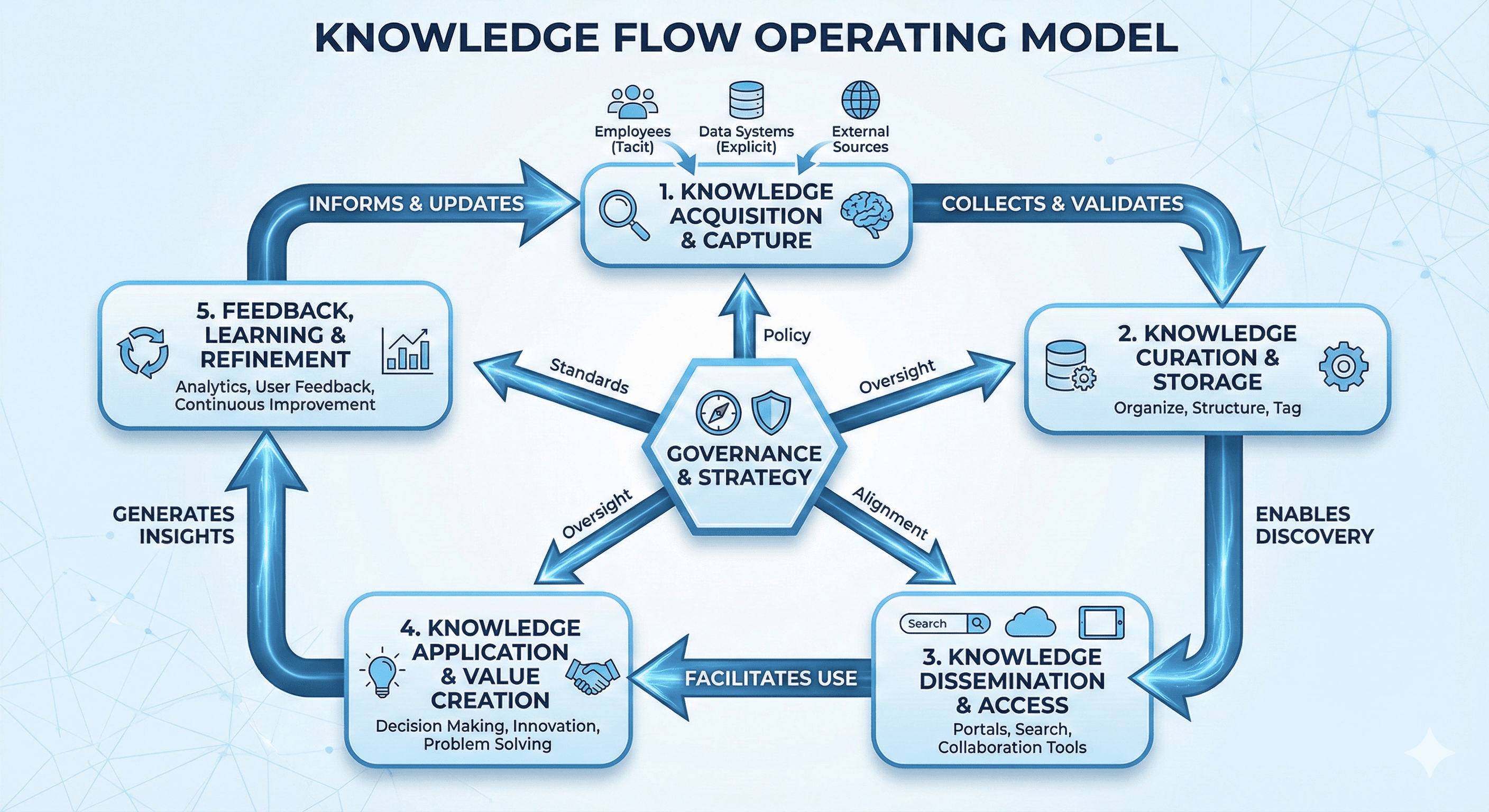
The knowledge paradox is the mismatch between how much information a business has and how little of it is easy to access and apply. As companies scale, knowledge fragments across systems and people. The outcome is consistent: decisions take longer, delivery slows, and the same questions get answered repeatedly.
Notion describes the core symptom plainly: when information is spread across people and tools, progress slows.
Why it shows up during growth
The paradox tends to get worse in predictable moments:
Headcount growth: onboarding becomes inconsistent, and “tribal knowledge” doesn’t scale.
Tool sprawl: every team adds a system, but nobody curates the whole.
Process changes: people keep old habits while new workflows emerge.
Distributed work: knowledge sharing becomes accidental rather than designed.
When leaders say “we need AI,” what they often mean is “we need answers faster.” But AI can only retrieve and reason over what your organisation has made findable and dependable.
Why stronger knowledge foundations make AI more valuable
If your knowledge is fragmented, an AI assistant tends to do one of two unhelpful things:
Hallucinate when it can’t retrieve the right information.
Summarise noise when it retrieves too much unstructured content.
That’s why the foundation matters. Gartner reported that many organisations lack the data management practices required for AI-ready data—an issue that can put AI projects at risk.
This is also where modern approaches like retrieval-augmented generation (RAG) become relevant: AI performs best when it can retrieve the right internal knowledge at the moment of need.
What European organisations are changing (and what to copy)
A common thread we see across successful programmes is that teams treat KM as both a platform choice and a change in behaviour. Tools like Notion can give you the structure and speed you need, but the real gains come when teams agree on standards, ownership, and how knowledge is created and maintained.
The organisations making progress tend to rebuild knowledge around three principles: clarity, ownership, and retrieval.
1) Clarity: decide what “good knowledge” looks like
Start by defining standards people can follow:
What belongs in the knowledge base vs project docs vs chat?
What is the minimum structure for a usable page?
What must be tagged, dated, and assigned an owner?
This isn’t about bureaucracy. It’s about reducing friction so knowledge is reusable.
2) Ownership: assign accountability for keeping knowledge alive
Knowledge bases fail when they’re treated like a one-off migration.
A sustainable model usually includes:
Domain owners (e.g., Sales Enablement, Support, Engineering) responsible for accuracy.
Cadence reviews for high-impact content (e.g., onboarding, policies, product answers).
Clear lifecycle rules: draft → reviewed → published → archived.
3) Retrieval: make knowledge easy to find in the flow of work
Even excellent documentation fails if it can’t be retrieved quickly.
Practical improvements that pay off:
A single, searchable “home” for core knowledge.
Consistent naming and a small set of agreed tags.
Templates for repeatable content types (SOPs, decision logs, playbooks).
AI/search tools that surface answers with sources, not just summaries.
This is where platforms like Notion shine: you can standardise templates, connect related knowledge, and keep day-to-day work and documentation close together—reducing the drift that happens when knowledge lives “somewhere else”.
Practical steps you can take this quarter
If you want momentum without a six-month transformation programme, focus on the bottlenecks you feel every week.
Step 1: Map your top knowledge journeys
Pick 3–5 high-volume journeys (for example: onboarding, customer responses, sales proposals, incident management). Identify where knowledge is created, where it should live, and how it is retrieved.
Step 2: Remove duplication at the source
If two tools contain the same “truth,” you’ll drift. Consolidate the canonical version and link out to supporting material.
Step 3: Standardise the formats that matter
Introduce lightweight templates:
“How we do X” (SOP)
“Decision record”
“Customer answer”
“Playbook / checklist”
Step 4: Add AI only where retrieval is trustworthy
The best early wins are usually:
Drafting and summarising from known, governed content
Internal Q&A that cites sources
Faster onboarding and enablement
Summary and next steps
European businesses aren’t “solving AI” first—they’re solving knowledge first. When information is accessible, maintained, and easy to retrieve, teams move faster, and AI becomes a reliable accelerator rather than a shiny distraction.
Next steps:
Identify your top 3 knowledge bottlenecks.
Define what “good knowledge” looks like and assign owners.
Consolidate your source of truth and improve retrieval.
Then layer AI on top for measurable gains.
If you’re considering Notion to tackle the KM paradox, Generation Digital can help you do it properly: align stakeholders, design the knowledge model, create templates and governance, migrate safely, and embed the new habits so teams actually use it. We specialise in helping organisations prepare for and adopt this change in the way of working, so the technology delivers measurable outcomes.
FAQs
Q1: What is the knowledge paradox?
It’s when organisations create more information than ever, but teams still can’t find or trust what they need quickly enough to act—so work slows and knowledge gets recreated.
Q2: Why is knowledge management important for growth?
Because scaling increases tool sprawl and fragmentation. Good KM makes knowledge reusable, speeds up onboarding and decision-making, and reduces operational drag.
Q3: How does AI help (and where does it fail)?
AI can accelerate search, summarisation, and drafting—if it can retrieve reliable internal knowledge. Without solid foundations, AI can amplify outdated or inconsistent information.
Q4: What’s the fastest way to improve knowledge retrieval?
Start with a single source of truth for high-impact content, apply simple templates, tag consistently, and assign owners so pages stay current.
Q5: Do we need a new tool to fix this?
Not always. Many teams can improve outcomes significantly by simplifying where knowledge lives, standardising formats, and implementing governance—then choosing tools that support that model.
The knowledge paradox is when organisations have more information than ever, yet teams still can’t find what they need quickly enough to act. European businesses are tackling it by rebuilding knowledge foundations—standardising where knowledge lives, how it’s maintained, and how it’s searched—so work moves faster and AI can retrieve reliable answers at scale.
Most growing organisations don’t suffer from a lack of information. They suffer from too much of it—spread across tools, teams, inboxes, wikis, shared drives, chat threads, and half-finished documents.
That’s the knowledge paradox: the more knowledge you create, the harder it becomes to find, trust, and reuse. Progress slows not because people aren’t working, but because they’re constantly recreating what already exists.
Across Europe, teams are responding with a more disciplined approach to knowledge management (KM)—and it’s becoming a prerequisite for AI that actually helps, rather than another layer of noise.
At Generation Digital, we typically recommend Notion as a strong foundation for modern knowledge management: it’s flexible enough for playbooks, SOPs and onboarding, but structured enough to become a genuine source of truth. More importantly, we help teams align on the new way of working—the governance, ownership, templates and habits that make any KM platform (including Notion) succeed long-term.
What is the knowledge paradox?
The knowledge paradox is the mismatch between how much information a business has and how little of it is easy to access and apply. As companies scale, knowledge fragments across systems and people. The outcome is consistent: decisions take longer, delivery slows, and the same questions get answered repeatedly.
Notion describes the core symptom plainly: when information is spread across people and tools, progress slows.

Why it shows up during growth
The paradox tends to get worse in predictable moments:
Headcount growth: onboarding becomes inconsistent, and “tribal knowledge” doesn’t scale.
Tool sprawl: every team adds a system, but nobody curates the whole.
Process changes: people keep old habits while new workflows emerge.
Distributed work: knowledge sharing becomes accidental rather than designed.
When leaders say “we need AI,” what they often mean is “we need answers faster.” But AI can only retrieve and reason over what your organisation has made findable and dependable.
Why stronger knowledge foundations make AI more valuable
If your knowledge is fragmented, an AI assistant tends to do one of two unhelpful things:
Hallucinate when it can’t retrieve the right information.
Summarise noise when it retrieves too much unstructured content.
That’s why the foundation matters. Gartner reported that many organisations lack the data management practices required for AI-ready data—an issue that can put AI projects at risk.
This is also where modern approaches like retrieval-augmented generation (RAG) become relevant: AI performs best when it can retrieve the right internal knowledge at the moment of need.
What European organisations are changing (and what to copy)
A common thread we see across successful programmes is that teams treat KM as both a platform choice and a change in behaviour. Tools like Notion can give you the structure and speed you need, but the real gains come when teams agree on standards, ownership, and how knowledge is created and maintained.
The organisations making progress tend to rebuild knowledge around three principles: clarity, ownership, and retrieval.
1) Clarity: decide what “good knowledge” looks like
Start by defining standards people can follow:
What belongs in the knowledge base vs project docs vs chat?
What is the minimum structure for a usable page?
What must be tagged, dated, and assigned an owner?
This isn’t about bureaucracy. It’s about reducing friction so knowledge is reusable.
2) Ownership: assign accountability for keeping knowledge alive
Knowledge bases fail when they’re treated like a one-off migration.
A sustainable model usually includes:
Domain owners (e.g., Sales Enablement, Support, Engineering) responsible for accuracy.
Cadence reviews for high-impact content (e.g., onboarding, policies, product answers).
Clear lifecycle rules: draft → reviewed → published → archived.
3) Retrieval: make knowledge easy to find in the flow of work
Even excellent documentation fails if it can’t be retrieved quickly.
Practical improvements that pay off:
A single, searchable “home” for core knowledge.
Consistent naming and a small set of agreed tags.
Templates for repeatable content types (SOPs, decision logs, playbooks).
AI/search tools that surface answers with sources, not just summaries.
This is where platforms like Notion shine: you can standardise templates, connect related knowledge, and keep day-to-day work and documentation close together—reducing the drift that happens when knowledge lives “somewhere else”.
Practical steps you can take this quarter
If you want momentum without a six-month transformation programme, focus on the bottlenecks you feel every week.
Step 1: Map your top knowledge journeys
Pick 3–5 high-volume journeys (for example: onboarding, customer responses, sales proposals, incident management). Identify where knowledge is created, where it should live, and how it is retrieved.
Step 2: Remove duplication at the source
If two tools contain the same “truth,” you’ll drift. Consolidate the canonical version and link out to supporting material.
Step 3: Standardise the formats that matter
Introduce lightweight templates:
“How we do X” (SOP)
“Decision record”
“Customer answer”
“Playbook / checklist”
Step 4: Add AI only where retrieval is trustworthy
The best early wins are usually:
Drafting and summarising from known, governed content
Internal Q&A that cites sources
Faster onboarding and enablement
Summary and next steps
European businesses aren’t “solving AI” first—they’re solving knowledge first. When information is accessible, maintained, and easy to retrieve, teams move faster, and AI becomes a reliable accelerator rather than a shiny distraction.
Next steps:
Identify your top 3 knowledge bottlenecks.
Define what “good knowledge” looks like and assign owners.
Consolidate your source of truth and improve retrieval.
Then layer AI on top for measurable gains.
If you’re considering Notion to tackle the KM paradox, Generation Digital can help you do it properly: align stakeholders, design the knowledge model, create templates and governance, migrate safely, and embed the new habits so teams actually use it. We specialise in helping organisations prepare for and adopt this change in the way of working, so the technology delivers measurable outcomes.
FAQs
Q1: What is the knowledge paradox?
It’s when organisations create more information than ever, but teams still can’t find or trust what they need quickly enough to act—so work slows and knowledge gets recreated.
Q2: Why is knowledge management important for growth?
Because scaling increases tool sprawl and fragmentation. Good KM makes knowledge reusable, speeds up onboarding and decision-making, and reduces operational drag.
Q3: How does AI help (and where does it fail)?
AI can accelerate search, summarisation, and drafting—if it can retrieve reliable internal knowledge. Without solid foundations, AI can amplify outdated or inconsistent information.
Q4: What’s the fastest way to improve knowledge retrieval?
Start with a single source of truth for high-impact content, apply simple templates, tag consistently, and assign owners so pages stay current.
Q5: Do we need a new tool to fix this?
Not always. Many teams can improve outcomes significantly by simplifying where knowledge lives, standardising formats, and implementing governance—then choosing tools that support that model.
Get weekly AI news and advice delivered to your inbox
By subscribing you consent to Generation Digital storing and processing your details in line with our privacy policy. You can read the full policy at gend.co/privacy.

Upcoming Workshops and Webinars


Operational Clarity at Scale - Asana
Virtual Webinar
Weds 25th February 2026
Online


Work With AI Teammates - Asana
In-Person Workshop
Thurs 26th February 2026
London, UK


From Idea to Prototype - AI in Miro
Virtual Webinar
Weds 18th February 2026
Online
Generation
Digital

UK Office
Generation Digital Ltd
33 Queen St,
London
EC4R 1AP
United Kingdom
Canada Office
Generation Digital Americas Inc
181 Bay St., Suite 1800
Toronto, ON, M5J 2T9
Canada
USA Office
Generation Digital Americas Inc
77 Sands St,
Brooklyn, NY 11201,
United States
EU Office
Generation Digital Software
Elgee Building
Dundalk
A91 X2R3
Ireland
Middle East Office
6994 Alsharq 3890,
An Narjis,
Riyadh 13343,
Saudi Arabia

Company No: 256 9431 77 | Copyright 2026 | Terms and Conditions | Privacy Policy
Generation
Digital

UK Office
Generation Digital Ltd
33 Queen St,
London
EC4R 1AP
United Kingdom
Canada Office
Generation Digital Americas Inc
181 Bay St., Suite 1800
Toronto, ON, M5J 2T9
Canada
USA Office
Generation Digital Americas Inc
77 Sands St,
Brooklyn, NY 11201,
United States
EU Office
Generation Digital Software
Elgee Building
Dundalk
A91 X2R3
Ireland
Middle East Office
6994 Alsharq 3890,
An Narjis,
Riyadh 13343,
Saudi Arabia










