Miro Templates 2026: 185 New Ways to Plan and Execute

Miro Templates 2026: 185 New Ways to Plan and Execute
Miro

Feb 25, 2026

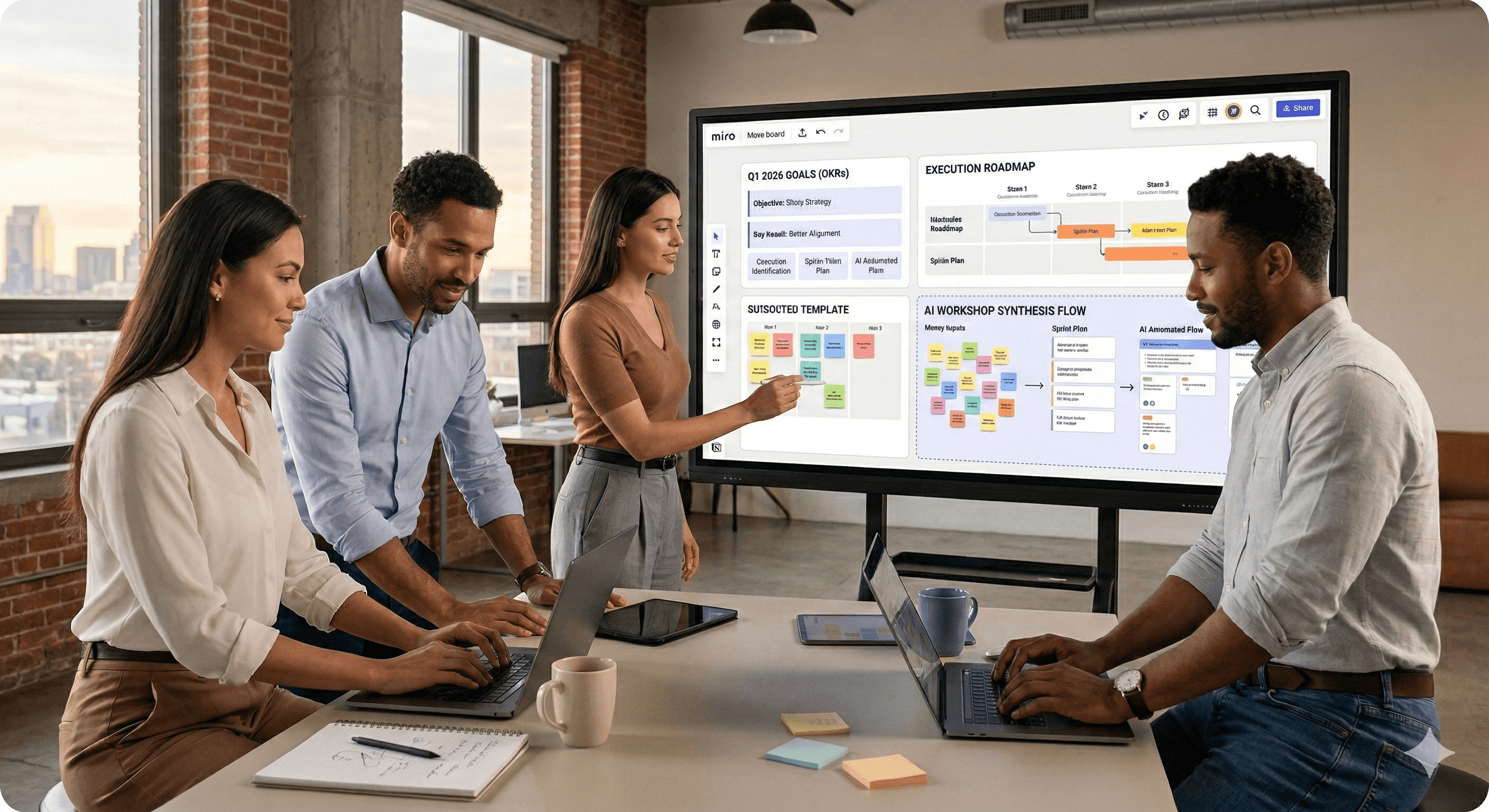
A group of four people collaborate in a modern office setting, using laptops and a large digital screen displaying Miro templates to plan and execute projects.

Not sure where to start with AI?
Assess readiness, risk, and priorities in under an hour.

Not sure where to start with AI?
Assess readiness, risk, and priorities in under an hour.

➔ Download Our Free AI Readiness Pack

Miro’s 2026 templates are ready-made boards in Miroverse that help teams plan and execute faster. The latest release adds 185 new templates across planning and goal-setting, plus AI-powered Flows that automate repetitive steps (like turning workshop notes into structured plans). Use them to set clear objectives, track progress, and keep everyone aligned.

Planning looks easy when it’s a slide deck. Execution is the hard part.

That’s why Miro’s latest template updates matter: they don’t just make your board look tidy—they reduce the time it takes to move from “we discussed it” to “we’re doing it.” As of January 2026, Miroverse introduced 185 new templates, including refreshed planning formats, goal-setting activities, and AI-powered frameworks built around Miro Flows.

If your 2026 priorities include sharper strategy, better alignment, and fewer status meetings, these templates are a simple (and surprisingly powerful) place to start.

What’s new in Miro’s 2026 templates
Miro’s 2026 template push focuses on three things teams typically struggle with:

  1. Turning plans into shared artefacts people can actually work from

  2. Making goal-setting measurable (without turning it into admin)

  3. Using AI to remove busywork, not add another tool to learn

1) More planning templates you’ll actually reuse

The new collection includes updated calendars, project and programme planning boards, and planning formats that suit both live workshops and async collaboration.

The key shift is reusability: templates are increasingly designed to become your standard operating rhythm—duplicated each quarter, shared across teams, and improved over time.

2) Fresh goal-setting formats for 2026

Miro’s goal-setting templates help teams move beyond vague intentions. You’ll see formats that encourage:

  • prioritising a small number of goals (so focus is real)

  • identifying obstacles early (so delivery risk is visible)

  • planning tasks and owners inside the same workspace

This is particularly useful for organisations adopting OKRs or quarterly planning, where the failure mode is rarely “we didn’t set goals” and more often “we didn’t keep them alive.”

3) AI-powered frameworks with Miro Flows

Flows are where the 2026 templates get interesting.

Instead of a static board, a Flow template can guide your team through a repeatable, multi-step workflow—often including AI actions that turn messy inputs into structured outputs. Think:

  • turning customer interviews into a sprint plan

  • converting brainstorm notes into prioritised options

  • generating first-draft strategy artefacts (then refining with humans)

If you’ve ever left a workshop with 200 sticky notes and no clear next steps, Flows are designed to close that gap.

Who these templates are best for

You don’t need a “template strategy” to benefit. But you do need to match templates to the job you’re trying to do.

Leadership and strategy teams

Use planning and strategy templates to align on:

  • company priorities

  • trade-offs and constraints

  • what success looks like this quarter

The win: fewer alignment loops and faster decisions.

Product and delivery teams

Use templates for:

  • roadmaps

  • dependency mapping

  • sprint planning and retros

  • discovery synthesis

The win: a single shared space from discovery through delivery.

PMO, ops, and enablement

Use templates to standardise:

  • quarterly planning cycles

  • reporting formats

  • portfolio reviews

  • governance and working agreements

The win: consistency without forcing every team into the same process.

How to use Miro’s 2026 templates in real planning work

Templates only create value when they’re used consistently. Here’s a practical way to adopt the 2026 release without overwhelming your teams.

Step 1: Start with a single planning ritual

Pick one repeatable moment in your calendar:

  • annual strategy refresh

  • quarterly goals and OKRs

  • monthly portfolio review

  • weekly prioritisation

Choose a template that matches that moment, not your entire operating model.

Step 2: Make the template your “single source of truth”

A template becomes powerful when it’s the place decisions live.

To make that happen:

  • link to the board from your meeting invite

  • keep the decisions on the canvas (not just in chat)

  • assign owners and deadlines where possible

  • keep updates inside the board so progress is visible

If you’re using goal-setting templates, consider using Miro Tables for status and ownership so updates don’t fragment across tools.

Step 3: Use Flows for the steps you always rush

Most teams rush the same steps:

  • synthesis after workshops

  • turning ideas into prioritised options

  • drafting a narrative or update for stakeholders

That’s where Flow templates help. You can run the same workflow each time, with the AI doing the repeatable work and your team doing the judgement.

A simple starting point:

  1. Capture inputs (notes, stickies, data)

  2. Use AI to cluster and summarise themes

  3. Turn themes into options or risks

  4. Convert decisions into a plan (owners, dates, milestones)

  5. Export or sync the action layer to your delivery tool

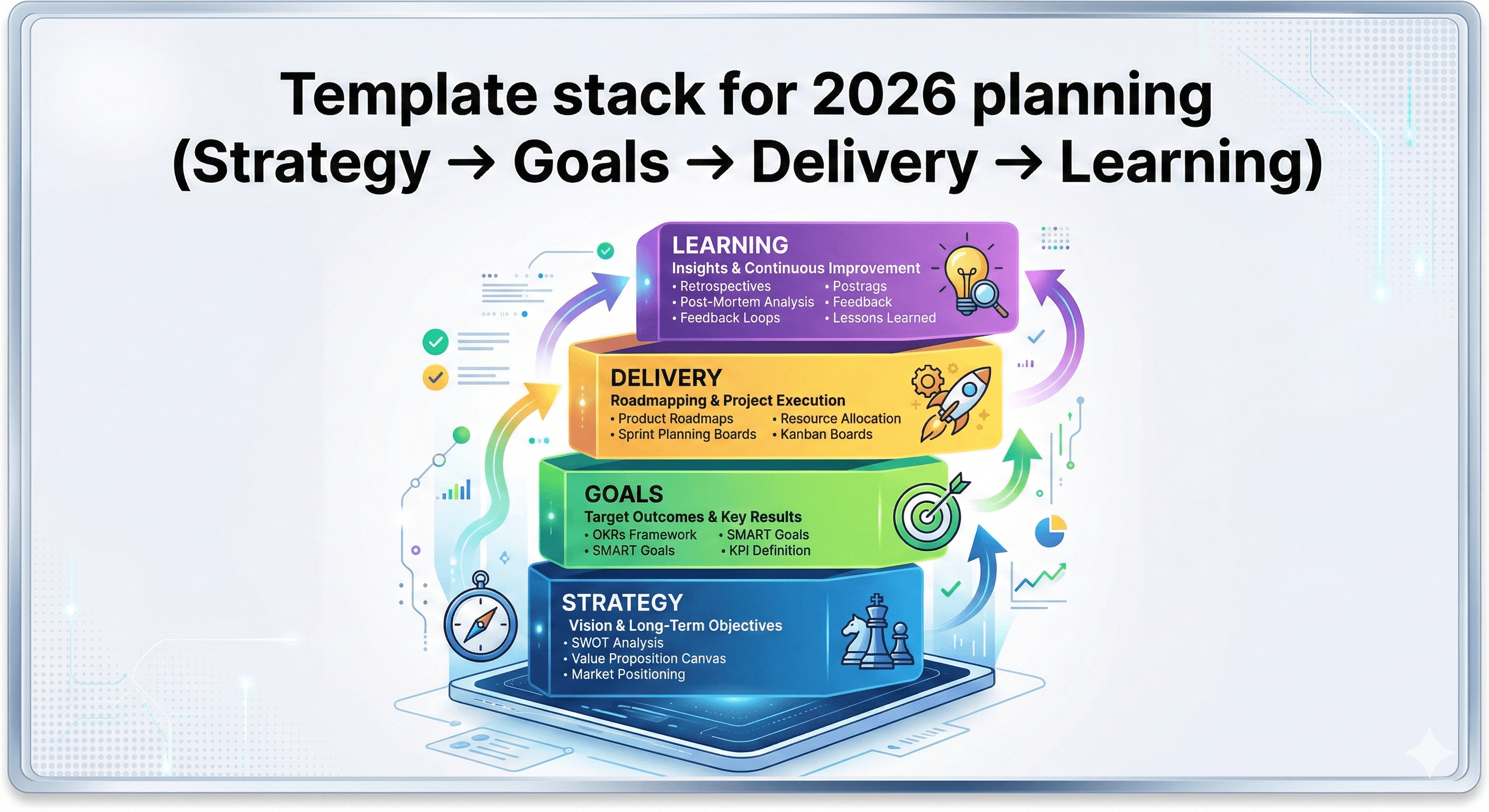
Step 4: Create a “template stack” for 2026

Once one ritual works, add a second.

A useful template stack looks like:

  • Annual direction: vision, themes, success measures

  • Quarterly goals: OKRs, initiatives, risks

  • Execution layer: roadmap, delivery plan, weekly updates

  • Learning loop: retro templates and insight capture

The point isn’t more boards. It’s fewer, better boards that your organisation trusts.

Practical examples your team can run this week

Example 1: Quarterly goals workshop (90 minutes)

  1. Duplicate a quarterly goals or OKR template

  2. Capture context: what changed, what we learned, what’s constrained

  3. Draft 3–5 objectives, each with 2–4 key results

  4. Decide ownership and review cadence

  5. Create a “progress table” on the same board

Outcome: goals that are measurable and revisited, not forgotten.

Example 2: Turning a planning workshop into an execution plan (with Flows)

  1. Run the session using a planning template

  2. Use a Flow to summarise inputs and cluster themes

  3. Generate a first pass at initiatives and milestones

  4. Human review: cut scope, clarify dependencies, assign owners

  5. Publish a one-page update from the board for stakeholders

Outcome: a workshop that ends with an action plan, not a backlog of notes.

Example 3: Standardising planning across teams (without killing autonomy)

  1. Create a “golden template” versioned by your enablement/ops team

  2. Allow teams to customise sections (but keep core fields consistent)

  3. Roll out via a short training and examples board

  4. Review adoption monthly and improve the template based on feedback

Outcome: consistent reporting and decision artefacts, without forcing identical processes.

Common pitfalls (and how to avoid them)

Pitfall 1: Too many templates, not enough habits

If you launch 20 templates at once, teams will ignore them.

Fix: pick one ritual and one template. Make it useful. Then expand.

Pitfall 2: AI used for “content”, not “structure”

AI is most useful when it gives shape to messy inputs.

Fix: use AI/Flows for clustering, summarising, turning notes into draft structures—then have humans refine.

Pitfall 3: No governance, so boards become messy fast

Without light rules, templates degrade into chaos.

Fix: define simple standards: naming, ownership, where decisions live, and what gets archived.

How Generation Digital can help you operationalise Miro templates

Templates are the start. Adoption and outcomes are the goal.

Generation Digital helps organisations make Miro a reliable planning and execution system—especially when you want to combine templates with AI safely.

We can help you:

  • select the right templates for your planning rituals

  • design a reusable “template stack” for 2026 (strategy → goals → delivery)

  • pilot and scale Miro Flows so AI reduces admin, not control

  • set lightweight governance for enterprise rollout

  • integrate Miro with tools like Asana, Notion, and Glean so execution stays connected

Summary

Miro’s 2026 template updates (including 185 new templates added in January 2026) make it easier to plan, set goals, and execute with less friction. Start with one planning ritual, adopt one template, and use Flows where you want repeatability and speed.

Next steps: If you want help choosing templates, building a 2026 planning system, or rolling out Miro Flows with the right guardrails, explore our Miro services page and speak to Generation Digital.

FAQs

Q1: What’s included in Miro’s 2026 template release?
A: The January 2026 Miroverse release adds 185 new templates, including updated planning boards, goal-setting activities, and AI-powered workflows using Miro Flows.

Q2: What are Miro Flows templates?
A: Flows templates are multi-step, on-canvas workflows that can automate repeatable planning tasks—such as summarising workshop notes, clustering themes, and drafting structured plans.

Q3: Which templates should we start with for goal-setting?
A: Start with a quarterly goals or OKR template. Limit yourself to 3–5 objectives and add a simple progress table for owners, status, and deadlines.

Q4: How do we roll templates out without overwhelming teams?
A: Adopt one template for one recurring ritual (e.g., quarterly planning). Prove it works, document the habit, then expand to a small “template stack.”

Q5: Can Miro templates connect to execution tools like Asana or Jira?
A: Yes. Many teams run planning in Miro and sync actions to delivery tools, keeping Miro as the decision space and the tracker as the execution system.

Miro’s 2026 templates are ready-made boards in Miroverse that help teams plan and execute faster. The latest release adds 185 new templates across planning and goal-setting, plus AI-powered Flows that automate repetitive steps (like turning workshop notes into structured plans). Use them to set clear objectives, track progress, and keep everyone aligned.

Planning looks easy when it’s a slide deck. Execution is the hard part.

That’s why Miro’s latest template updates matter: they don’t just make your board look tidy—they reduce the time it takes to move from “we discussed it” to “we’re doing it.” As of January 2026, Miroverse introduced 185 new templates, including refreshed planning formats, goal-setting activities, and AI-powered frameworks built around Miro Flows.

If your 2026 priorities include sharper strategy, better alignment, and fewer status meetings, these templates are a simple (and surprisingly powerful) place to start.

What’s new in Miro’s 2026 templates

Miro’s 2026 template push focuses on three things teams typically struggle with:

  1. Turning plans into shared artefacts people can actually work from

  2. Making goal-setting measurable (without turning it into admin)

  3. Using AI to remove busywork, not add another tool to learn

1) More planning templates you’ll actually reuse

The new collection includes updated calendars, project and programme planning boards, and planning formats that suit both live workshops and async collaboration.

The key shift is reusability: templates are increasingly designed to become your standard operating rhythm—duplicated each quarter, shared across teams, and improved over time.

2) Fresh goal-setting formats for 2026

Miro’s goal-setting templates help teams move beyond vague intentions. You’ll see formats that encourage:

  • prioritising a small number of goals (so focus is real)

  • identifying obstacles early (so delivery risk is visible)

  • planning tasks and owners inside the same workspace

This is particularly useful for organisations adopting OKRs or quarterly planning, where the failure mode is rarely “we didn’t set goals” and more often “we didn’t keep them alive.”

3) AI-powered frameworks with Miro Flows

Flows are where the 2026 templates get interesting.

Instead of a static board, a Flow template can guide your team through a repeatable, multi-step workflow—often including AI actions that turn messy inputs into structured outputs. Think:

  • turning customer interviews into a sprint plan

  • converting brainstorm notes into prioritised options

  • generating first-draft strategy artefacts (then refining with humans)

If you’ve ever left a workshop with 200 sticky notes and no clear next steps, Flows are designed to close that gap.

Who these templates are best for

You don’t need a “template strategy” to benefit. But you do need to match templates to the job you’re trying to do.

Leadership and strategy teams

Use planning and strategy templates to align on:

  • company priorities

  • trade-offs and constraints

  • what success looks like this quarter

The win: fewer alignment loops and faster decisions.

Product and delivery teams

Use templates for:

  • roadmaps

  • dependency mapping

  • sprint planning and retros

  • discovery synthesis

The win: a single shared space from discovery through delivery.

PMO, ops, and enablement

Use templates to standardise:

  • quarterly planning cycles

  • reporting formats

  • portfolio reviews

  • governance and working agreements

The win: consistency without forcing every team into the same process.

How to use Miro’s 2026 templates in real planning work

Templates only create value when they’re used consistently. Here’s a practical way to adopt the 2026 release without overwhelming your teams.

Step 1: Start with a single planning ritual

Pick one repeatable moment in your calendar:

  • annual strategy refresh

  • quarterly goals and OKRs

  • monthly portfolio review

  • weekly prioritisation

Choose a template that matches that moment, not your entire operating model.

Step 2: Make the template your “single source of truth”

A template becomes powerful when it’s the place decisions live.

To make that happen:

  • link to the board from your meeting invite

  • keep the decisions on the canvas (not just in chat)

  • assign owners and deadlines where possible

  • keep updates inside the board so progress is visible

If you’re using goal-setting templates, consider using Miro Tables for status and ownership so updates don’t fragment across tools.

Step 3: Use Flows for the steps you always rush

Most teams rush the same steps:

  • synthesis after workshops

  • turning ideas into prioritised options

  • drafting a narrative or update for stakeholders

That’s where Flow templates help. You can run the same workflow each time, with the AI doing the repeatable work and your team doing the judgement.

A simple starting point:

  1. Capture inputs (notes, stickies, data)

  2. Use AI to cluster and summarise themes

  3. Turn themes into options or risks

  4. Convert decisions into a plan (owners, dates, milestones)

  5. Export or sync the action layer to your delivery tool

Step 4: Create a “template stack” for 2026

Once one ritual works, add a second.

A useful template stack looks like:

  • Annual direction: vision, themes, success measures

  • Quarterly goals: OKRs, initiatives, risks

  • Execution layer: roadmap, delivery plan, weekly updates

  • Learning loop: retro templates and insight capture

The point isn’t more boards. It’s fewer, better boards that your organisation trusts.

Practical examples your team can run this week

Example 1: Quarterly goals workshop (90 minutes)

  1. Duplicate a quarterly goals or OKR template

  2. Capture context: what changed, what we learned, what’s constrained

  3. Draft 3–5 objectives, each with 2–4 key results

  4. Decide ownership and review cadence

  5. Create a “progress table” on the same board

Outcome: goals that are measurable and revisited, not forgotten.

Example 2: Turning a planning workshop into an execution plan (with Flows)

  1. Run the session using a planning template

  2. Use a Flow to summarise inputs and cluster themes

  3. Generate a first pass at initiatives and milestones

  4. Human review: cut scope, clarify dependencies, assign owners

  5. Publish a one-page update from the board for stakeholders

Outcome: a workshop that ends with an action plan, not a backlog of notes.

Example 3: Standardising planning across teams (without killing autonomy)

  1. Create a “golden template” versioned by your enablement/ops team

  2. Allow teams to customise sections (but keep core fields consistent)

  3. Roll out via a short training and examples board

  4. Review adoption monthly and improve the template based on feedback

Outcome: consistent reporting and decision artefacts, without forcing identical processes.

Common pitfalls (and how to avoid them)

Pitfall 1: Too many templates, not enough habits

If you launch 20 templates at once, teams will ignore them.

Fix: pick one ritual and one template. Make it useful. Then expand.

Pitfall 2: AI used for “content”, not “structure”

AI is most useful when it gives shape to messy inputs.

Fix: use AI/Flows for clustering, summarising, turning notes into draft structures—then have humans refine.

Pitfall 3: No governance, so boards become messy fast

Without light rules, templates degrade into chaos.

Fix: define simple standards: naming, ownership, where decisions live, and what gets archived.

How Generation Digital can help you operationalise Miro templates

Templates are the start. Adoption and outcomes are the goal.

Generation Digital helps organisations make Miro a reliable planning and execution system—especially when you want to combine templates with AI safely.

We can help you:

  • select the right templates for your planning rituals

  • design a reusable “template stack” for 2026 (strategy → goals → delivery)

  • pilot and scale Miro Flows so AI reduces admin, not control

  • set lightweight governance for enterprise rollout

  • integrate Miro with tools like Asana, Notion, and Glean so execution stays connected

Summary

Miro’s 2026 template updates (including 185 new templates added in January 2026) make it easier to plan, set goals, and execute with less friction. Start with one planning ritual, adopt one template, and use Flows where you want repeatability and speed.

Next steps: If you want help choosing templates, building a 2026 planning system, or rolling out Miro Flows with the right guardrails, explore our Miro services page and speak to Generation Digital.

FAQs

Q1: What’s included in Miro’s 2026 template release?
A: The January 2026 Miroverse release adds 185 new templates, including updated planning boards, goal-setting activities, and AI-powered workflows using Miro Flows.

Q2: What are Miro Flows templates?
A: Flows templates are multi-step, on-canvas workflows that can automate repeatable planning tasks—such as summarising workshop notes, clustering themes, and drafting structured plans.

Q3: Which templates should we start with for goal-setting?
A: Start with a quarterly goals or OKR template. Limit yourself to 3–5 objectives and add a simple progress table for owners, status, and deadlines.

Q4: How do we roll templates out without overwhelming teams?
A: Adopt one template for one recurring ritual (e.g., quarterly planning). Prove it works, document the habit, then expand to a small “template stack.”

Q5: Can Miro templates connect to execution tools like Asana or Jira?
A: Yes. Many teams run planning in Miro and sync actions to delivery tools, keeping Miro as the decision space and the tracker as the execution system.

Get weekly AI news and advice delivered to your inbox

By subscribing you consent to Generation Digital storing and processing your details in line with our privacy policy. You can read the full policy at gend.co/privacy.


Upcoming Workshops and Webinars

A diverse group of professionals collaborating around a table in a bright, modern office setting.

Operational Clarity at Scale - Asana

Virtual Webinar
Weds 25th February 2026
Online

A diverse group of professionals collaborating around a table in a bright, modern office setting.

Work With AI Teammates - Asana

In-Person Workshop
Thurs 26th February 2026
London, UK

A diverse group of professionals collaborating around a table in a bright, modern office setting.

From Idea to Prototype - AI in Miro

Virtual Webinar
Weds 18th February 2026
Online

Generation
Digital

UK Office

Generation Digital Ltd
33 Queen St,
London
EC4R 1AP
United Kingdom

Canada Office

Generation Digital Americas Inc
181 Bay St., Suite 1800
Toronto, ON, M5J 2T9
Canada

USA Office

Generation Digital Americas Inc
77 Sands St,
Brooklyn, NY 11201,
United States

EU Office

Generation Digital Software
Elgee Building
Dundalk
A91 X2R3
Ireland

Middle East Office

6994 Alsharq 3890,
An Narjis,
Riyadh 13343,
Saudi Arabia

UK Fast Growth Index UBS Logo
Financial Times FT 1000 Logo
Febe Growth 100 Logo (Background Removed)

Company No: 256 9431 77 | Copyright 2026 | Terms and Conditions | Privacy Policy

Generation
Digital

UK Office

Generation Digital Ltd
33 Queen St,
London
EC4R 1AP
United Kingdom

Canada Office

Generation Digital Americas Inc
181 Bay St., Suite 1800
Toronto, ON, M5J 2T9
Canada

USA Office

Generation Digital Americas Inc
77 Sands St,
Brooklyn, NY 11201,
United States

EU Office

Generation Digital Software
Elgee Building
Dundalk
A91 X2R3
Ireland

Middle East Office

6994 Alsharq 3890,
An Narjis,
Riyadh 13343,
Saudi Arabia

UK Fast Growth Index UBS Logo
Financial Times FT 1000 Logo
Febe Growth 100 Logo (Background Removed)


Company No: 256 9431 77
Terms and Conditions
Privacy Policy
Copyright 2026




