PVH Uses OpenAI's ChatGPT to Innovate Fashion Industry
OpenAI

Jan 27, 2026

Not sure where to start with AI?
Assess readiness, risk, and priorities in under an hour.
Not sure where to start with AI?
Assess readiness, risk, and priorities in under an hour.
➔ Download Our Free AI Readiness Pack
PVH Corp., parent of Calvin Klein and Tommy Hilfiger, is adopting ChatGPT Enterprise and OpenAI’s enterprise APIs to modernise workflows across product, marketing, supply chain and retail. The goal is to help teams design and plan with better insight, optimise inventory and demand decisions, and improve consumer engagement—while maintaining strong governance and security.
Fashion runs on speed: faster trend signals, faster design cycles, faster decisions across planning and inventory.
PVH Corp.—the global apparel group behind Calvin Klein and Tommy Hilfiger—is leaning into that reality by collaborating with OpenAI. PVH is rolling out ChatGPT Enterprise alongside OpenAI’s enterprise APIs to accelerate modern workflows across product, marketing, supply chain, and retail.
This matters because it reflects the next wave of enterprise AI: not isolated experiments, but AI embedded in the work where value is created.
What PVH announced
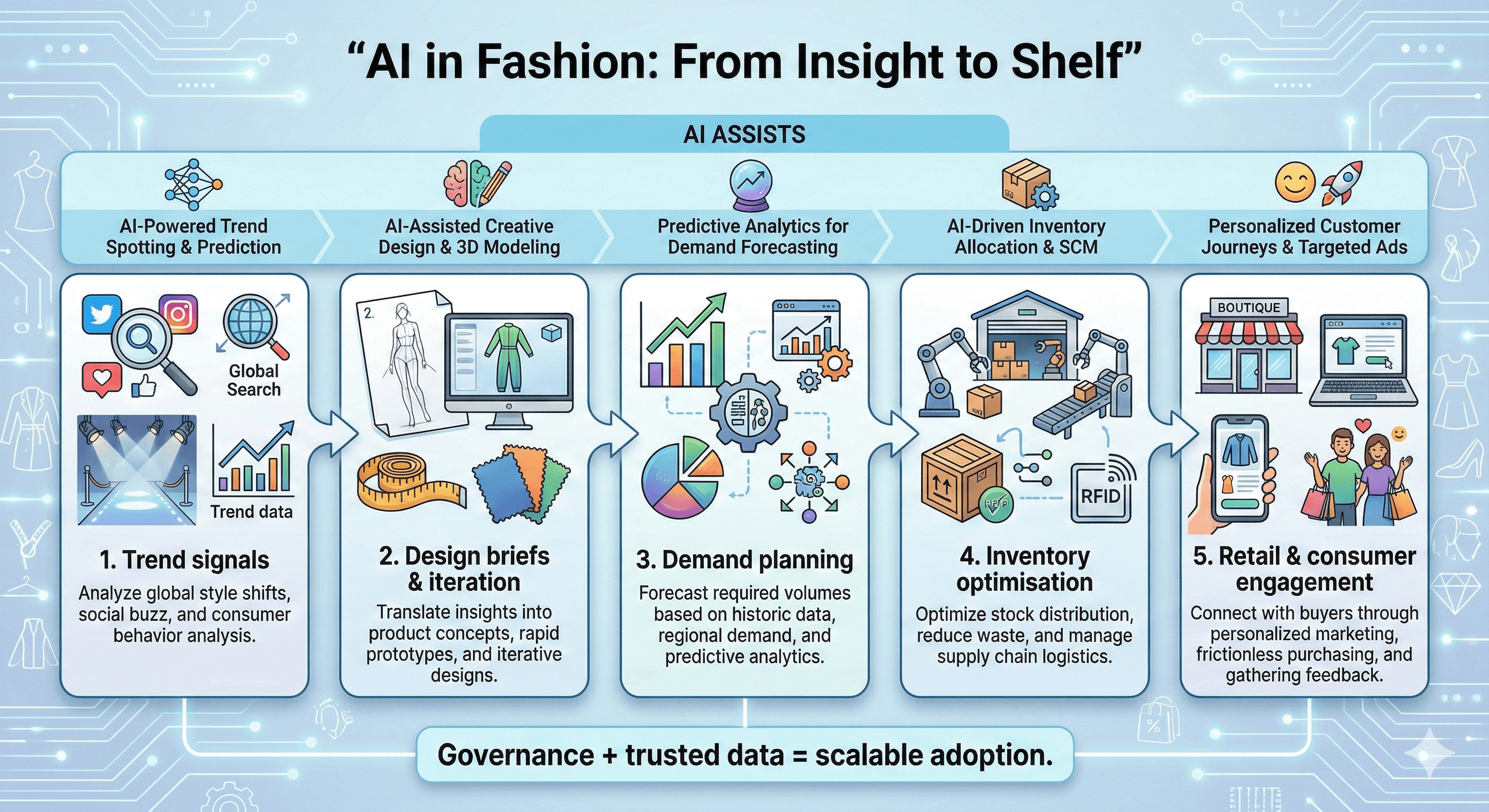
PVH has announced a collaboration with OpenAI to co-create custom AI capabilities and expand access to OpenAI models across its business. The initiative includes:
ChatGPT Enterprise for employees,
integration of OpenAI enterprise APIs,
and custom applications and environments built specifically for PVH teams.
Rather than positioning AI as a single “use case”, PVH is aiming for end-to-end impact—connecting insight and execution across the lifecycle from product to consumer.
Where AI can create impact in fashion
PVH’s focus areas map to three high-value domains.
1) Product and design: faster iteration with better context
Design teams often need rapid exploration: briefs, concepts, palettes, copy, and structured research.
AI can support:
trend scanning and synthesis,
first-draft briefs and concept directions,
and faster iteration on product narratives.
The key is not replacing creativity, but compressing the “research and drafting” time so designers can spend more time designing.
2) Supply chain and planning: fewer surprises, less waste
Inventory risk is costly in apparel. Better forecasting, clearer exception handling, and faster communication across suppliers reduce waste and improve margins.
AI can support:
demand-planning summaries and scenario explanation,
inventory exception reporting,
and faster translation of planning decisions into operational actions.
3) Consumer engagement: personalisation that scales
Retail brands win when they understand consumer intent and communicate consistently.
AI can support:
campaign ideation and copy variants,
customer support summarisation and consistent responses,
and personalisation inputs that respect policy and governance.
How ChatGPT Enterprise fits
ChatGPT Enterprise is positioned for large organisations that need stronger controls around data and governance.
For PVH, the key value is enabling teams to use AI day-to-day across roles—while aligning to the company’s security and governance requirements.
Practical steps: how to get similar outcomes in your organisation
If you want to learn from PVH’s approach, focus on outcomes and operating model—not just tooling.
Step 1: Pick 3 workflows with measurable impact
Examples:
product briefs and research synthesis
planning exception reporting
customer case summarisation
Define success metrics: cycle time, throughput, error reduction, cost avoidance.
Step 2: Ground AI in trusted sources
Where possible, connect AI outputs to approved knowledge and data sources so teams can verify and reuse results.
Step 3: Add governance that enables delivery
Governance should be usable:
define what data is in scope,
set review points,
and log outputs for audit and improvement.
Step 4: Standardise patterns into reusable templates
Capture what works: prompt templates, output formats, and review checklists.
Step 5: Scale by role
Train teams with role-based modules so adoption grows safely and consistently.
Where collaboration tools help
Scaling AI is a change programme. Your collaboration stack makes it repeatable.
Use Asana to manage rollout waves, ownership, and reporting.
Use Miro to map workflows, handoffs, and governance patterns.
Use Notion to publish playbooks, templates, and “known-good” examples.
Use Glean to surface trusted internal knowledge so outputs stay grounded.
Summary
PVH’s adoption of ChatGPT Enterprise highlights how fashion organisations can embed AI into the core of design, planning, and consumer engagement—accelerating decisions and reducing friction across the lifecycle.
If you want help selecting high-impact workflows, setting governance, and rolling out adoption with measurable outcomes, Generation Digital can support your programme end-to-end.
Next steps
Identify 3 workflows to optimise.
Define success metrics and data boundaries.
Publish templates and review steps.
Pilot, measure, then scale.
FAQ
Q1: How does AI improve fashion design at PVH?
PVH is using OpenAI tools to accelerate research and drafting workflows that support design teams—helping them move faster from insight to concept and iteration.
Q2: What benefits does AI bring to PVH’s supply chain?
AI can reduce friction in planning and execution by improving insight, summarising operational information, and supporting faster decisions around demand and inventory.
Q3: How does AI enhance consumer engagement for PVH?
AI can support personalisation and consistent communication by helping teams generate and refine content, summarise customer context, and respond faster—within governance boundaries.
Q4: Is PVH only using ChatGPT Enterprise?
No. PVH has stated it will also integrate OpenAI’s enterprise APIs and build custom applications and environments for internal teams.
Q5: What should other retailers learn from this?
Start with a small set of measurable workflows, ground outputs in trusted knowledge and data, set governance early, and scale through standard templates and training.
PVH Corp., parent of Calvin Klein and Tommy Hilfiger, is adopting ChatGPT Enterprise and OpenAI’s enterprise APIs to modernise workflows across product, marketing, supply chain and retail. The goal is to help teams design and plan with better insight, optimise inventory and demand decisions, and improve consumer engagement—while maintaining strong governance and security.
Fashion runs on speed: faster trend signals, faster design cycles, faster decisions across planning and inventory.
PVH Corp.—the global apparel group behind Calvin Klein and Tommy Hilfiger—is leaning into that reality by collaborating with OpenAI. PVH is rolling out ChatGPT Enterprise alongside OpenAI’s enterprise APIs to accelerate modern workflows across product, marketing, supply chain, and retail.
This matters because it reflects the next wave of enterprise AI: not isolated experiments, but AI embedded in the work where value is created.
What PVH announced

PVH has announced a collaboration with OpenAI to co-create custom AI capabilities and expand access to OpenAI models across its business. The initiative includes:
ChatGPT Enterprise for employees,
integration of OpenAI enterprise APIs,
and custom applications and environments built specifically for PVH teams.
Rather than positioning AI as a single “use case”, PVH is aiming for end-to-end impact—connecting insight and execution across the lifecycle from product to consumer.
Where AI can create impact in fashion
PVH’s focus areas map to three high-value domains.
1) Product and design: faster iteration with better context
Design teams often need rapid exploration: briefs, concepts, palettes, copy, and structured research.
AI can support:
trend scanning and synthesis,
first-draft briefs and concept directions,
and faster iteration on product narratives.
The key is not replacing creativity, but compressing the “research and drafting” time so designers can spend more time designing.
2) Supply chain and planning: fewer surprises, less waste
Inventory risk is costly in apparel. Better forecasting, clearer exception handling, and faster communication across suppliers reduce waste and improve margins.
AI can support:
demand-planning summaries and scenario explanation,
inventory exception reporting,
and faster translation of planning decisions into operational actions.
3) Consumer engagement: personalisation that scales
Retail brands win when they understand consumer intent and communicate consistently.
AI can support:
campaign ideation and copy variants,
customer support summarisation and consistent responses,
and personalisation inputs that respect policy and governance.
How ChatGPT Enterprise fits
ChatGPT Enterprise is positioned for large organisations that need stronger controls around data and governance.
For PVH, the key value is enabling teams to use AI day-to-day across roles—while aligning to the company’s security and governance requirements.
Practical steps: how to get similar outcomes in your organisation
If you want to learn from PVH’s approach, focus on outcomes and operating model—not just tooling.
Step 1: Pick 3 workflows with measurable impact
Examples:
product briefs and research synthesis
planning exception reporting
customer case summarisation
Define success metrics: cycle time, throughput, error reduction, cost avoidance.
Step 2: Ground AI in trusted sources
Where possible, connect AI outputs to approved knowledge and data sources so teams can verify and reuse results.
Step 3: Add governance that enables delivery
Governance should be usable:
define what data is in scope,
set review points,
and log outputs for audit and improvement.
Step 4: Standardise patterns into reusable templates
Capture what works: prompt templates, output formats, and review checklists.
Step 5: Scale by role
Train teams with role-based modules so adoption grows safely and consistently.
Where collaboration tools help
Scaling AI is a change programme. Your collaboration stack makes it repeatable.
Use Asana to manage rollout waves, ownership, and reporting.
Use Miro to map workflows, handoffs, and governance patterns.
Use Notion to publish playbooks, templates, and “known-good” examples.
Use Glean to surface trusted internal knowledge so outputs stay grounded.
Summary
PVH’s adoption of ChatGPT Enterprise highlights how fashion organisations can embed AI into the core of design, planning, and consumer engagement—accelerating decisions and reducing friction across the lifecycle.
If you want help selecting high-impact workflows, setting governance, and rolling out adoption with measurable outcomes, Generation Digital can support your programme end-to-end.
Next steps
Identify 3 workflows to optimise.
Define success metrics and data boundaries.
Publish templates and review steps.
Pilot, measure, then scale.
FAQ
Q1: How does AI improve fashion design at PVH?
PVH is using OpenAI tools to accelerate research and drafting workflows that support design teams—helping them move faster from insight to concept and iteration.
Q2: What benefits does AI bring to PVH’s supply chain?
AI can reduce friction in planning and execution by improving insight, summarising operational information, and supporting faster decisions around demand and inventory.
Q3: How does AI enhance consumer engagement for PVH?
AI can support personalisation and consistent communication by helping teams generate and refine content, summarise customer context, and respond faster—within governance boundaries.
Q4: Is PVH only using ChatGPT Enterprise?
No. PVH has stated it will also integrate OpenAI’s enterprise APIs and build custom applications and environments for internal teams.
Q5: What should other retailers learn from this?
Start with a small set of measurable workflows, ground outputs in trusted knowledge and data, set governance early, and scale through standard templates and training.
Get weekly AI news and advice delivered to your inbox
By subscribing you consent to Generation Digital storing and processing your details in line with our privacy policy. You can read the full policy at gend.co/privacy.

Upcoming Workshops and Webinars

Operational Clarity at Scale - Asana
Virtual Webinar
Weds 25th February 2026
Online

Work With AI Teammates - Asana
In-Person Workshop
Thurs 26th February 2026
London, UK

From Idea to Prototype - AI in Miro
Virtual Webinar
Weds 18th February 2026
Online
Generation
Digital

UK Office
Generation Digital Ltd
33 Queen St,
London
EC4R 1AP
United Kingdom
Canada Office
Generation Digital Americas Inc
181 Bay St., Suite 1800
Toronto, ON, M5J 2T9
Canada
USA Office
Generation Digital Americas Inc
77 Sands St,
Brooklyn, NY 11201,
United States
EU Office
Generation Digital Software
Elgee Building
Dundalk
A91 X2R3
Ireland
Middle East Office
6994 Alsharq 3890,
An Narjis,
Riyadh 13343,
Saudi Arabia

Company No: 256 9431 77 | Copyright 2026 | Terms and Conditions | Privacy Policy
Generation
Digital

UK Office
Generation Digital Ltd
33 Queen St,
London
EC4R 1AP
United Kingdom
Canada Office
Generation Digital Americas Inc
181 Bay St., Suite 1800
Toronto, ON, M5J 2T9
Canada
USA Office
Generation Digital Americas Inc
77 Sands St,
Brooklyn, NY 11201,
United States
EU Office
Generation Digital Software
Elgee Building
Dundalk
A91 X2R3
Ireland
Middle East Office
6994 Alsharq 3890,
An Narjis,
Riyadh 13343,
Saudi Arabia










