End the Meeting Hangover: Shift Coordination to Asana AI, Not Your Calendar
Asana
Free AI at Work Playbook for managers using ChatGPT, Claude and Gemini.
➔ Download the Playbook
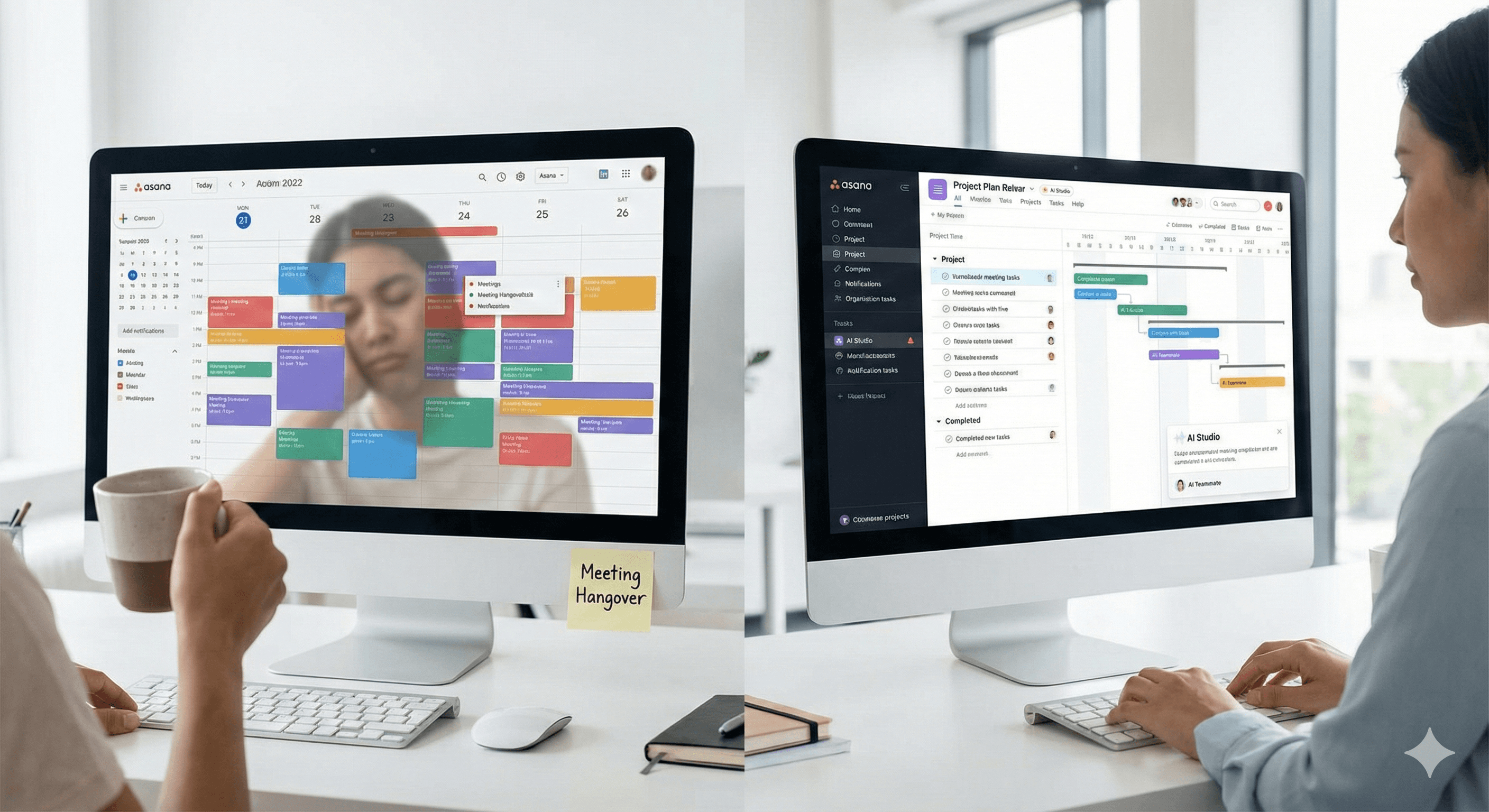
Your calendar shouldn’t be your operating model. When every update, dependency and approval requires a live call, days turn into a puzzle of half-useful sessions that drain energy and still don’t move work forward. That’s the meeting hangover: foggy alignment, slow decisions, and the nagging sense that the real work happens after hours.
The problem isn’t your people—it’s trying to coordinate complex work without a system of record. Treating coordination as a string of events forces everyone to sync in real time, even when the work would be better handled asynchronously. The fix is to move coordination into the workflow itself so status, hand-offs and decisions progress without summoning the whole team.
Shift coordination out of the calendar and into Asana AI
This is where Asana AI changes the game. Two pillars now carry the coordination load inside Asana. AI Studio is a no-code builder for AI-powered workflows that capture intake, enrich briefs, create tasks and keep dependencies up to date—right where the work lives. AI Teammates are governed, collaborative agents that run rules, draft updates and surface risks under enterprise controls, with humans staying firmly in charge of outcomes. Together they replace a surprising number of status meetings with reliable, auditable progress.
When coordination lives in Asana, meetings narrow to what they do best: discussion and decision. Status becomes a stream you can read, not a room you have to join. Leaders get pre-digested roll-ups and risk highlights from AI, contributors get clear ownership and deadlines, and nobody has to build slide decks just to “share where we are”. Asana’s latest releases lean into this with pre-built AI workflows and templates that standardise approvals, reviews and stakeholder updates—so teams stop reinventing the wheel every quarter.
Proof that clarity drives engagement
If you need evidence, look to the NCAA. By moving from scattered tools to a single system in Asana, they created repeatable workflows and quadrupled content consumption—evidence that when work is unified and visible, audiences respond and teams stop wasting time explaining themselves. That same foundation is what makes fewer meetings possible: shared context, trusted automation and one place to see the truth.
Day-to-day: what it actually feels like
Intake no longer starts with a meeting; requests arrive via forms and are enriched by AI, so the right details are present from the start. Dependencies and due dates adjust automatically when upstream tasks shift, replacing “quick catch-ups” with clear nudges inside the workflow. Weekly updates summarise themselves, with AI Teammates compiling accurate notes from live project data. The meeting that remains is tighter, shorter and focused on decisions—because the coordination has already happened.
The cultural benefits are real. Teams report fewer status calls, more deep-work blocks and clearer ownership because context, updates and history are captured where the work actually happens. Even outside Asana, the shift away from bloated calendars is well documented; what Asana adds is a governed, scalable way to operationalise that change with AI that respects enterprise controls.
What changes when meetings stop being your coordination method
You get time back—hours each week reclaimed from updates software can assemble. You get alignment—goals, owners and status visible in one place, not buried in email. And you get better outcomes—like the NCAA’s 4× lift—because people spend more time doing the work and less time narrating it.
Asana AI ends the “meeting hangover” by moving coordination into the workflow. With AI Studio to build no-code, AI-powered processes and AI Teammates to run governed updates and hand-offs, teams replace status meetings with automated progress and human-in-the-loop decisions—validated by results like the NCAA’s 4× content-consumption lift.
Next steps
Ready to end the meeting hangover and let work move itself forward? Book an Asana Workflow Consultation. We’ll map your current meeting load, replace one status ritual with an AI Studio flow, pilot AI Teammates for updates and risk surfacing, and instrument the time you win back.
FAQs
Will AI start scheduling more meetings for us?
The goal is the opposite. Asana AI automates status, hand-offs and summaries so meetings are reserved for discussion and decision. AI Studio and AI Teammates operate with human checkpoints.
How do we start without disrupting everything?
Begin by mapping one recurring status call and rebuilding it as an AI Studio workflow (intake → updates → approvals). Pilot with one team, then scale via templates.
Is this enterprise-grade and secure?
Yes. AI Teammates inherit Asana’s enterprise controls (SSO/SCIM, role-based access, audit trails). You decide what agents can see and do, and every action is visible.
Get weekly AI news and advice delivered to your inbox
By subscribing you consent to Generation Digital storing and processing your details in line with our privacy policy. You can read the full policy at gend.co/privacy.


Generation
Digital

UK Office
Generation Digital Ltd
33 Queen St,
London
EC4R 1AP
United Kingdom
Canada Office
Generation Digital Americas Inc
181 Bay St., Suite 1800
Toronto, ON, M5J 2T9
Canada
USA Office
Generation Digital Americas Inc
77 Sands St,
Brooklyn, NY 11201,
United States
EU Office
Generation Digital Software
Elgee Building
Dundalk
A91 X2R3
Ireland
Middle East Office
6994 Alsharq 3890,
An Narjis,
Riyadh 13343,
Saudi Arabia




Company No: 256 9431 77 | Copyright 2026 | Terms and Conditions | Privacy Policy